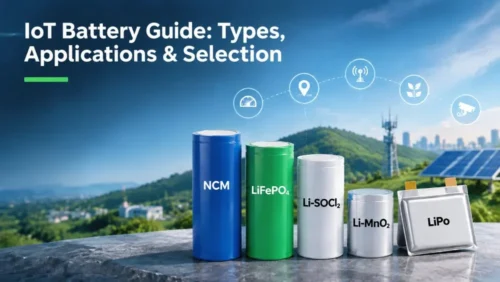
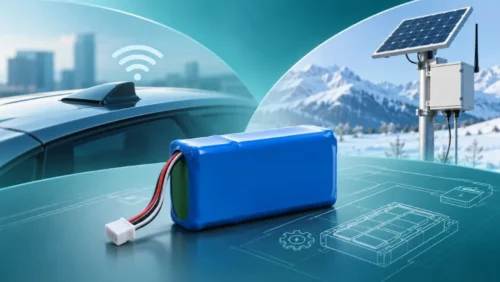
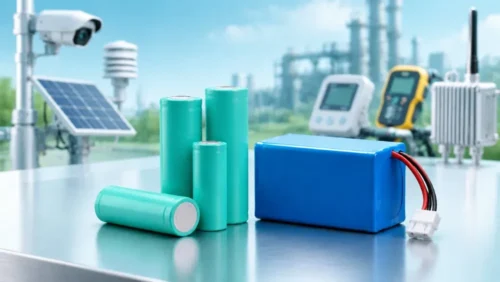
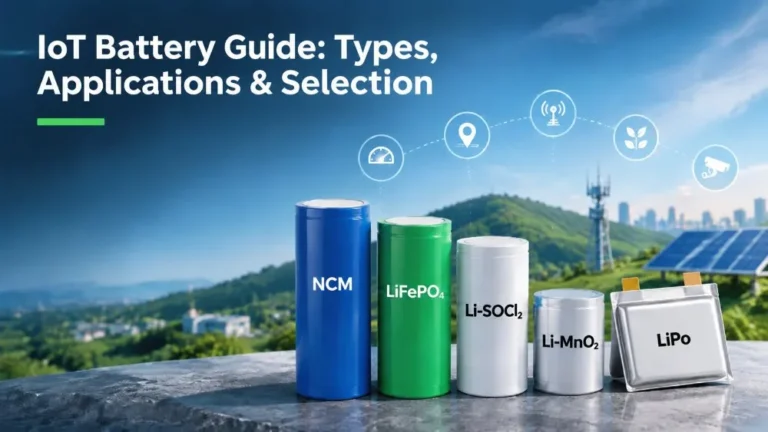
Common options for IoT batteries include primary lithium batteries such as Li-SOCl₂ and Li-MnO₂, as well as rechargeable lithium-ion, LiFePO₄, and lithium polymer batteries.
Each offers different advantages in energy density, discharge capability, service life, and integration flexibility.
This guide compares primary lithium and rechargeable battery technologies, their performance characteristics, and suitable applications to help engineers and procurement professionals select the right battery for their IoT devices.
Types of Batteries for IoT Devices
Different IoT applications require different batteries. The main distinction is between primary batteries for long-term, single-use operation and rechargeable batteries for repeated charging and discharging.
| Parameter | Li-SOCl₂ | Li-MnO₂ | NCM | LiFePO₄ | LiPo | UltraXel Lithium Battery (NCM & LiFePO₄) |
| Rechargeable | No | No | Yes | Yes | Yes | Yes |
| Nominal Voltage | 3.6V | 3.0V | 3.6–3.7V | 3.2V | Typically 3.7V | 3.2V / 3.6V |
| Specific Energy | 400–500 Wh/kg | 250–270 Wh/kg | 180–250 Wh/kg | 100–160 Wh/kg | 150–250 Wh/kg | 90–245 Wh/kg |
| Self-discharge Rate | ≤1%/year | ≤2%/year | ~1–3%/month | ~1–3%/month | ~1–3%/month | ~1–3%/month |
| Typical Cycle Life | Single-use | Single-use | 500–1,000 cycles | 2,000–4,000 cycles | 500–1,000 cycles | 500–2,000 cycles |
| Representative Pulse Current | 250mA | 2,000mA | 6,600mA (10s) | 18,000mA (10s) | 3C (1ms) | 2.4–45A (max. discharge) |
| Typical Operating Temperature | -55 to +85°C | -40 to +70°C | -20 to +60°C | -20 to +60°C | -20 to +60°C | −40 to +85°C (discharge) −20 to +60°C (charge) |
| Main Advantage | Long service life | Primary power with pulse demand | Energy and power flexibility | Long cycle life and thermal stability | Flexible dimensions | Wide-temperature performance, sub-zero charging and high-power options |
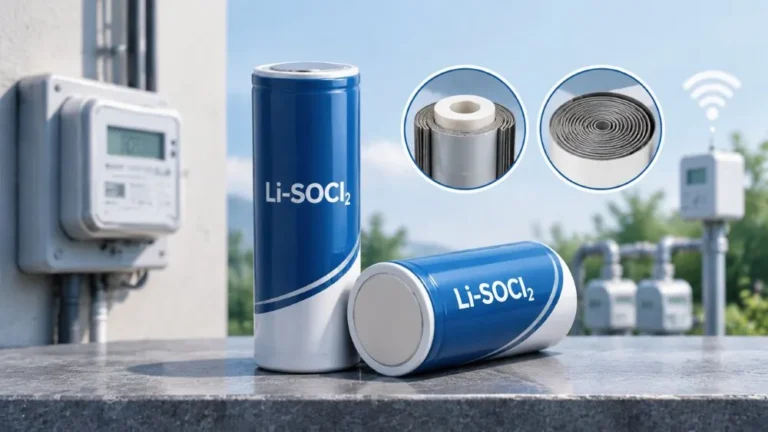
Lithium Thionyl Chloride (Li-SOCl₂) Battery
Li-SOCl₂ batteries are widely used in industrial IoT applications requiring long service life and minimal maintenance.
Key characteristics:
- High energy density and low self-discharge.
- 3.6V nominal voltage.
- Long storage life and extended service potential.
- Available in bobbin and spiral constructions.
Bobbin-type cells prioritize energy density and long-duration, low-current discharge. Spiral-type ones offer better current delivery for applications with higher pulse demands.
Typical applications: Smart electricity meters, water meters, gas meters, and long-life remote monitoring sensors.
Selection consideration: Li-SOCl₂ cells may exhibit passivation and voltage delay after prolonged storage or low-current operation.
Lithium Manganese Dioxide (Li-MnO₂) Battery
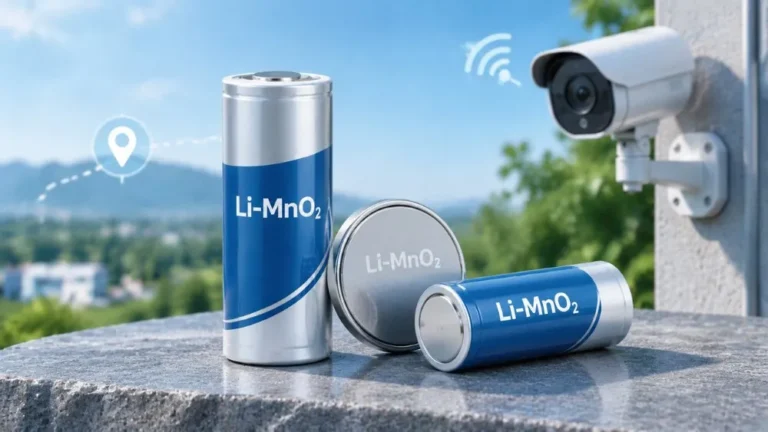
Li-MnO₂ is a primary lithium battery chemistry available in cylindrical and coin-cell formats.
Key characteristics:
- Nominal voltage of approx. 3.0V.
- Good energy density and low self-discharge.
- Suitable for higher pulse loads than bobbin-type Li-SOCl₂ cells.
- Available in compact formats.
Li-MnO₂ offers a lower nominal voltage but can be advantageous for devices requiring relatively strong pulse output.
Typical applications: GPS trackers, wireless security sensors, asset tracking devices, and compact monitoring equipment.
Selection consideration: Check voltage compatibility throughout discharge, particularly when the device has a relatively high minimum operating voltage.
Lithium-ion (NCM) Battery
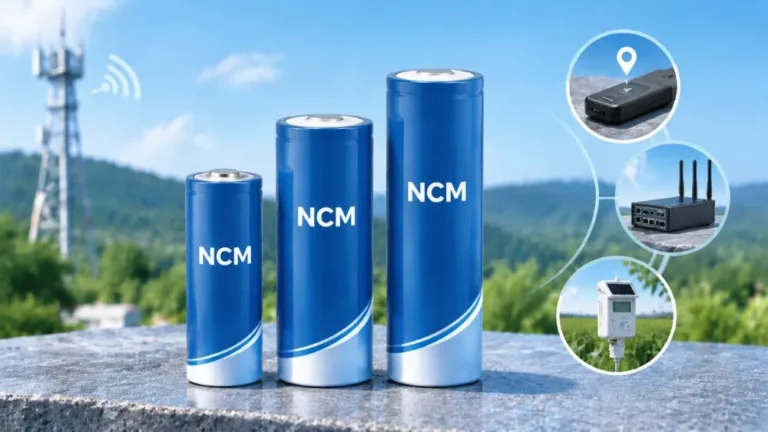
Rechargeable NCM lithium-ion batteries are suitable for IoT devices requiring higher energy density, repeated charging, or relatively high discharge power.
Key characteristics:
- Typically around 3.6–3.7V nominal voltage.
- High energy density.
- Available in multiple cylindrical formats.
- Different cell designs support different capacity and discharge requirements.
NCM cells offer flexibility for devices with higher power consumption or frequent communication activity. High-energy cells prioritize runtime, while high-power cells are for greater continuous or peak discharge demands.
Typical applications: GPS tracking systems, industrial gateways, wireless data loggers, and rechargeable monitoring devices.
Selection consideration: Evaluate continuous discharge current, peak current, cycle life, and charging requirements.
Lithium Iron Phosphate (LiFePO₄) Battery
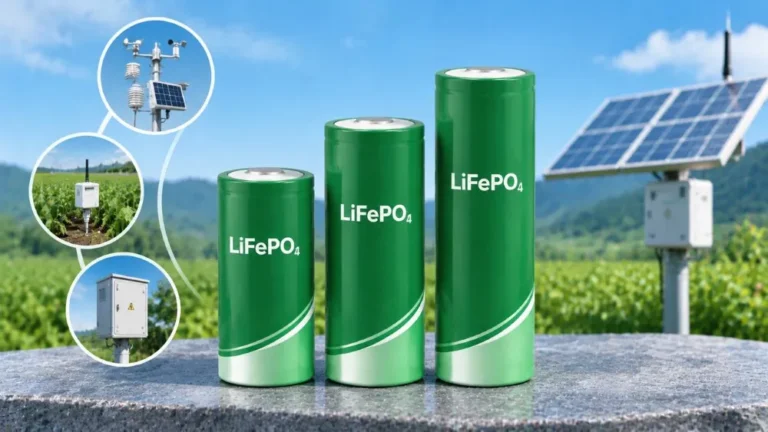
LiFePO₄ batteries are rechargeable lithium batteries known for their thermal stability and long cycle life.
Key characteristics:
- 3.2V nominal voltage.
- Long cycle life.
- Good thermal stability.
- Suitable for repeated charging and discharging.
LiFePO₄ generally offers lower energy density but provides advantages in cycle life and thermal stability. It is particularly suitable for systems with regular charging, including solar-powered IoT installations.
Typical applications: Solar data loggers, smart agriculture systems, remote monitoring stations, and industrial backup power.
Selection consideration: Account for its lower nominal voltage when designing the power system.
Lithium Polymer (LiPo) Battery
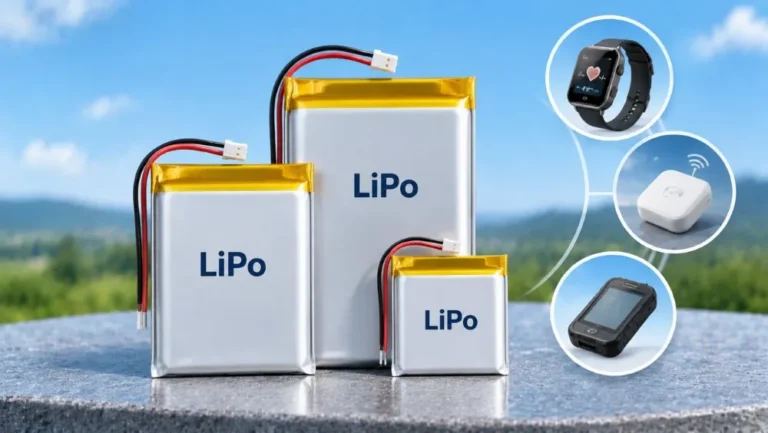
Lithium polymer batteries commonly use pouch-cell construction, allowing greater flexibility in battery dimensions and packaging.
Key characteristics:
- Thin and lightweight form factors.
- Customizable dimensions.
- Rechargeable design.
- Suitable for compact electronic devices.
LiPo batteries are useful when conventional cylindrical cells cannot fit the available installation space.
Typical applications: Wearable devices, compact wireless sensors, portable IoT equipment, and space-constrained electronics.
Selection consideration: Evaluate mechanical protection, swelling allowance, enclosure design, and charging protection.
Other Battery Options
Coin cells, alkaline batteries, and NiMH batteries are also used in selected low-power IoT applications.
| Battery Type | Typical Applications | Main Consideration |
| Coin Cells | Compact wireless sensors, small electronic devices | Limited capacity and current |
| Alkaline | Basic low-power sensors and consumer devices | Discharge characteristics and service life |
| NiMH | Rechargeable sensors and consumer electronics | Self-discharge and energy density |
Which Battery Type Is Best for Different IoT Applications?
Different IoT applications prioritize different battery characteristics:
1. Long-Life, Low-Maintenance Applications
- Smart Electricity & Water Meters – Li-SOCl₂: Low self-discharge and long service life support extended unattended operation.
- Remote Environmental Sensors – Li-SOCl₂ / LiFePO₄: Choose based on maintenance access and whether external charging is available.
2. High-Pulse Power Applications
- GPS Trackers – Li-MnO₂ / NCM: Suitable for devices requiring short bursts of current during positioning and wireless communication.
- Wireless Sensors – Li-SOCl₂ / Li-ion: Selection depends on standby current, transmission frequency, and peak discharge requirements.
3. Rechargeable and Continuous-Power Applications
- Solar Data Loggers – LiFePO₄ / NCM: Rechargeability and cycle life support repeated solar charging.
- Industrial Gateways – NCM / LiFePO₄: Suitable for higher power consumption and longer operating periods.
4. Compact, Space-Constrained Devices
Wearable IoT Devices – LiPo: Thin, lightweight construction and customizable dimensions support compact device designs.
Key Performance Factors When Selecting an IoT Battery
Beyond battery chemistry, engineers should evaluate five key parameters to ensure battery compatibility with the device’s operating requirements.
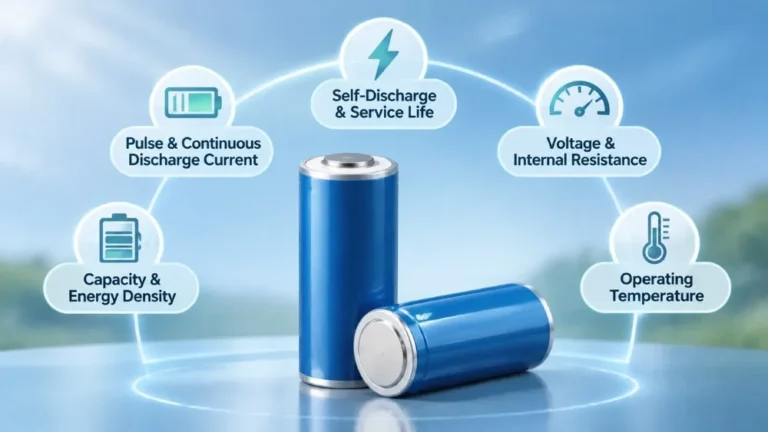
Capacity and Energy Density
Battery capacity (Ah or mAh) indicates the amount of charge available, while energy capacity (Wh) accounts for voltage.
Higher energy density allows more energy storage within limited space and weight. Actual usable capacity depends on discharge conditions and operating temperature.
Pulse and Continuous Discharge Current
Wireless modules such as LoRaWAN, NB-IoT, and LTE-M can generate short-duration current peaks. Engineers should verify both continuous and pulse discharge ratings.
Insufficient pulse capability can cause voltage drops, device resets, or communication failures.
Self-Discharge and Service Life
Self-discharge gradually reduces stored energy, even when a device is inactive. Li-SOCl₂ batteries are often preferred for long-term, maintenance-free applications due to their very low self-discharge, while rechargeable batteries suit systems with regular charging.
Voltage and Internal Resistance
Nominal voltage must match the device’s operating requirements, while the battery voltage under load must remain above the device’s cut-off voltage. Internal resistance is also important because higher resistance can cause voltage drops during peak current demand.
Operating Temperature
Temperature affects available capacity, internal resistance, discharge performance, and battery aging. Engineers should verify actual performance at the expected operating temperature and check charging and discharging limits separately.
For outdoor and extreme-temperature applications, see our guide on choosing the right battery for outdoor IoT devices.
UltraXel IoT Battery Solutions
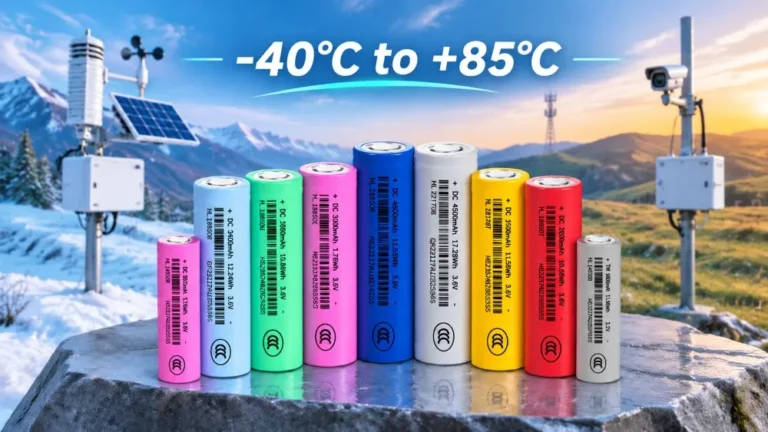
UltraXel provides rechargeable wide-temperature lithium-ion cells and custom wide-temp battery packs for industrial IoT applications.
Battery models support discharge temperatures from -40°C to +85°C, with different capacities and discharge ratings for different device requirements.
Recommended UltraXel Battery Models
| Model | Chemistry | Nominal Voltage | Capacity | Max. Discharge Current | Best For |
| HL14500R Wide-Temp 14500 Li-ion battery | NCM | 3.6V | 750mAh | 3.5A | Compact GPS trackers, asset tracking tags, smart locks |
| HL14500S Wide-Temp Long-Cycle 14500 LiFePO4 Battery | LiFePO₄ | 3.2V | 500mAh | 2.4A | Solar-powered wireless sensors, smart agriculture sensors, rechargeable metering devices |
| HL18650V Low Temperature 18650 Battery | NCM | 3.6V | 2,900mAh | 10A | Cold-chain trackers, outdoor environmental sensors |
| HL18650T High Temperature 18650 Battery Cell | NCM | 3.6V | 2,000mAh | 10A | High-temperature data loggers, outdoor telemetry devices |
| HL18650F Wide-Temp High Discharge 18650 Battery | NCM | 3.6V | 3,000mAh | 30A | Industrial IoT gateways, cellular IoT terminals, wireless surveillance cameras |
| HL18650G Wide-Temp 18650 LiFePO4 Battery | LiFePO₄ | 3.2V | 1,600mAh | 7.75A | Solar-powered data loggers, smart irrigation controllers |
| HL32140L Wide-Temp Large Capacity LiFePO4 Battery | LiFePO₄ | 3.2V | 15,000mAh | 3C | Solar streetlights, industrial IoT backup power systems |
These models address different design priorities:
- Compact devices: HL14500R and HL14500S for space-constrained applications.
- Longer runtime: HL18650V and HL18650Y for higher-capacity requirements.
- High-power applications: HL18650F for applications requiring higher discharge current.
- Frequent cycling: HL18650G and HL32140L for LiFePO₄-based rechargeable systems.
Custom IoT Battery Pack Design

UltraXel also supports custom wide-temp battery pack development.
Key integration capabilities include:
- Cell Selection: 14500, 18650, 21700, and 32140 NCM or LiFePO₄ cells.
- Voltage and Capacity Configuration: Custom series and parallel arrangements.
- PCM/BMS Protection: Protection and charging control according to system requirements.
- Temperature Monitoring: NTC sensing and temperature-related control.
- Pack Integration: Custom dimensions, wiring, connectors, and validation.
Contact UltraXel with your IoT project battery requirements. Our engineering team can help evaluate suitable cells and custom battery pack configurations.
FAQ
What is the best battery chemistry for IoT devices?
Li-SOCl₂ is suitable for long-life, low-maintenance applications, while NCM and LiFePO₄ are better suited to rechargeable systems.
Li-MnO₂ is an option for primary applications with pulse current requirements, and LiPo is useful for compact custom designs.
How long do IoT device batteries typically last?
Battery life depends on usable capacity, average current consumption, transmission frequency, temperature, and self-discharge.
Some low-power industrial devices are designed for multi-year operation, but actual runtime should be calculated and validated under the device’s operating conditions.
Which IoT batteries support high pulse current?
Li-MnO₂ spiral cells and selected high-power rechargeable lithium-ion cells can support relatively high pulse loads. Spiral-type Li-SOCl₂ cells are another option for certain primary battery applications.
Are rechargeable or primary batteries better for industrial IoT devices?
Primary batteries are generally suitable for remote devices requiring long-term operation without charging access. Rechargeable batteries are preferable when solar charging or another charging source is available, particularly for devices with frequent communication or repeated power demands.