Battery pack design involves more than selecting the right voltage and capacity. A battery that works well in one application may not meet the electrical, environmental, or mechanical requirements of another.
For OEM engineers and equipment manufacturers, the challenge is balancing performance, reliability, safety, and integration constraints.
This guide outlines the key pack design considerations and examines two UltraXel application examples for you to evaluate the design.

Key Battery Pack Design Considerations
Five interconnected factors generally influence the final solution:
| Design Consideration | Key Engineering Requirements |
| Electrical Performance | Voltage range, capacity, runtime, continuous and peak discharge current |
| Operating Environment | Charging and discharging temperatures, humidity, vibration, and thermal conditions |
| Mechanical Integration | Cell dimensions, pack layout, enclosure space, mounting, and connectors |
| Protection & Safety | PCM/BMS functions, temperature monitoring, electrical protection, and applicable standards |
| Manufacturability & Reliability | Cell consistency, assembly methods, validation, and production requirements |
Basic Battery Pack Design Calculations
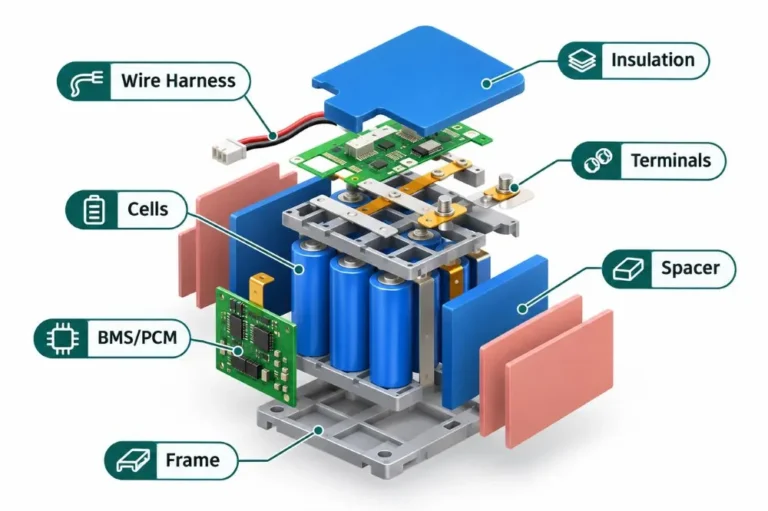
Basic calculations help determine the initial battery pack configuration based on voltage, capacity, and energy requirements.
For a pack using matched cells, the following formulas provide a starting point:
| Parameter | Formula | Design Purpose |
| Nominal Voltage (V) | Cell Voltage × Series Count (S) | Determines the pack’s nominal operating voltage |
| Nominal Capacity (Ah) | Cell Capacity × Parallel Count (P) | Determines the pack’s nominal charge capacity |
| Nominal Energy (Wh) | Pack Voltage × Pack Capacity | Estimates the total nominal stored energy |
Example: HL18650Y-1S7P Battery Pack
UltraXel’s HL18650Y-1S7P configuration uses seven 3.6V, 3.2Ah cells connected in parallel.
- Nominal voltage: 3.6V × 1 = 3.6V
- Nominal capacity: 3.2Ah × 7 = 22.4Ah
- Nominal energy: 3.6V × 22.4Ah = 80.64Wh
This configuration increases energy capacity while maintaining a 3.6V nominal voltage.
Custom Battery Pack Design Process
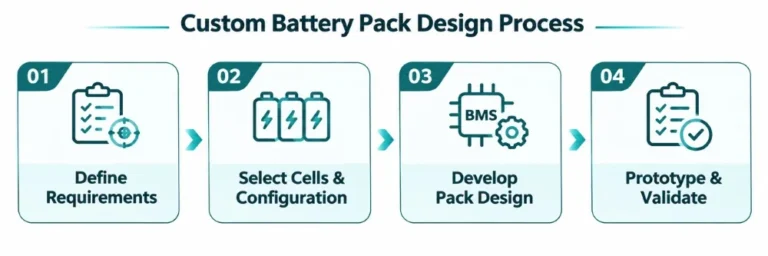
Custom battery pack design involves translating application requirements into a suitable electrical and mechanical solution.
1. Define Application Requirements
Identify the required voltage, runtime, continuous and peak discharge current, operating temperature, and available installation space.
2. Select Cells and Pack Configuration
Choose the battery chemistry, cell model, and series-parallel configuration based on energy, power, temperature, and size requirements.
3. Integrate Protection and Mechanical Design
Determine the required PCM/BMS protection, charging controls, temperature monitoring, wiring, connectors, and mechanical layout.
4. Prototype and Validate
Evaluate the proposed battery pack under application-relevant electrical loads, temperature conditions, and mechanical requirements. The final configuration depends on the application’s priorities.
The following two UltraXel projects illustrate how these design considerations translate into practical battery pack solutions.
Real-World Battery Pack Design Examples
Case 1: Automotive T-Box Backup Battery Design
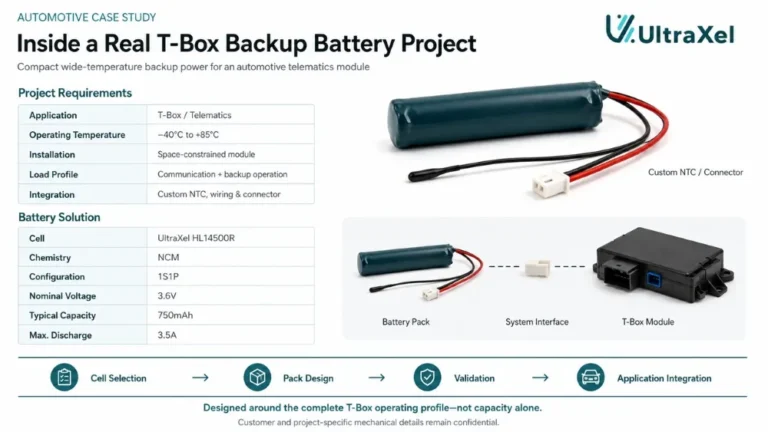
Application Challenge
Automotive T-Box backup batteries require reliable power delivery, wide-temperature performance, and compact integration.
UltraXel developed an HL14500R-1S1P lithium-ion solution as an alternative to a conventional 3S1P NiMH battery pack.
Battery Solution and Comparison
| Design Factor | HL14500R-1S1P | Conventional NiMH 3S1P |
| Nominal Voltage | 3.6V | 3.6V |
| Nominal Capacity | 750mAh | 600mAh |
| Maximum Continuous Discharge | 3.5A | 2.5A |
| Maximum Charging Current | 0.7A | 0.055A |
| Discharge Temperature | −40°C to +85°C | −20°C to +85°C |
| Weight | Approx. 25g | Approx. 37g |
Key Design Considerations
- Higher capacity: 25% more nominal capacity than the NiMH reference.
- Wider temperature range: Discharge capability specified down to −40°C.
- Improved power and integration: Higher stated discharge current, approximately 32% lower weight, and integrated fuse, temperature sensor, and connector.
Engineering Takeaway
This design demonstrates how battery chemistry and pack configuration can improve capacity, power capability, and temperature range without changing the nominal system voltage.
For more details, explore Automotive T-Box Backup Battery Design Case Study.
Case 2: Battery Pack Design for Solar-Powered Industrial Data Loggers

Application Challenge
Solar-powered industrial data loggers require sufficient energy storage for periods of limited sunlight and reliable operation in cold outdoor environments.
Battery Solution
The project adopted UltraXel’s HL18650Y-1S7P lithium-ion battery pack.
| Parameter | Specification |
| Battery Pack Model | HL18650Y-1S7P |
| Chemistry | NCM Lithium-ion |
| Configuration | 1S7P |
| Nominal Voltage | 3.6V |
| Nominal Capacity | 22,400mAh |
| Minimum Capacity | 20,000mAh |
| Nominal Energy | 80.64Wh |
| Maximum Discharge Current | 3A |
| Published Operating Temperature | −40°C to +85°C |
Key Design Decisions
- Extended energy storage: The 1S7P configuration provides 80.64Wh nominal energy to support operation during periods of limited solar input.
- Wide-temperature capability: Designed around a battery specification covering −40°C to +85°C, with cold-weather charging conditions requiring separate control.
- Customized pack integration: PCM protection and a tailored parallel-cell configuration support electrical protection and equipment integration.
Engineering Takeaway
This project highlights the importance of balancing battery capacity, low-temperature performance, charging control, and protection design in solar-powered industrial equipment.
From Battery Pack Design to Validation
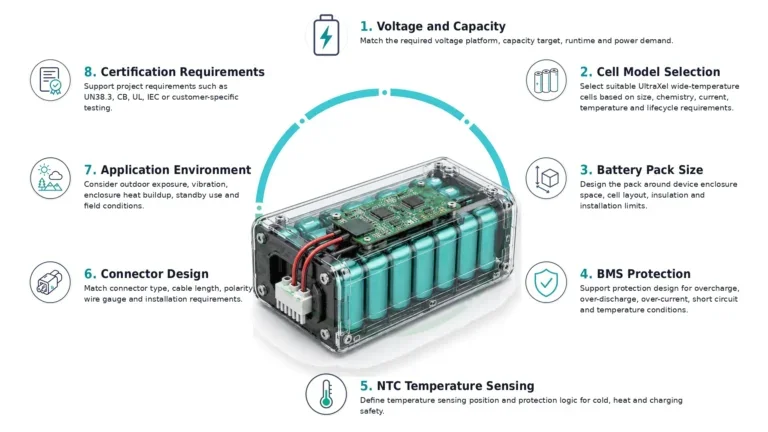
A suitable battery configuration must be verified under the intended operating conditions.
Depending on the application, validation may include capacity and runtime testing, continuous and peak-load evaluation, low-temperature discharge performance, PCM/BMS protection checks, and mechanical reliability testing.
For example, a T-Box backup battery may require particular attention to communication-related current peaks and temperature exposure.
An outdoor data logger may place greater emphasis on usable energy at low temperatures and operation during periods of limited solar input.
Key Takeaways
- Start with application requirements, not battery specifications. Voltage, load profile, runtime, temperature, and installation constraints should guide cell selection and pack configuration.
- Battery configuration depends on the design priority. The T-Box’s 1S1P solution illustrates compact backup power, while the industrial data logger’s 1S7P configuration demonstrates how parallel cells increase energy capacity without increasing nominal voltage.
- Wide-temperature capability requires application-specific evaluation. Cell temperature ratings alone do not establish usable capacity, charging suitability, or reliability under actual operating conditions.
- A reliable design requires system-level integration and validation. Cell matching, PCM/BMS protection, mechanical layout, and testing must be considered alongside nominal electrical specifications.
Custom Battery Pack Design with UltraXel
The two examples demonstrate how battery pack design priorities change with the application.
The automotive T-Box project emphasizes compact integration and wide-temp performance, while the industrial data logger project illustrates the use of a higher-capacity parallel configuration for extended operation.
UltraXel supports application-specific custom wide temperature battery pack solutions, including:
- Wide-temperature lithium battery cell selection.
- Custom series and parallel battery configurations.
- PCM/BMS and temperature monitoring integration.
- Customized battery pack layout, wiring, and connectors.
- Battery prototype evaluation and application-specific engineering support.
Contact UltraXel for a Custom Battery Pack Design Consultation.