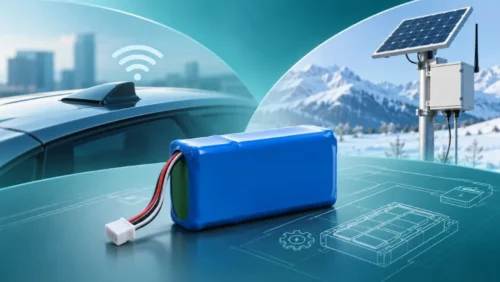
As electric vehicles (EVs), energy storage systems, and industrial equipment are increasingly deployed in cold climates, battery performance under low temperatures is critical. Standard lithium batteries can experience reduced capacity, slower discharge, and limited charging efficiency in subzero conditions, affecting vehicle range and equipment reliability.
To address these challenges, low-temperature lithium batteries and wide temperature lithium batteries have been developed. These technologies combine advanced materials, thermal management, and intelligent BMS (Battery Management System) strategies to maintain stable performance in extreme conditions.
I. How Low Temperatures Affect Lithium Battery Performance
- Slower Electrochemical Reactions
In cold environments, lithium-ion mobility decreases, and electrode reaction resistance increases, reducing available capacity and limiting range.
- Higher Internal Resistance
Increased resistance causes voltage drop during discharge, reducing acceleration and operational stability.
- BMS Restrictions to Protect Battery Life
Battery Management Systems limit low-temperature discharge depth and power output, leaving part of the energy unused and lowering effective range.
- Increased Energy Consumption for Thermal Management
Extra energy is required for cabin heating and battery preheating, consuming 5–10% of total energy and further impacting range.

II. Core Technologies of Wide Temperature Lithium Batteries
UltraXel wide temperature batteries, developed by Guangzhou Aochuang Technology, address low-temperature challenges through materials optimization, thermal management systems, and intelligent BMS coordination.
1. Materials Optimization
- Modified ternary cathode and high surface-area anode to enhance low-temperature discharge
- Low-viscosity electrolyte to improve ion mobility and reduce internal resistance
- Optimized SEI (Solid Electrolyte Interface) layer for stable ion conduction and capacity retention
2. Battery Thermal Management System (BTMS)
- Liquid cooling/heating systems balance cell temperature and eliminate cold spots
- Preheating strategies using PTC heaters or heat pumps bring batteries quickly to optimal temperature
- Heat recovery utilizes excess energy from the motor and inverter for improved efficiency
3. Intelligent BMS Control
- SOC (State of Charge) dynamic estimation with temperature compensation for accurate available energy assessment
- Low-temperature discharge optimization ensures safe energy release in cold environments
- Cycle life management reduces degradation under low-temperature conditions

III. Low-Temperature Performance Improvements
| Ambient Temperature | Standard Battery Range Loss | UltraXel Wide Temperature Battery Range Loss |
| -10°C | ~30% | ~15% |
| -20°C | ~40% | ~20% |
| -30°C | ~50% | ~25% |
These results demonstrate that UltraXel wide temperature batteries, combined with thermal management and intelligent BMS, can reduce winter range loss by approximately 50%, providing reliable energy support for EVs and industrial equipment in cold climates.
IV. Main Application Scenarios
Urban Logistics Vehicles
- Temperature Range: -5°C to -10°C
- Daily Routes: 120–150 km
- Performance Impact: Daily range increases by ~25%, fewer mid-route charges
- Operational Benefits: Improved on-time delivery and vehicle turnover efficiency
Cold Chain Transportation
- Temperature Range: -10°C to -20°C
- Applications: Perishable and frozen food transport
- Performance Impact: Stable low-temperature discharge, ~20% winter range loss
- Operational Benefits: Reliable cold chain transport with reduced charging stops
Outdoor Industrial Equipment
- Applications: Polar monitoring, cold-region construction, outdoor power equipment
- Performance Impact: Stable operation at low temperatures, consistent cycle life
- Operational Benefits: Reliable equipment operation and lower maintenance costs
V. UltraXel Technology Advantages
Guangzhou Aochuang Technology (UltraXel) specializes in wide temperature lithium battery development, offering solutions for extreme environments:
- Wide operating temperature range: -40℃~+85℃
- Improved low-temperature range stability
- Enhanced cold-weather charging efficiency
- Stable cycle life for multiple applications, including urban logistics, cold chain transport, and industrial outdoor equipment
VI. Application Value of Wide Temperature Lithium Batteries
Wide temperature lithium battery technology is becoming essential for reliable operation in cold climates:
- Minimizes winter range reduction
- Enhances operational efficiency for vehicles and equipment
- Reduces mid-route charging and maintenance costs
- Provides stable, efficient power support for EVs, cold chain logistics, and industrial applications
Through ongoing innovation, UltraXel wide temperature lithium batteriesdeliver reliable, high-performance energy solutions for cold climate applications, helping operators maintain efficiency and equipment longevity even under extreme conditions.