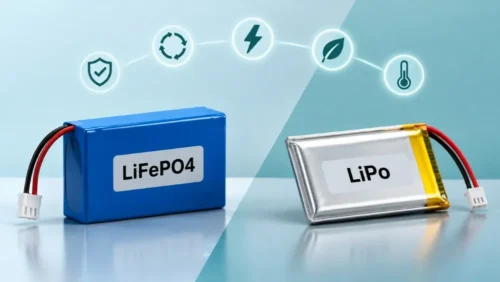
LiFePO4 and LiPo batteries differ in energy density, discharge performance, cycle life, and thermal stability.
LiPo batteries are generally preferred for lightweight, high-power applications, while LiFePO4 batteries are better suited to applications requiring long service life, safety, and reliability.
The right choice depends on your application’s power requirements, operating temperature, available space, and expected service life.
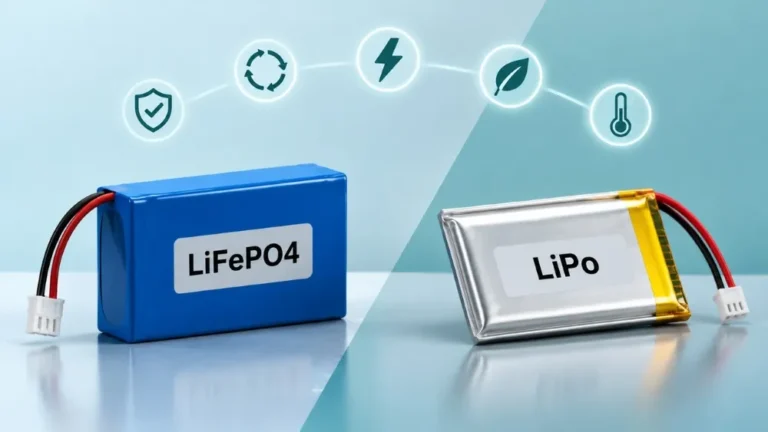
LiFePO4 vs LiPo: Chemistry and Cell Structure
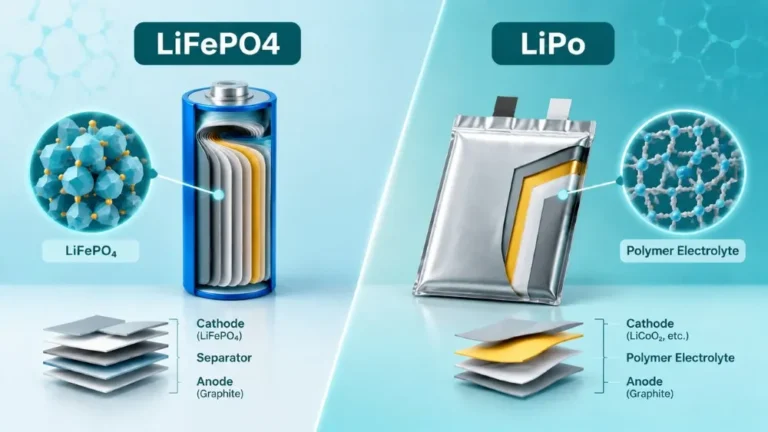
LiFePO4 and LiPo are not strictly equivalent battery classifications.
- LiFePO4 (LFP): Refers to a specific lithium-ion cathode chemistry using lithium iron phosphate.
- LiPo: Commonly describes lithium-ion batteries with polymer-based packaging or electrolyte configurations.
LiFePO4 cells are available in cylindrical, prismatic, and pouch formats. LiPo batteries are commonly associated with lightweight pouch-cell designs.
| Feature | LiFePO4 (LFP) | Conventional LiPo |
| Classification | Cathode chemistry | Commonly refers to polymer-based cell construction |
| Cathode Material | Lithium Iron Phosphate | Often NMC, LCO, or other lithium-ion chemistries |
| Cell Format | Cylindrical, prismatic, and pouch | Pouch |
| Nominal Cell Voltage | 3.2V | 3.7V |
| Typical Characteristics | Thermal stability, long cycle life | High energy density, lightweight and flexible packaging |
| Common Applications | Energy storage, industrial equipment, backup power | Drones, RC vehicles, portable electronics |
LiFePO4 vs LiPo: 6 Key Performance Differences
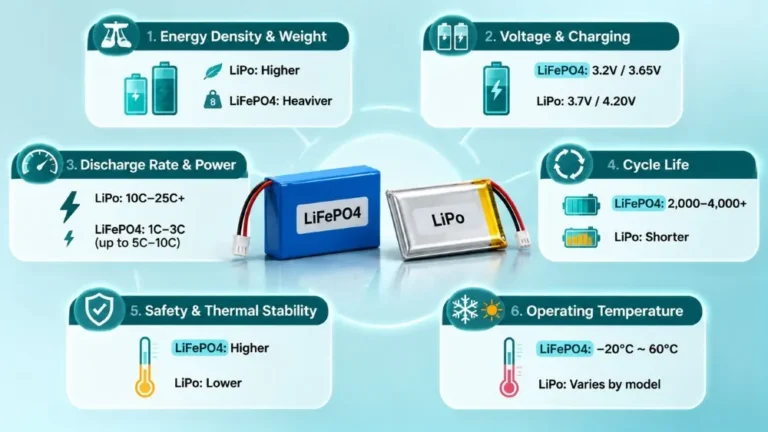
1. Energy Density and Weight
LiPo batteries generally offer higher energy density and lighter packaging, making them suitable for weight-sensitive applications.
LiFePO4 batteries typically have lower energy density but can provide a longer service life and better thermal stability.
| Comparison | LiFePO4 | LiPo |
| Gravimetric Energy Density | 90–160 Wh/kg | 150–250 Wh/kg |
| Volumetric Energy Density | 220–350 Wh/L | 300–600 Wh/L |
| Weight Efficiency | 6.3–11.1 kg/kWh | 4.0–6.7 kg/kWh |
| Design Flexibility | Cylindrical, prismatic, and pouch cells | Thin, lightweight pouch |
Engineering consideration:
Choose LiPo for drones, portable equipment, and other weight-sensitive devices. LiFePO4 is often more suitable for stationary and industrial systems where reliability and service life matter more than weight.
2. Voltage Characteristics and Charging Requirements
| Voltage Parameter | LiFePO4 | LiPo |
| Nominal Cell Voltage | 3.2V | 3.7V |
| Typical Maximum Charge Voltage | 3.65V | 4.20V |
| Charging method | CC-CV | CC-CV |
| Discharge Voltage Profile | Relatively flat | Gradually decreases during discharge |
LiFePO4 maintains a relatively stable voltage throughout much of its discharge cycle, while LiPo voltage gradually decreases.
Both require chargers configured for the correct battery chemistry, cell count, and manufacturer-specified voltage and current limits.
3. Discharge Rate and Power Output
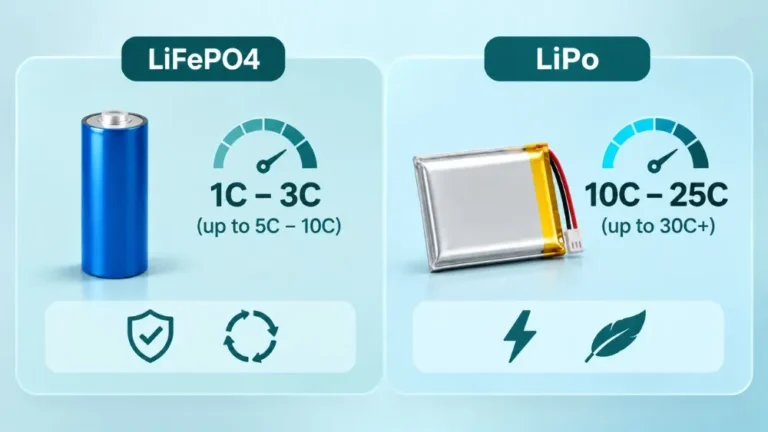
Typical discharge rate references:
- LiFePO4: Standard cells commonly support around 1C–3C continuous discharge, while high-rate models can reach 5C–10C or higher.
- LiPo: High-power RC cells commonly offer 10C–25C continuous discharge, with some models rated for 30C or higher.
LiPo is generally better suited to lightweight, high-power applications requiring high current output.
LiFePO4 is a strong choice for industrial equipment requiring stable discharge, durability, and long service life.
4. Cycle Life and Long-Term Reliability
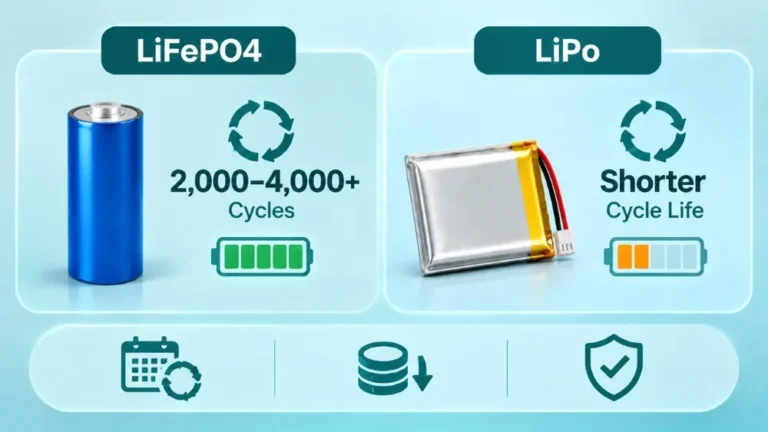
LiFePO4 batteries generally provide significantly longer cycle life than conventional high-energy-density LiPo batteries.
- LiFePO4: Around 2,000–4,000 cycles or more.
- LiPo: Often provides shorter cycle life, particularly in high-discharge applications or under frequent deep cycling.
Key Difference: LiFePO4 is often more economical for applications involving frequent charge and discharge cycles because of its longer service life and potentially lower battery replacement costs.
5. Safety and Thermal Stability
LiFePO4 offers better thermal stability and lower thermal runaway risk than conventional LiPo batteries using less thermally stable cathode chemistries.
Its phosphate-based cathode has a stable chemical structure, providing better resistance to thermal degradation and oxygen release.
LiPo safety performance depends on its cathode chemistry and cell design. Pouch cells may also experience swelling due to gas generation during aging, overcharging, or abnormal operation.
6. Operating Temperature Performance
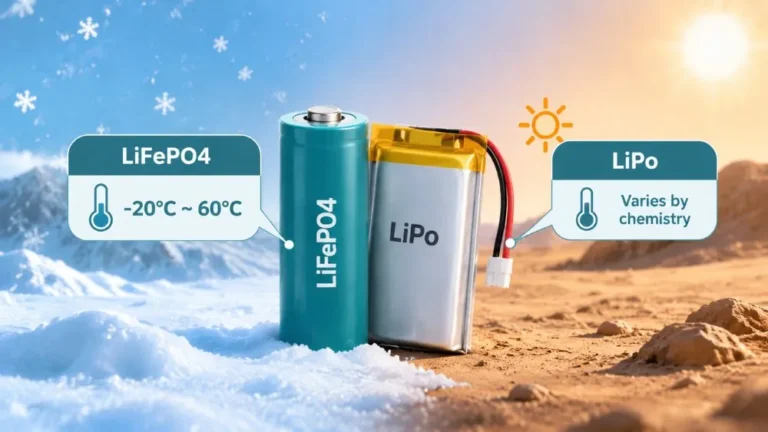
Both battery types experience reduced capacity and increased internal resistance at low temperatures.
- LiFePO4: Standard cells commonly support discharge temperatures around -20°C to 60°C. Low-temperature charging generally requires temperature control or specially designed cells.
- LiPo: Operating temperature limits vary by chemistry and manufacturer. Standard models also experience reduced power output in cold environments and require strict charging temperature control.
Note: For wide-temperature environments, specially designed wide-temperature cells with verified charging and discharging specifications are essential.
LiFePO4 vs LiPo: Which Is Better for Different Applications?
The best battery depends on the equipment’s power requirements, weight limitations, operating environment, and expected service life.
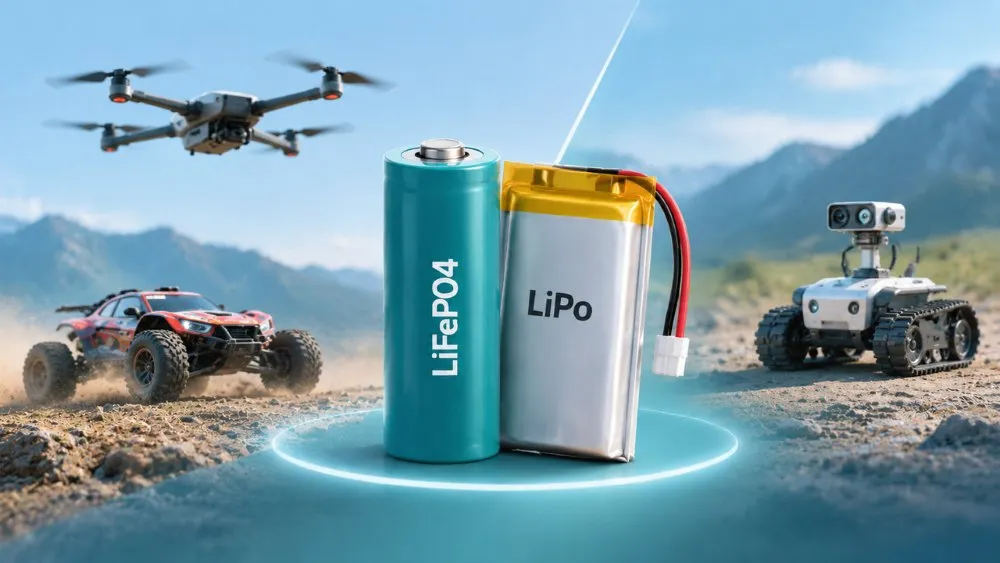
High-Power and Weight-Sensitive Applications
Typical applications: Drones, UAVs, RC vehicles, and mobile robotics.
LiPo batteries are commonly preferred because of their high energy density, lightweight pouch construction, and availability of high-discharge configurations.
LiFePO4 may be considered when safety, longer cycle life, and operating reliability are more important.
Key selection factors:
- Energy density and battery weight
- Continuous and peak discharge current
- Voltage stability under load
- Battery dimensions and mechanical constraints
Energy Storage and Backup Power Systems
Typical applications: Solar energy storage, UPS systems, and industrial backup power.
LiFePO4 is generally a strong choice because of its long cycle life, thermal stability, and suitability for repeated charging and discharging.
It can also offer better long-term value when battery replacement and maintenance costs are important.
Key selection factors:
- Cycle life at the required DOD
- Charge and discharge efficiency
- System voltage and capacity
- Thermal management and BMS protection
- Total cost of ownership
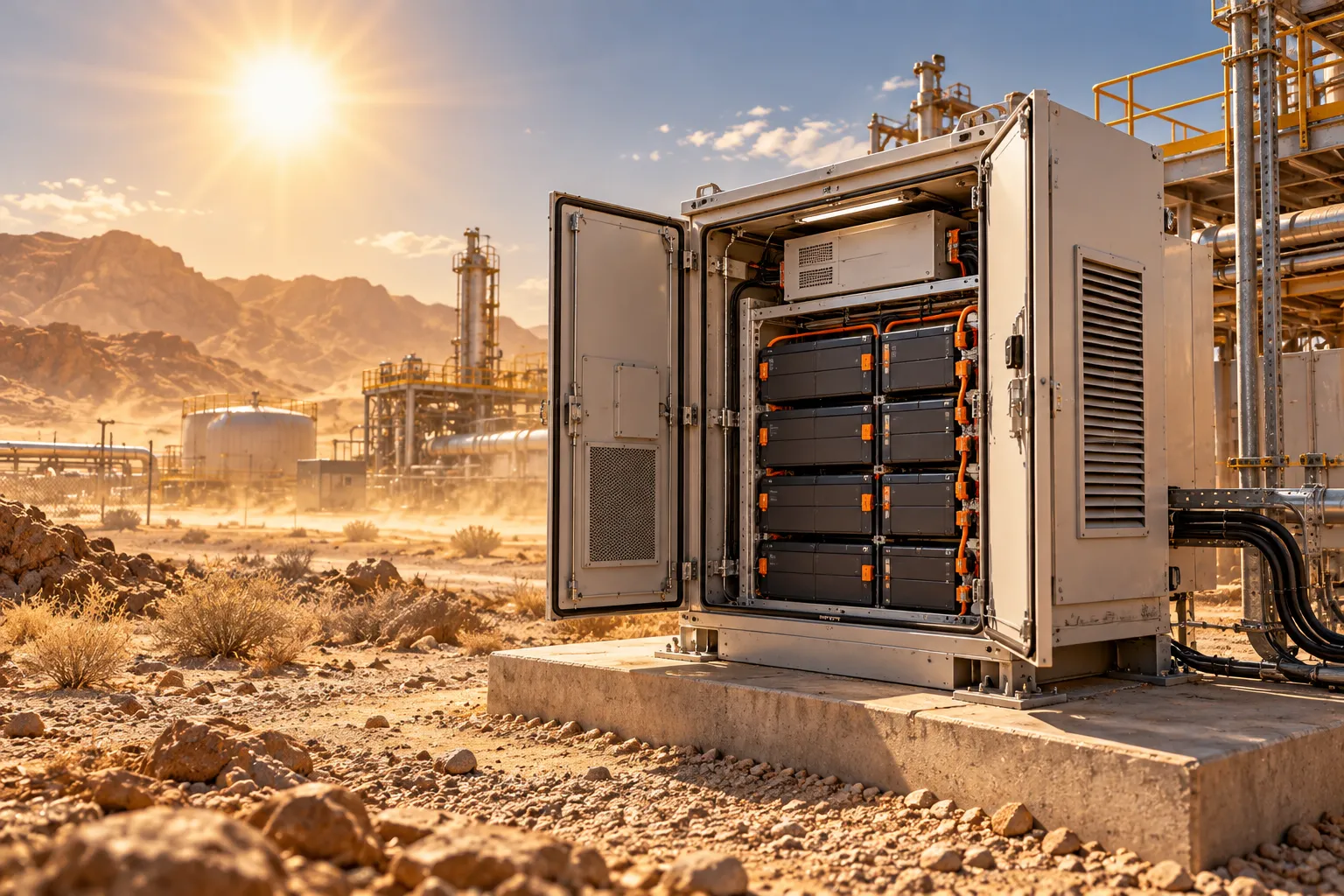
Industrial and Outdoor Equipment
Typical applications: Industrial monitoring equipment, outdoor IoT devices, automotive electronics, and remote sensing systems.
Equipment may operate in remote locations, experience significant temperature fluctuations, or remain in standby mode for extended periods.
Specialized lithium-ion cells may be appropriate when higher energy density, compact dimensions, or specific low-temperature performance is required.
Key selection factors:
- Capacity retention under actual operating conditions
- Standby time and self-discharge
- Continuous and peak current requirements
- Battery pack protection and integration
Battery Performance Under Extreme Temperature Conditions
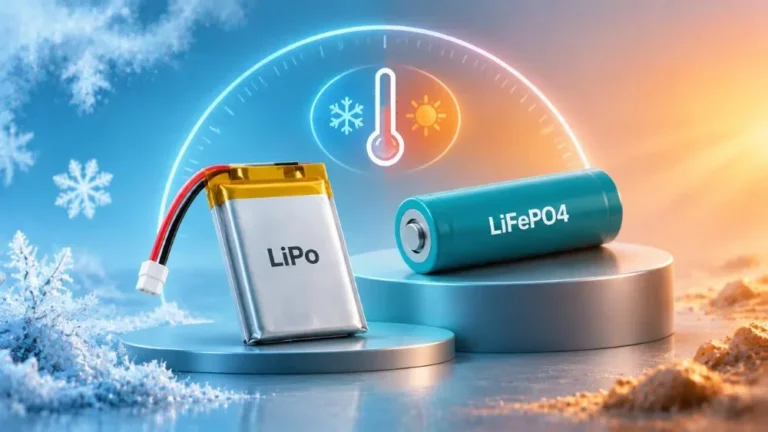
Both standard LiFePO4 and LiPo batteries have limitations under extreme temperatures. LiFePO4 generally offers better thermal stability, but neither chemistry is inherently designed for extreme cold or high-temperature operation.
Low-Temperature Performance
At low temperatures, both battery types experience reduced capacity, increased internal resistance, and lower discharge power.
Charging below 0°C may cause lithium plating and permanent cell damage unless the cells are specifically for low-temperature charging.
High-Temperature Performance
LiFePO4 generally provides better thermal stability than conventional LiPo batteries using NMC or LCO cathodes.
However, prolonged exposure to high temperatures accelerates capacity degradation in both battery types. Neither should operate beyond its specified temperature range without appropriate cell selection and thermal management.
UltraXel Wide-Temperature LiFePO4 Batteries for Industrial Applications
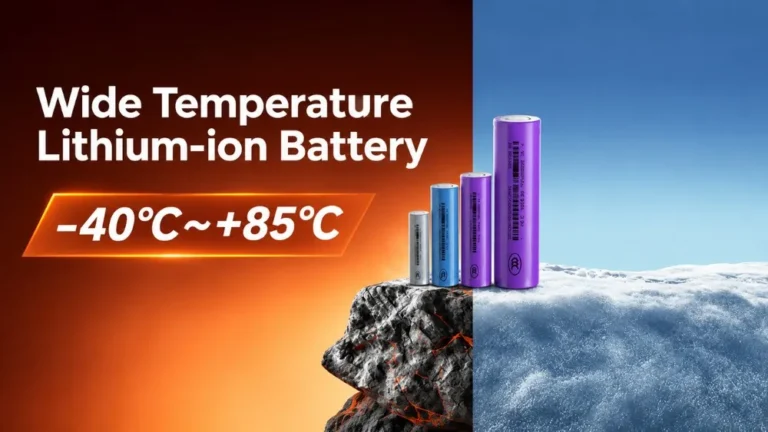
For applications prioritizing safety, long cycle life, and reliable operation, UltraXel offers LiFePO4 cylindrical cells in multiple sizes and capacities.
| Model | Cell Format | Typical Capacity | Key Characteristics | Suitable Applications |
| HL14500S wide-temp long-life 14500 battery | 14500 | 500mAh | Compact size, 1,000+ cycles, wide-temperature discharge | Smart locks, sensors, compact IoT devices |
| HL18650G long-cycle-life LFP battery | 18650 | 1600mAh | 1,500+ cycles, high safety, 5C+ discharge capability | Industrial monitoring, outdoor equipment, automotive backup |
| HL32140L large high-capacity LFP battery | 32140 | 15,000mAh | 2,000+ cycles, 3C continuous discharge | Solar lighting, energy storage, and heavy-duty industrial systems |
These LiFePO4 cells cover a wide range of industrial power requirements, from compact IoT devices to high-capacity energy storage systems.
Beyond standard cells, UltraXel provides custom wide-temp battery pack solutions, including cell configuration, BMS/PCM integration, mechanical design, and thermal management.
Contact UltraXel to discuss your application requirements and find the right wide-temperature LiFePO4 battery solution.
FAQ
Is LiFePO4 a type of LiPo battery?
No. LiFePO4 refers to a specific lithium-ion cathode chemistry, while LiPo commonly describes polymer-based battery construction or packaging.
LiFePO4 cells can be manufactured in different formats, including cylindrical, prismatic, and pouch designs. A pouch cell is not necessarily a LiFePO4 battery.
Can you charge a LiFePO4 battery with a LiPo charger?
Only if the charger explicitly supports the LiFePO4 charging profile and voltage limits.
A conventional LiPo charger configured for a 4.20V-per-cell charging limit is not suitable for a standard LiFePO4 cell, which typically has a maximum charging voltage of approximately 3.65V.
Which battery lasts longer, LiFePO4 or LiPo?
LiFePO4 batteries generally offer longer cycle life than conventional high-energy-density LiPo batteries.
Actual cycle life depends on cell chemistry, charging and discharging rates, depth of discharge, operating temperature, and the manufacturer’s end-of-life criteria.
Which battery is better for cold-weather applications?
Neither chemistry is better for every cold-weather application. Engineers should compare available capacity, internal resistance, voltage under load, and charging restrictions at the expected operating temperature.
For extreme cold environments, specialized wide-temperature cells and appropriate battery pack thermal management may be necessary.
Which battery is better for high-discharge applications?
Both LiFePO4 and LiPo batteries are available in high-discharge configurations. LiPo batteries are commonly used in drones and RC equipment requiring high power relative to battery weight. High-rate LiFePO4 cells can also support demanding industrial loads.
The decision should be based on the cell’s rated continuous current, peak current, voltage sag, thermal performance, and operating conditions.