Why Does Cold Weather Affect EV Battery Performance?
With the widespread adoption of electric vehicles and electric logistics vehicles, more and more drivers notice significant range loss in winter. In fact, the impact of low temperatures on lithium-ion battery performance is a common technical challenge across the industry.
In cold environments, the electrochemical reaction efficiency inside the battery decreases, directly affecting battery capacity, discharge power, and charging efficiency, ultimately leading to reduced vehicle performance.
Typically, when the ambient temperature drops below 0℃, EV battery performance begins to decline noticeably. Under extreme low-temperature conditions such as -20℃, range loss can even exceed 40%.
Therefore, improving battery stability in low-temperature environments has become a key direction in electric vehicle technology development.
Main Effects of Low Temperature on Lithium Batteries
1. Reduced Battery Capacity
In low-temperature environments, the migration speed of lithium ions in the electrolyte slows down, and the electrode reaction rate decreases. This prevents some active materials from participating in the reaction, thereby reducing the usable capacity of the battery.
For example, at -20℃, the usable capacity of a standard lithium battery may be only 60%–70% of its capacity at room temperature.
2. Increased Battery Internal Resistance
As temperature drops, the electrochemical impedance inside the battery increases.
Higher internal resistance leads to reduced discharge efficiency
Faster voltage drop
Weakened vehicle acceleration performance
In high-power demand scenarios such as climbing hills or high-speed driving, this effect becomes more pronounced.
3. Slower Charging Speed
In low-temperature environments, the diffusion capability of lithium ions decreases. If charging continues using the same methods as at room temperature, the risk of lithium plating inside the battery increases, affecting battery safety.
Therefore, the Battery Management System (BMS) typically limits charging power under low-temperature conditions, which results in:
- Extended charging time
- Reduced fast-charging efficiency
For electric logistics vehicles requiring frequent operation, this directly impacts operational efficiency.
4. Limited Available Power
To protect battery safety and extend service life, the BMS limits the battery’s discharge power under low-temperature conditions.
This means that even if the battery still has remaining capacity, the vehicle may not be able to accelerate or climb hills properly due to limited power output, affecting the driving experience.
Impact of Low-Temperature Environments on EV Applications
Low-temperature environments not only affect the battery itself but also create a chain reaction on overall EV operation.
Urban Commuter and Home Electric Vehicles
For daily commuter home electric vehicles, the main issues caused by winter low temperatures are:
Significant reduction in range
Increased energy consumption from cabin heating
Higher charging frequency, affecting travel convenience
Ultraxel automotive applications
Urban Delivery Electric Vehicles
Urban delivery vehicles typically require frequent start-stop cycles and stable range. In winter conditions:
Vehicle range decreases
Charging frequency increases
Delivery efficiency declines
This directly impacts logistics operational efficiency.
Electric Cold Chain Transport Vehicles
Cold chain transport vehicles often need to operate in even lower temperature environments while also maintaining low-temperature conditions for cargo.
Therefore, these vehicles not only face reduced battery performance in low temperatures but also require additional energy consumption to maintain cold chain system operation, placing higher demands on battery performance.
Long-Haul Electric Buses and Logistics Vehicles
In long-haul transportation scenarios, unstable range caused by low temperatures may lead to:
- Disrupted charging schedules
- Extended transportation time
- Increased operating costs
Therefore, improving battery low-temperature performance is crucial for ensuring the reliability of electric vehicle long-haul transportation.
Technical Solutions to Improve Battery Low-Temperature Performance
To enhance EV performance in low-temperature environments, the industry typically employs multiple technical approaches.
1. Wide-Temperature Lithium Battery Technology
Wide-temperature lithium batteries optimize battery materials, electrolyte formulations, and electrode structures to enable stable operation over a broader temperature range.
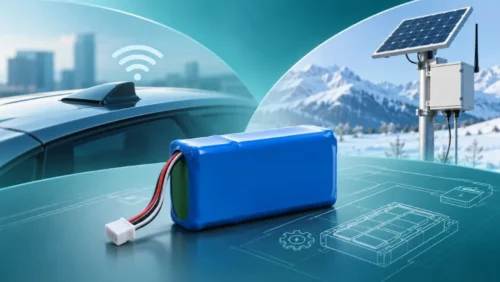
For example, UltraXel wide-temperature lithium batteries can maintain stable performance in environments ranging from -30℃ to +60℃, significantly reducing winter range loss.
UltraXel Wide Temperature Lithium Battery
2. Battery Thermal Management System
The Battery Thermal Management System (BTMS) can control battery temperature through heating or cooling systems, keeping it within the optimal operating range.
Common technologies include:
- Liquid cooling systems
- PTC heaters
- Heat pump systems
Through these technologies, batteries can maintain stable performance even in low-temperature environments. Currently, more and more electric vehicles come standard with battery preheating functions.
3. Intelligent BMS Control Strategy
Advanced Battery Management Systems can optimize charge and discharge strategies through temperature compensation algorithms, for example:
- Intelligent battery preheating
- Dynamically adjusting charging power
- Accurate SOC estimation
This effectively reduces the impact of low temperatures on battery performance and ensures winter driving experience.
Practical Value of Wide-Temperature Lithium Batteries
Through the coordinated design of material optimization, thermal management systems, and intelligent BMS, wide-temperature lithium batteries can significantly improve EV stability in low-temperature environments.
For EV users and operators, this means:
- More stable and reliable winter range
- Higher charging efficiency and shorter waiting times
- Smoother vehicle power output
- Reduced overall vehicle operating costs
As the electric vehicle market continues to expand, wide-temperature lithium battery technology is becoming a key solution for addressing winter battery performance issues.
Conclusion
Low-temperature environments have multiple effects on EV battery performance, including reduced capacity, increased internal resistance, slower charging speed, and limited available power.
By adopting wide-temperature lithium battery technology, advanced thermal management systems, and intelligent BMS control strategies, EV performance in winter conditions can be significantly improved.
In the future, as battery technology continues to advance, the performance and reliability of electric vehicles in extreme environments will also continue to improve, making winter travel worry-free.