Lithium batteries can work in cold weather, but temperatures below 0°C (32°F) can reduce their capacity. Common lithium batteries can discharge at -20°C (-4°F), and some specialized ones can continue discharging at temperatures as low as -40°C (-40°F).
This guide explains how lithium batteries in cold weather behave, common problems, and practical ways to improve performance in freezing and extreme-cold environments.

Do Lithium Batteries Work in Cold Weather?
Yes. Many lithium batteries can discharge in cold weather, but their performance depends on battery chemistry, cell design, temperature, and operating conditions.
As temperatures fall, electrochemical reactions slow down and internal resistance increases. This makes it harder for the battery to deliver energy efficiently, especially when a device requires high current.
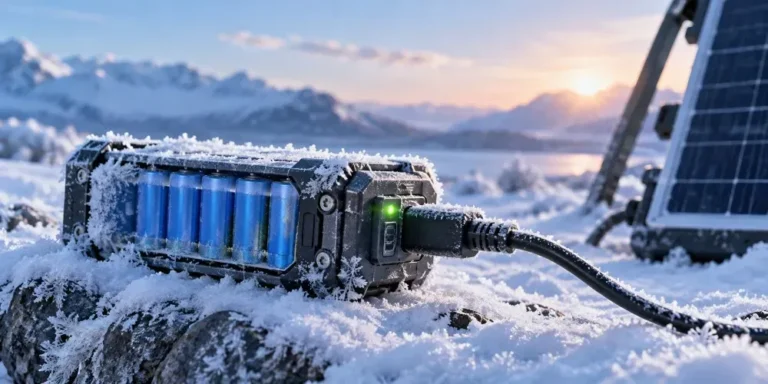
The most common effects include:
| Cold-Weather Effect | What Happens |
| Reduced usable capacity | Less energy is available before the battery reaches its cutoff voltage. |
| Shorter runtime | Devices may need recharging more frequently. |
| Increased voltage drop | Battery voltage falls more sharply under load. |
| Reduced power output | High-current equipment may struggle to start or operate. |
| Charging restrictions | Charging may be limited or blocked at low temperatures. |
Some lithium batteries may lose 20–30% of their usable capacity near freezing temperatures, although actual losses vary with cell chemistry, discharge rate, and test conditions.
Many rechargeable lithium-ion batteries restrict charging below 0°C (32°F), while some can continue discharging at lower temperatures.
Specialized low-temperature cells may support wider operating ranges when properly designed and validated.
For detailed charging, discharging, and temperature limits, see our guide: How Cold Is Too Cold for Lithium Batteries?
Common Lithium Battery Problems in Cold Weather
Cold weather can affect lithium batteries in several ways, from shorter operating time to unexpected device shutdowns.
Understanding the likely cause makes it easier to determine whether the problem requires a change in operating conditions, battery management, or battery selection.
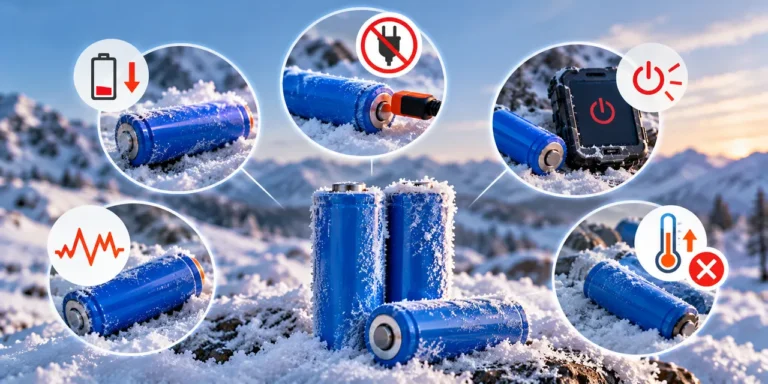
| Common Problem | Possible Cause | Recommended Action |
| Battery drains faster in winter | Reduced usable capacity at low temperatures | Check capacity at the actual operating temperature and reduce unnecessary power consumption. |
| Battery will not charge | Low-temperature charging protection has been activated | Check cell temperature and allow the battery to reach its permitted charging range. |
| Device shuts down unexpectedly | Voltage drops below the device cutoff during high-current operation | Check peak current, voltage stability, and battery discharge capability. |
| Battery performance becomes inconsistent | Temperature fluctuations and changing electrical loads | Evaluate performance under representative operating conditions. |
| Battery does not recover after warming | Possible protection state, aging, or internal damage | Follow manufacturer guidance and inspect the battery before further use. |
Does Cold Weather Permanently Damage Lithium Batteries?
Not necessarily. The reduction in available capacity and power during cold-weather discharge is often largely reversible. When the battery returns to a suitable operating temperature, much of its normal performance may recover.
There is the point: charging a conventional lithium-ion battery below its specified temperature limit can cause lithium plating, leading to permanent capacity loss and increased safety risks.
A battery that fails to recover after warming should not automatically be assumed to have suffered cold-related damage. Protection circuitry, aging, or other faults may also be responsible.
How to Improve Lithium Battery Performance in Cold Weather
Improving lithium battery performance in extremely cold temperatures requires more than simply keeping the battery warm.
1. Use Proper Charging and Temperature Management
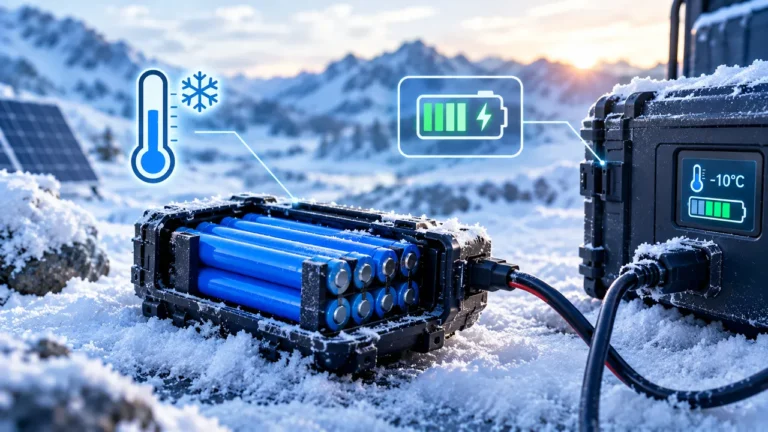
Charging requires particular attention because lithium-ion batteries generally have stricter charging temperature limits than discharging limits.
To reduce cold-weather charging risks:
- Follow the manufacturer’s specified charging temperature and current limits.
- Use battery temperature monitoring and appropriate BMS or PCM protection.
- Allow batteries to warm to a permitted temperature before charging.
- Use controlled preheating where the application requires charging in freezing environments.
A low-temperature charging cutoff helps prevent charging outside the permitted range. However, BMS protection does not always make a lithium battery capable of low-temperature charging.
For equipment that must recharge outdoors throughout winter, the battery system may require dedicated low-temperature cells, controlled heating, or both.
2. Reduce High Power Demand in Extreme Cold
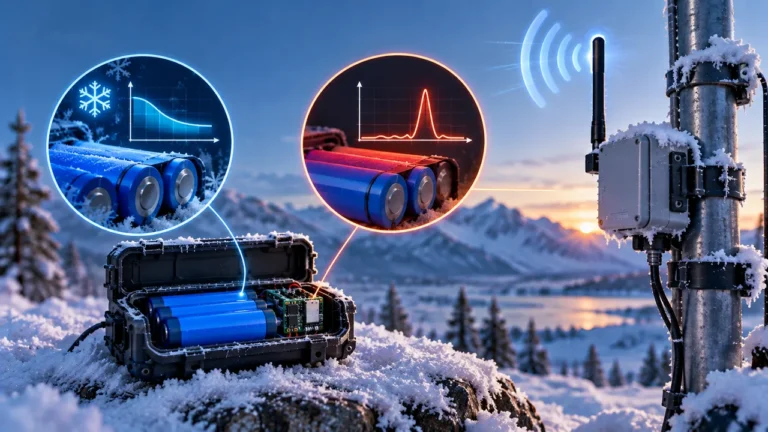
Cold temperatures increase battery internal resistance, making voltage drops more noticeable during high-current operation.
This can be problematic for equipment with startup surges, wireless communication peaks, or intermittent high-power loads.
For example, an outdoor monitoring device may consume very little power most of the time but require a short, high-current pulse when transmitting data.
Practical improvements include:
- Reducing unnecessary peak power consumption.
- Optimizing device startup and communication cycles.
- Selecting cells with sufficient low-temperature discharge capability.
- Allowing additional capacity and voltage margin for cold-weather operation.
3. Use Insulation or Battery Heating
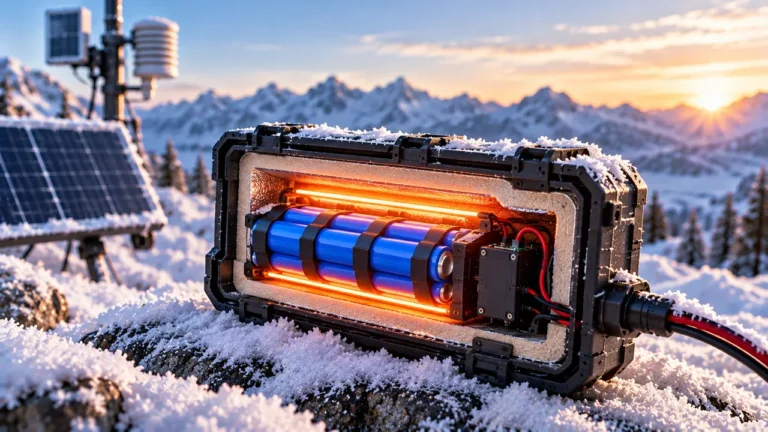
Thermal management can help reduce performance losses caused by extreme cold.
Insulation slows heat transfer and can help retain warmth generated by the battery or surrounding equipment. However, insulation alone cannot maintain a battery above ambient temperature indefinitely.
Active heating uses an external or integrated heat source to raise the battery temperature before charging or operation.
For compact, low-power devices, adding a heater may increase system complexity and reduce available runtime.
In these applications, choosing a battery for low-temperature discharge may be more practical.
4. Choose Specialized Batteries for Cold Environments

When equipment must operate continuously in freezing or sub-zero conditions, a standard lithium battery may not provide sufficient usable capacity or power.
Low-temperature lithium batteries improve performance under challenging temperature conditions through appropriate cell chemistry, electrolyte formulation, and electrode design.
Depending on the specific cell, these designs can help provide:
- Improved usable capacity at low temperatures.
- More stable voltage under load.
- Better discharge capability in sub-zero environments.
- More reliable operation for outdoor and industrial equipment.
When Do You Need a Low-Temperature Lithium Battery?
For devices exposed to occasional mild cold, a conventional lithium battery may be sufficient if its temperature, capacity, and current limits are respected.
Dedicated low-temperature cells become more important when equipment must operate continuously in freezing conditions or cannot tolerate unexpected power interruptions.
| Operating Condition | Battery Consideration |
| Occasional exposure to mild cold | A standard lithium battery may be sufficient. |
| Regular operation below 0°C | Check actual low-temperature capacity and voltage performance. |
| Continuous operation near -20°C | Consider cells specifically for low-temperature discharge. |
| Operation near -40°C | Evaluate extreme-cold batteries. |
| High-current operation in freezing conditions | Verify pulse discharge capability and voltage stability. |
| Outdoor charging below freezing | Confirm permitted charging conditions and appropriate thermal protection. |
For industrial applications, the minimum operating temperature is only one part of battery selection.
Other key factors include usable capacity, discharge current, voltage stability, device cutoff voltage, and the required operating lifetime.
These factors are important for remote monitoring systems, outdoor sensors, industrial data loggers, and communication equipment in locations where battery replacement is difficult.
UltraXel Low-Temperature Battery Solutions
For industrial equipment operating in cold environments, reliable power depends on selecting the right cell and integrating it into a battery system that meets the application’s requirements.
UltraXel provides low-temperature lithium battery cells and customized battery pack solutions for industrial and outdoor applications.
Rather than selecting a battery based only on its minimum operating temperature, UltraXel focuses on matching battery performance to actual equipment requirements.
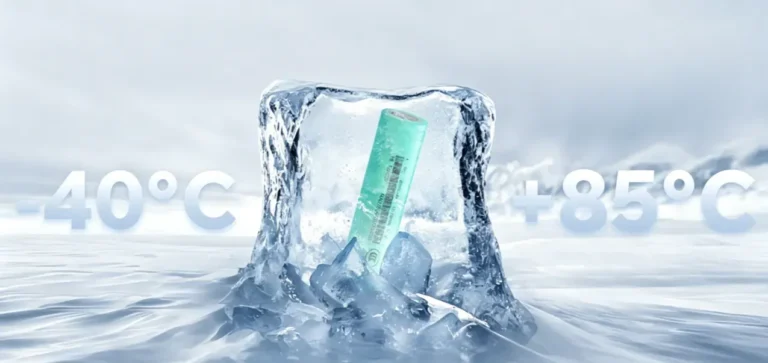
Low-Temperature Battery Options for Different Applications
UltraXel offers low-temperature lithium batteries and customized battery packs for reliable operation in cold-weather industrial applications.
| Battery Solution | Battery Model | Recommended Applications | Key Advantages |
| Low-Temperature 18650 Batteries | HL18650V HL18650Y | Outdoor monitoring, industrial instruments, remote communication | High-capacity options, reliable low-temperature discharge |
| Low-Temperature 14500 Batteries | HL14500R HL14500S | Compact sensors, portable devices, industrial IoT | Compact size, low-temperature performance |
Contact UltraXel to find the right low-temperature battery or customized solution for your application.
FAQ
Can lithium batteries recover after being exposed to cold weather?
Yes. Most temporary capacity and power losses recover when the battery warms up. However, damage caused by improper low-temperature charging may be permanent.
Do lithium batteries freeze in cold weather?
Not necessarily. Lithium batteries do not automatically freeze at 0°C (32°F), but cold temperatures can reduce their capacity, voltage stability, and power output.
Are LiFePO4 batteries better for cold weather?
Not always. Cold-weather performance depends on cell chemistry and design. Specialized low-temperature lithium-ion batteries may perform better in extreme cold.
Does cold weather shorten lithium battery lifespan?
Cold-weather discharge mainly causes temporary performance loss. Charging below the battery’s specified temperature limit can cause permanent damage and shorten its lifespan.
What is the best way to improve lithium battery performance in extreme cold?
Use batteries rated for low temperatures, reduce high-current loads, and apply appropriate thermal management. For continuous extreme-cold operation, specialized low-temperature cells are often preferable.