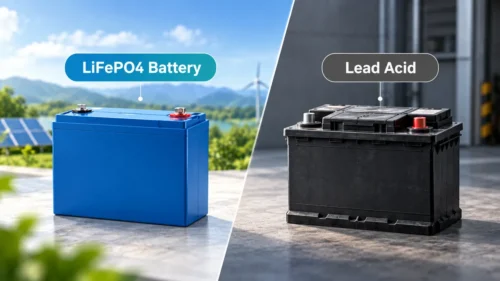
LiFePO4 generally offers longer cycle life, higher usable capacity, and lighter weight, while lead-acid remains a cost-effective option for less demanding applications.
For applications in extreme temperatures, it can affect both battery types, making operating conditions an important factor in battery selection.
This guide compares LiFePO4 vs lead-acid batteries across key performance factors, costs, and applications, including the role of wide-temperature LiFePO4 cells in demanding environments.
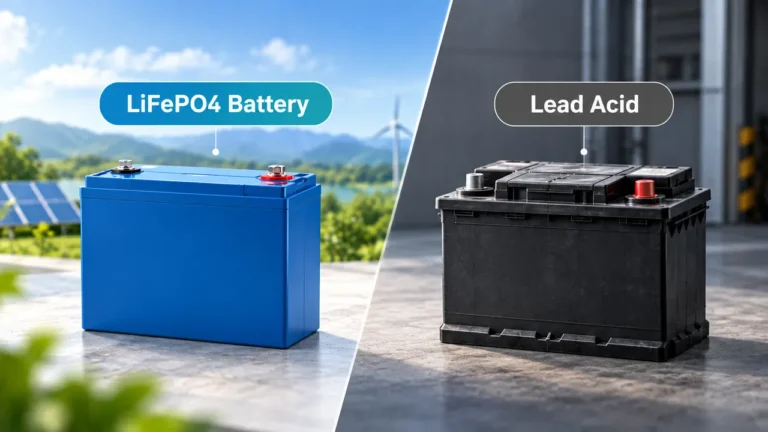
LiFePO4 vs Lead Acid Battery: A Quick Look
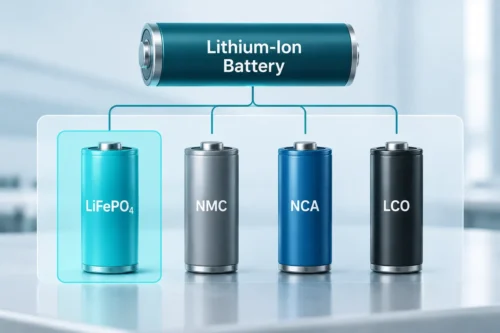
LiFePO4 (Lithium Iron Phosphate) batteries are a type of rechargeable lithium-ion battery that uses lithium iron phosphate as the cathode material. They store and release energy through the movement of lithium ions between the electrodes.
Lead-acid batteries are rechargeable batteries that use lead-based electrodes and a sulfuric acid electrolyte to store and release energy through chemical reactions. Common types include flooded, AGM, and gel batteries.
Although both technologies can provide rechargeable power, their electrical characteristics and operating requirements differ.
| Feature | LiFePO4 Battery | Lead-Acid Battery |
| Nominal cell voltage | 3.2V | 2V |
| Typical cycle life | 2,000–5,000+ cycles | 300–1,000 cycles |
| Energy density | 90–160 Wh/kg | 30–50 Wh/kg |
| Depth of Discharge (DOD) | 80–100% | 50% typically recommended |
| Round-Trip Efficiency | ~90–95% | ~70–85% |
| Weight | ~6–11 kg/kWh | ~20–33 kg/kWh |
| Maintenance | Minimal; BMS required | Varies; flooded types require more maintenance |
| Discharge Temperature | -20°C to 60°C | -20°C to 50°C |
| Initial cost | Higher | Lower |
| Long-term cost | Often lower with frequent cycling | Often lower for infrequent use |
| Typical applications | Solar storage, industrial equipment, mobile power | UPS, automotive, standby power |
Note: Values are representative ranges rather than universal specifications.
LiFePO4 vs Lead Acid: Key Performance Differences
Lifespan and Cycle Life
LiFePO4 batteries typically deliver 2,000–5,000+ cycles, compared with approximately 300–1,000 cycles for lead-acid batteries under their respective rated test conditions. This gives LiFePO4 a significant advantage in applications requiring frequent charging and discharging.
Lead-acid batteries generally require more frequent replacement in high-cycle applications, while LiFePO4 can provide a longer service life and reduce replacement frequency.
However, actual battery lifespan depends on depth of discharge (DOD), operating temperature, and charging conditions.
Energy Density and Weight
LiFePO4 batteries offer approximately 90–160 Wh/kg, compared with just 30–50 Wh/kg for lead-acid batteries. This means LiFePO4 can store roughly 2–3 times more energy per kilogram under representative conditions.
For the same energy capacity, LiFePO4 batteries are generally much lighter and more compact, making them better suited for portable devices, space-constrained equipment, and industrial applications where weight reduction matters.
Depth of Discharge and Usable Capacity
LiFePO4 batteries typically support 80–100% depth of discharge (DOD), compared with around 50% for lead-acid batteries when prioritizing cycle life. This allows LiFePO4 to deliver more usable energy at a similar rated capacity.
For example, two 100Ah battery systems provide different usable energy:
| Battery Type | Assumed DOD | Usable Energy |
| Lead-Acid (12V, 100Ah) | 50% | 600 Wh |
| LiFePO4 (12.8V, 100Ah) | 80% | 1,024 Wh |
Result: LiFePO4 provides approximately 71% more usable energy in this example, making it more suitable for applications requiring longer runtime or deeper discharge.
Charging Speed and Efficiency
LiFePO4 batteries typically achieve 90–95% round-trip efficiency,compared with approximately 70–85% for lead-acid batteries. LiFePO4 can also support faster charging, while lead-acid charging slows significantly as the battery approaches full capacity.
This gives LiFePO4 an advantage in frequently cycled systems by reducing charging time and energy losses.
Charging speed depends on battery specifications, charger output, and temperature. LiFePO4 requires a compatible charging profile, as some lead-acid charging functions may cause damage.
Safety and Maintenance
LiFePO4 batteries offer good thermal stability and typically require minimal maintenance, while lead-acid batteries carry risks of electrolyte leakage, corrosion, and hydrogen gas generation during charging.
LiFePO4 battery packs require a properly designed BMS to protect against overcharging, over-discharging, short circuits, and temperature extremes.
In contrast, flooded lead-acid batteries require periodic electrolyte checks and maintenance, although sealed AGM and gel types need less attention.
For industrial applications, LiFePO4 generally offers lower maintenance requirements, provided the battery system includes appropriate protection.
LiFePO4 vs Lead Acid: Performance in Extreme Temperatures
Both LiFePO4 and lead-acid batteries lose performance in extreme temperatures, but their discharge capability, charging restrictions, and aging characteristics differ significantly.
Low-Temperature Discharge Performance
Both batteries lose usable capacity in cold conditions, but their actual performance depends on cell design and discharge load. Lead-acid batteries experience reduced capacity and voltage under load, while conventional LiFePO4 batteries also suffer capacity and power losses as temperatures fall.
For industrial equipment operating at -40°C or below, specialized wide-temperature LiFePO4 cells may offer better low-temperature discharge performance than conventional LiFePO4 cells. Actual capacity and voltage at the required temperature should be verified through test data.
Charging Below Freezing
Lead-acid batteries can often be charged below 0°C with appropriate charging controls, while conventional LiFePO4 batteries generally cannot.
Charging LiFePO4 below its specified temperature limit can cause lithium plating and permanent damage. Lead-acid batteries require temperature-compensated charging and may accept lower charging currents in cold conditions.
Some wide-temperature LiFePO4 cells support sub-zero charging. Otherwise, battery heating or charging restrictions may be necessary.
High-Temperature Performance and Battery Lifespan
High temperatures shorten the lifespan of both battery types, but through different aging mechanisms.
Lead-acid batteries are particularly affected by accelerated grid corrosion and water loss, while LiFePO4 batteries experience faster capacity degradation, especially at high states of charge.
LiFePO4 offers favorable thermal stability, but this does not eliminate heat-related aging.
For outdoor and industrial equipment, specially designed wide-temperature LiFePO4 cells may provide a broader validated operating range, depending on their specifications.
Extreme-Temperature Comparison at a Glance
| Factor | Lead-Acid Battery | Standard LiFePO4 | UltraXel Wide-Temperature LiFePO4 |
| Discharge Temperature | Often -20°C to +50°C | Typically -20°C to +60°C | -40°C to +85°C |
| Charging Temperature | Sub-zero charging possible with appropriate controls | Typically 0°C to +45–55°C | -20°C to +60°C |
| Low-Temperature Capacity | Significant capacity loss in extreme cold | Reduced capacity and power below 0°C | Over 60% capacity retention at -40°C (0.2C) |
| High-Temperature Performance | Accelerated corrosion and water loss | Accelerated capacity degradation | Extended discharge range for high-temperature applications |
| Best For | Moderate climates and cost-sensitive systems | General energy storage and equipment | Extreme-climate outdoor and industrial equipment |
Note: Temperature limits and performance vary by battery model.
LiFePO4 vs Lead Acid: Cost and Long-Term Value
Lead-acid batteries cost less upfront, but LiFePO4 batteries often deliver better long-term value through longer cycle life, higher energy efficiency, and lower maintenance requirements. These advantages are particularly significant in frequently cycled energy storage and industrial applications.
Although LiFePO4 batteries require a higher initial investment, their longer lifespan can substantially reduce replacement costs over time.
| Cost Factor | LiFePO4 Battery | Lead-Acid Battery |
| Initial Purchase Cost | Higher | Lower |
| Typical Cycle Life | 2,000–5,000+ cycles | 300–1,000 cycles |
| Round-Trip Efficiency | ~90–95% | ~70–85% |
| Maintenance Costs | Generally lower | Higher for flooded types |
| Replacement Frequency | Less frequent under comparable cycling conditions | More frequent in high-cycle applications |
| Long-Term Value | Better for frequent cycling | Competitive for occasional use |
For applications requiring daily charging and discharging, LiFePO4 can significantly reduce lifetime battery replacement and maintenance costs. Lead-acid remains an economical option for low-cycle or budget-sensitive systems.
Environmental Impact and Sustainability
LiFePO4 batteries offer several potential environmental advantages over lead-acid batteries, particularly in long-life applications.
LiFePO4 contains no lead or cadmium and uses an iron-phosphate cathode without nickel or cobalt. Its longer cycle life can also reduce battery replacement frequency and the amount of battery waste generated over time.
For industrial applications, LiFePO4 can offer a more resource-efficient long-term solution, especially where batteries are frequently cycled or difficult to replace.
Which Battery Is Better for Different Applications?
The choice between LiFePO4 and lead-acid batteries depends on how frequently the battery cycles, its operating environment, available installation space, and the importance of upfront cost.
| Application | Recommended Consideration | Why It Matters |
| Solar energy storage | LiFePO4 often preferred | High usable capacity, cycle life, and efficiency |
| RV and mobile power | LiFePO4 often preferred | Reduced weight and deeper usable discharge |
| Conventional standby UPS | Either technology | Lead acid can be economical for infrequent cycling |
| Industrial backup power | Application-dependent LiFePO4 | Long service life, voltage requirements, and reliability |
| Outdoor monitoring equipment | Wide-temperature LiFePO4 worth evaluating | Temperature variation, compact design, and long operating life |
| Remote communication systems | Wide-temperature LiFePO4 worth evaluating | Cold-weather discharge and power availability |
| Budget-sensitive low-cycle systems | Lead acid may be suitable | Lower upfront cost |
| Extreme-temperature industrial equipment | Specialized battery solution | Cell performance and system protection must match the environment |
For solar and mobile applications, LiFePO4 is often preferred because of its higher usable energy and longer cycle life.
Lead-acid batteries remain relevant in cost-sensitive standby systems, particularly where battery weight and frequent cycling are less important.
Industrial applications require a more detailed evaluation. For compact equipment or custom battery packs, wide-temperature cylindrical LiFePO4 cells may provide a suitable starting point for system design.
Wide-Temperature Cylindrical LiFePO4 Cells for Industrial Applications

For industrial equipment operating in extreme temperatures, wide-temperature cylindrical LiFePO4 cells offer flexible battery integration, long cycle life, and reliable performance within their specified operating ranges.
UltraXel provides cylindrical LiFePO4 cells in multiple sizes to support OEM battery development, from compact sensors to industrial backup systems.
| UltraXel Cell Model | Cell Format | Applications |
| HL14500S | 14500 | Compact sensors, IoT devices, small backup systems |
| HL18650G | 18650 | Industrial monitoring, remote communication equipment |
| HL21700D | 21700 | Portable industrial devices, custom battery modules |
| HL32140L | 32140 | Industrial backup power, higher-capacity battery packs |
FAQ
Is LiFePO4 better than lead acid?
LiFePO4 is generally better for applications requiring long cycle life, low weight, high usable capacity, and frequent charging and discharging. Lead-acid batteries can still be suitable for low-cost standby applications with infrequent cycling.
Can I replace a 12V lead-acid battery with LiFePO4?
In some applications, a 12V lead-acid battery can be replaced with a nominal 12.8V LiFePO4 battery pack. However, compatibility is not guaranteed. The charging system, voltage limits, discharge current, BMS, physical dimensions, and temperature requirements must be checked before replacement.
Can LiFePO4 batteries charge below freezing?
Many conventional LiFePO4 cells prohibit charging below 0°C because of lithium-plating risks. Some specialized wide-temperature cells may support charging at lower temperatures under specified conditions.
How long do LiFePO4 batteries last compared to lead acid?
Many LiFePO4 batteries are rated for approximately 2,000–5,000 cycles or more, while lead-acid batteries often provide around 300–1,000 cycles, depending on design and operating conditions. Actual service life also depends on temperature, depth of discharge, charging practices, and calendar aging.
Are LiFePO4 batteries suitable for extreme temperatures?
LiFePO4 batteries can be used in challenging environments when the cell design and battery system support the required temperatures. Conventional cells may have limited cold-weather discharge capability and restrictions on sub-zero charging. Specialized wide-temperature LiFePO4 cells can be evaluated for applications requiring broader operating conditions.
Are cylindrical LiFePO4 cells suitable for industrial battery packs?
Yes. Cylindrical LiFePO4 cells can be combined into battery packs with different voltage and capacity configurations. They are suitable for many compact and modular industrial designs, provided that the cell specifications, electrical connections, protection system, and thermal design meet the application requirements.