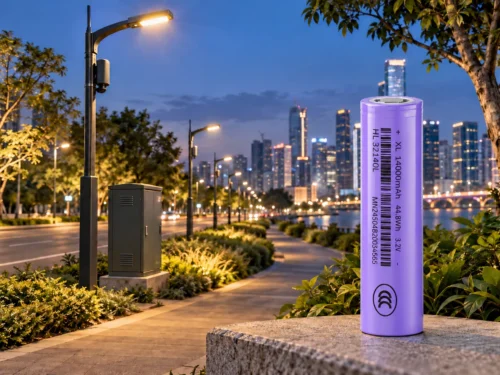
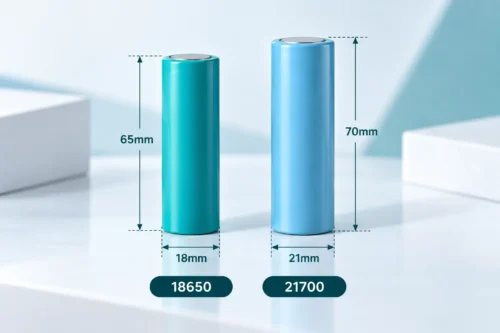
Although both are cylindrical lithium-ion cell formats, their differences in dimensions, energy storage, discharge performance, and pack integration can affect the entire battery system.
An 18650 battery measures approximately 18 mm in diameter and 65 mm in length, while a 21700 battery measures 21 mm in diameter and 70 mm in length. The larger 21700 format generally accommodates higher cell capacity, but it is not always the better choice.
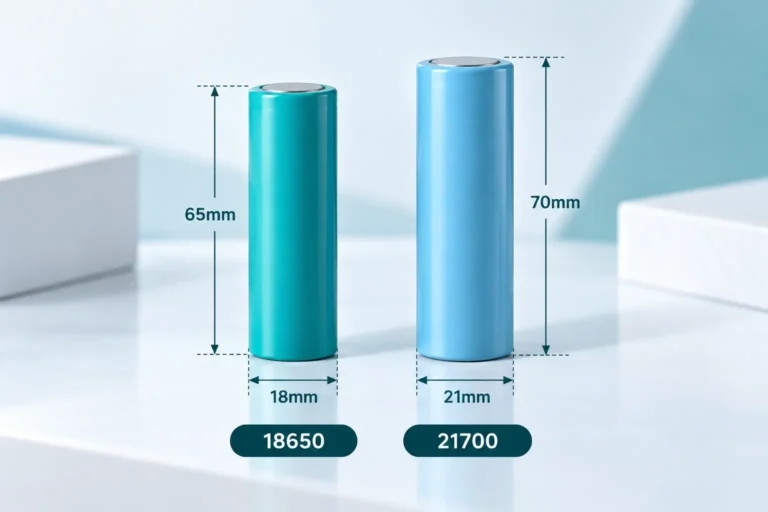
18650 vs 21700 Battery: Quick Comparison
| Specification | 18650 Battery | 21700 Battery |
| Nominal dimensions | 18 × 65 mm | 21 × 70 mm |
| Approximate cylindrical volume | 16.5 cm³ | 24.2 cm³ |
| Typical capacity | 2,000–3,500 mAh | 4,000–5,000 mAh |
| Nominal voltage | 3.6–3.7V | 3.6–3.7V |
| Typical cell weight | 43–50 g | 60–75 g |
| Continuous discharge current (reference) | 5–15A | 10–20A |
| Space requirement | Smaller | Larger |
| Common applications | Compact electronics, industrial IoT, legacy battery packs | High-energy portable equipment, power tools, industrial battery packs |
What Are 18650 and 21700 Batteries?
Both 18650 and 21700 refer to cylindrical cell formats, not specific battery chemistries.
The numerical designations indicate nominal cell dimensions:
- 18650 battery: Approximately 18 mm in diameter and 65 mm in length. Its smaller dimensions make it suitable for compact devices and established battery pack designs. (Read more about what is an 18650 battery.)
- 21700 battery: Approximately 21 mm in diameter and 70 mm in length. Its larger internal volume generally allows greater energy storage per cell.
Both formats are available with different lithium-ion chemistries and cell designs, including high-energy and high-power variants.
18650 vs 21700 Energy Density
Energy density describes how much energy a battery stores relative to its mass or volume.
- Gravimetric energy density (Wh/kg): Energy stored per unit mass.
- Volumetric energy density (Wh/L): Energy stored per unit volume.
A 21700 cell generally stores more total energy because of its larger size. However, it does not necessarily have higher energy density than every 18650 cell.
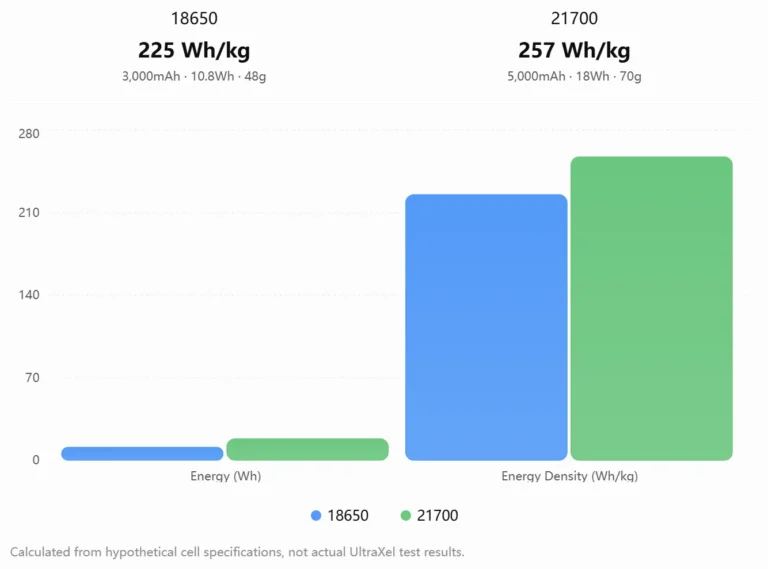
We take two hypothetical cells with the same nominal voltage:
| Parameter | Example 18650 | Example 21700 |
| Nominal capacity | 3,000 mAh | 5,000 mAh |
| Nominal voltage | 3.6V | 3.6V |
| Nominal energy | 10.8 Wh | 18.0 Wh |
| Assumed weight | 48 g | 70 g |
| Gravimetric energy density | 225 Wh/kg | 257 Wh/kg |
In this example, the 21700 stores approximately 67% more energy per cell, but its gravimetric energy density is only about 14% higher.
18650 vs 21700 Discharge Performance
A 21700 battery generally offers higher capacity per cell, but it does not always deliver higher discharge current or better power performance than an 18650 battery.
For example, a high-power 2,500mAh 18650 cell rated at 20A can deliver more continuous current than a high-energy 5,000mAh 21700 cell rated at 10A, despite having half the capacity. These are illustrative specifications, not universal ratings.
For industrial equipment with motors, startup surges, or intermittent high-current loads, engineers should prioritize continuous and peak discharge ratings, voltage sag under load, and thermal performance over nominal capacity alone.
21700 vs 18650 Battery Life
A 21700 battery generally provides longer runtime per charge due to its higher energy capacity. However, a larger cell does not necessarily offer longer cycle life or calendar life than an 18650 battery.
The following comparison illustrates the differences under equivalent operating conditions.
| Factor | 18650 Battery | 21700 Battery |
| Example capacity | 3,000 mAh | 5,000 mAh |
| Nominal energy (3.6V) | 10.8 Wh | 18.0 Wh |
| Theoretical runtime at 5W | 2.16 hours | 3.60 hours |
(Runtime values are theoretical estimates based on hypothetical cells and exclude conversion losses, voltage cutoff, and temperature effects.)
In this example, the 21700 cell provides approximately 67% longer theoretical runtime per charge. This can benefit industrial equipment where operating time between charging intervals is a priority.
However, an industrial-grade 18650 cell may outlast a high-capacity 21700 cell in repeated cycling, depending on chemistry, depth of discharge, charge voltage, and operating temperature.
Takeaway: Choose 21700 when higher energy per cell provides a meaningful runtime advantage. For applications prioritizing multi-year reliability, compare validated cycle-life and aging data rather than assuming the larger format lasts longer.
Which Battery Is Better for Different Applications?
For consumer devices, 18650 cells are commonly used in compact flashlights and portable electronics, while 21700 cells are often selected for higher-capacity flashlights and power tools with more space.
For industrial applications, they require a more detailed evaluation of cell performance and system integration.

GPS Trackers and Remote IoT Sensors
Recommended Format: 18650
18650 batteries are often preferred for compact GPS trackers and remote IoT sensors due to their smaller dimensions and flexible integration.

Outdoor Monitoring and Surveillance Systems
Recommended Format: Both
Both 18650 and 21700 batteries can support outdoor monitoring equipment and outdoor security cameras.
A wide-temperature 18650 may be preferable for compact devices operating in extreme cold, while a 21700 can provide higher energy per cell for systems requiring longer maintenance intervals.

Industrial Handheld and Portable Inspection Equipment
Recommended Format: 18650
18650 cells are suitable for compact handheld instruments, while 21700 cells are often preferable when longer runtime is required and sufficient installation space is available.
For portable inspection equipment, higher-capacity 21700 cells may also reduce the number of cells needed to meet the energy requirement.

Industrial Robotics and Backup Power Systems
Recommended Format: Both
For motor-driven equipment, high-power 18650 or 21700 cells should be selected according to continuous discharge current, peak loads, and thermal performance rather than capacity alone.
For industrial backup power, either format can be used depending on required backup duration, available enclosure space, and long-term reliability requirements.
18650 vs 21700: Does Size Affect Temperature Performance?
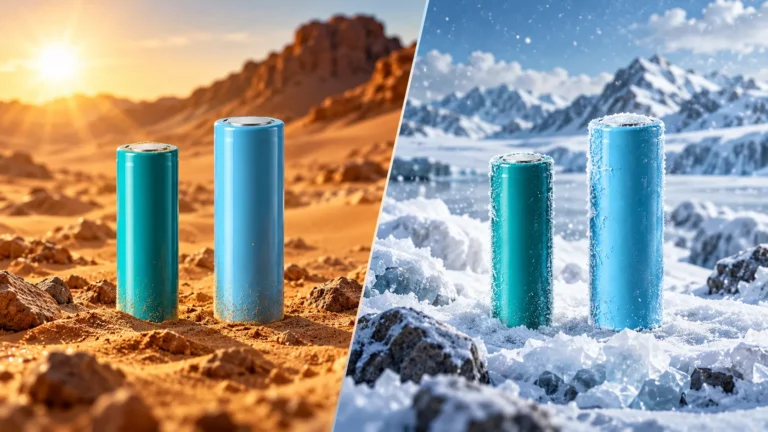
Battery size alone does not determine temperature performance. Although 21700 cells have more internal volume, their performance in extreme temperatures depends primarily on cell chemistry, electrolyte formulation, internal resistance, and cell design.
For industrial applications, a wide temperature 18650 cell may outperform a standard 21700 cell in cold or hot environments, despite having lower nominal capacity.
At low temperatures, increased internal resistance and slower electrochemical reactions reduce usable capacity and cause greater voltage sag under load.
For reliable comparison, engineers should evaluate actual discharge performance under equivalent test conditions.
| Test Parameter | Why It Matters |
| Capacity retention at -20°C / -40°C | Determines available capacity in cold conditions |
| Discharge voltage curve | Evaluates voltage sag and usable energy |
| Continuous and pulse discharge | Verifies performance under sustained and peak loads |
| Discharge cutoff voltage | Determines usable operating range |
Low-Temperature Charging Limitations
Charging limits differ from discharge limits. Many standard lithium-ion cells restrict charging below 0°C due to the risk of lithium plating.
Specialized low-temperature cells may support sub-zero charging under specified conditions, while other systems require preheating or charging protection.
A battery rated for discharge at -40°C is not necessarily suitable for charging at -40°C.
High-Temperature Performance and Reliability
Elevated temperatures can accelerate battery degradation, reduce cycle life, and affect long-term reliability.
For industrial equipment operating at 60°C or higher, engineers should evaluate high-temperature capacity retention, cycle life, voltage stability, and charging limits.
UltraXel offers low-temperature lithium battery solutions and high-temperature battery solutions for industrial equipment operating in demanding environments.
18650 vs 21700 Battery Pack Designs
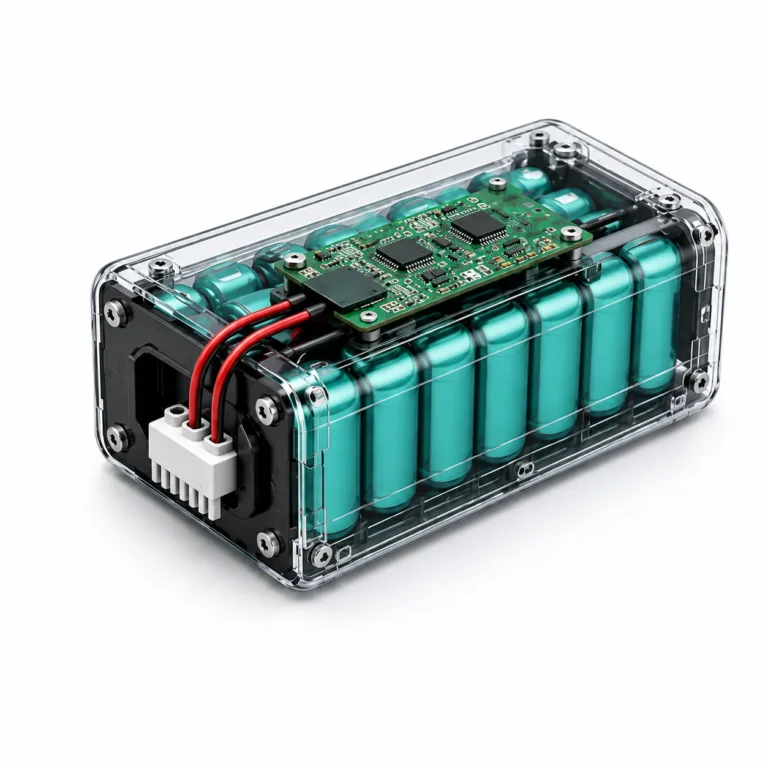
When designing a lithium-ion battery pack, choosing between 18650 and 21700 cells affects cell count, pack dimensions, current distribution, and mechanical integration.
A 21700 battery pack may require fewer cells to achieve the same nominal energy, but this does not necessarily result in a smaller or higher-performance pack.
Consider two battery packs designed to deliver 72Wh at a nominal voltage of 14.4V:
| Parameter | 18650 Battery Pack | 21700 Battery Pack |
| Cell capacity | 2,500mAh | 5,000mAh |
| Cell configuration | 4S2P | 4S1P |
| Total cells | 8 | 4 |
| Nominal pack voltage | 14.4V | 14.4V |
| Nominal pack capacity | 5Ah | 5Ah |
| Nominal energy | 72Wh | 72Wh |
| Current per cell at 10A pack load | 5A | 10A |
| Approx. total cell volume | 132cm³ | 169cm³ |
Although both packs provide the same nominal energy, the 21700 configuration uses 50% fewer cells, while the 18650 configuration distributes the load current across two parallel cells.
When to Choose an 18650 or 21700 Battery Pack
Choose an 18650 battery pack when:
- The enclosure has limited space or requires a flexible cell arrangement.
- Multiple parallel cells are beneficial for distributing high discharge currents.
- The equipment uses an existing 18650-based mechanical design.
Choose a 21700 battery pack when:
- Higher energy per cell can reduce cell count and assembly complexity.
- The enclosure can accommodate larger cylindrical cells.
- The selected 21700 cells meet the required pack current without excessive voltage sag or temperature rise.
For OEM battery projects, the final selection should compare usable pack energy, continuous and peak current capability, assembled dimensions, thermal performance, and integration requirements under the same operating conditions.
UltraXel Wide Temperature Battery Solutions
As temperature performance depends on cell design rather than size alone, selecting the right battery requires evaluating its capacity, discharge capability, and operating temperature.
UltraXel offers wide-temperature 18650 and 21700 lithium-ion battery solutions for industrial electronics, outdoor monitoring, and other demanding applications.
The following UltraXel 18650 models demonstrate different performance priorities:


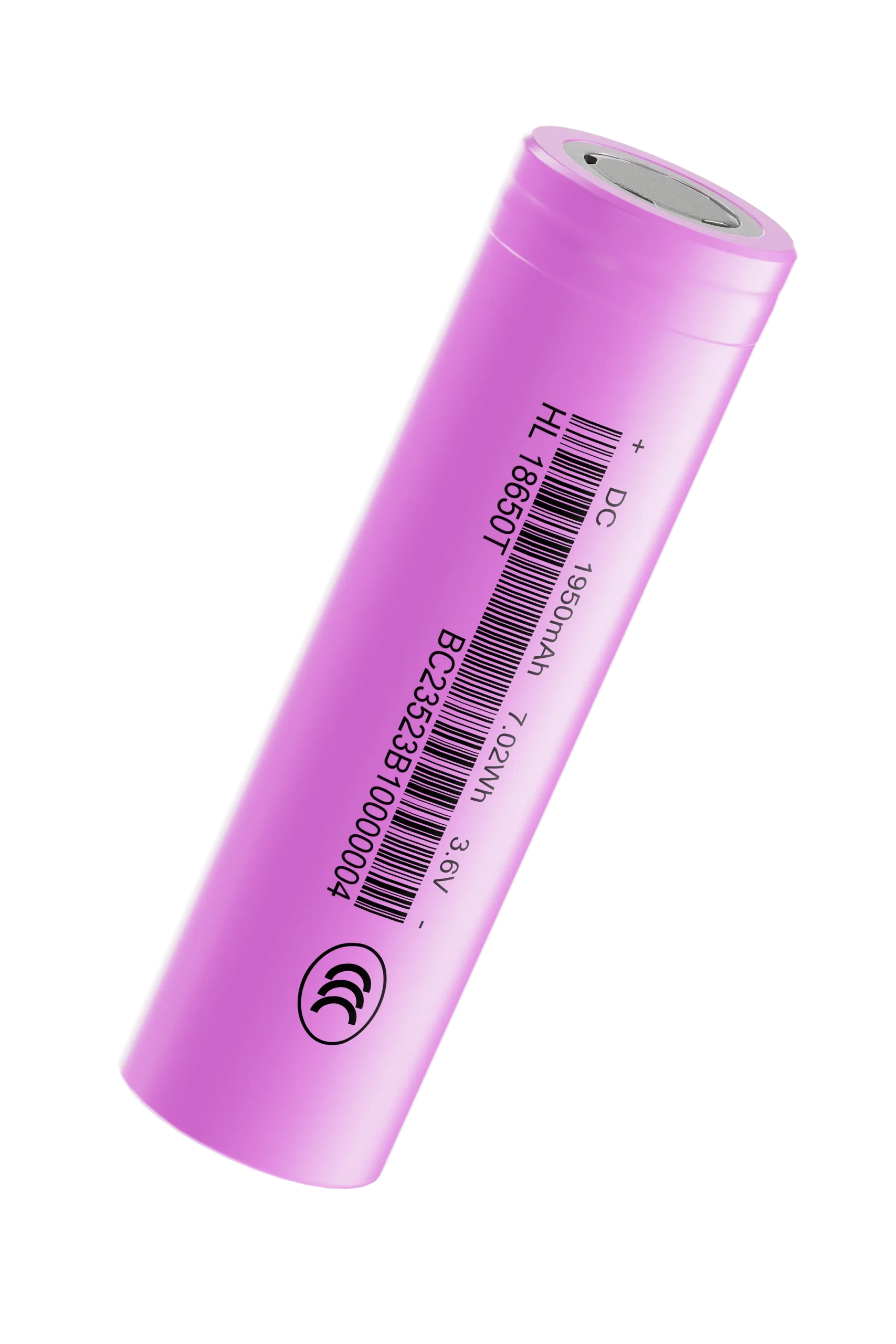
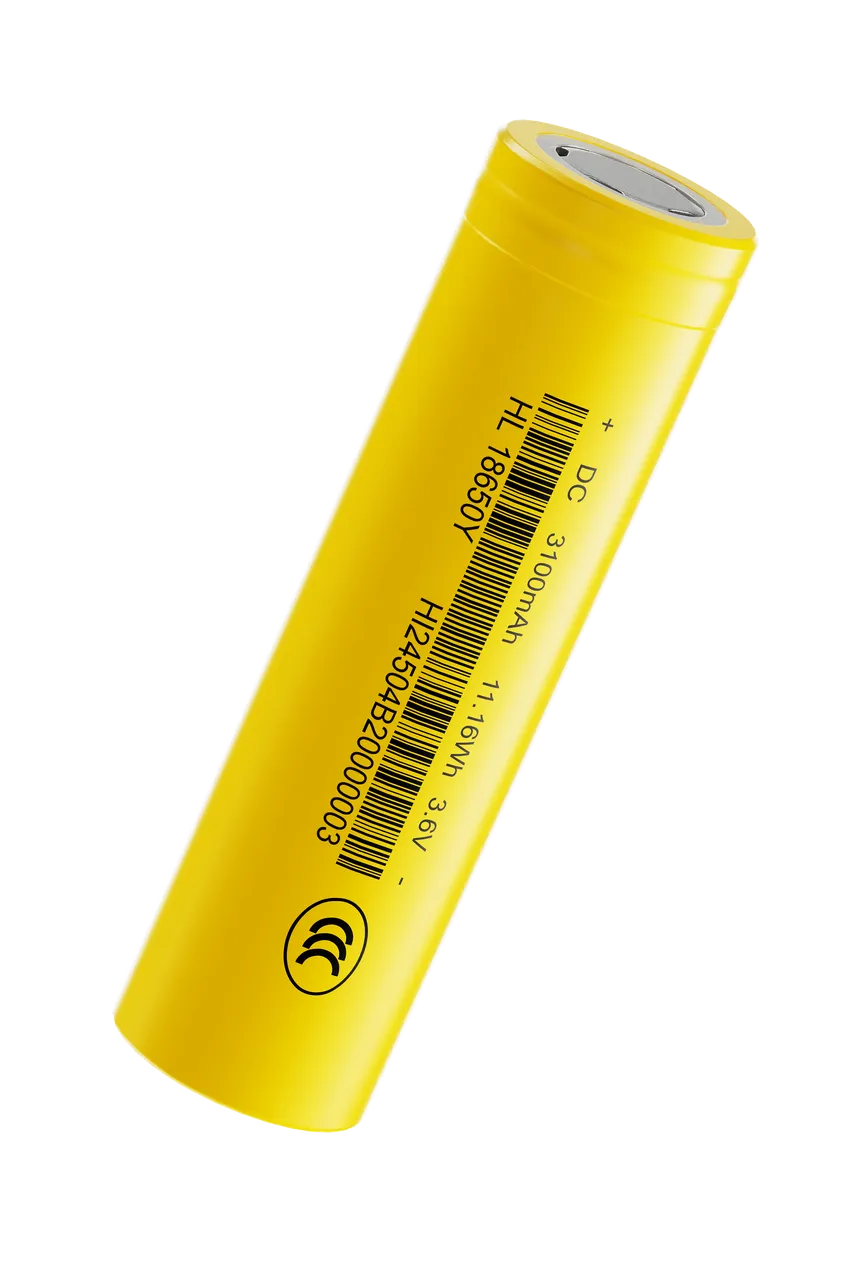
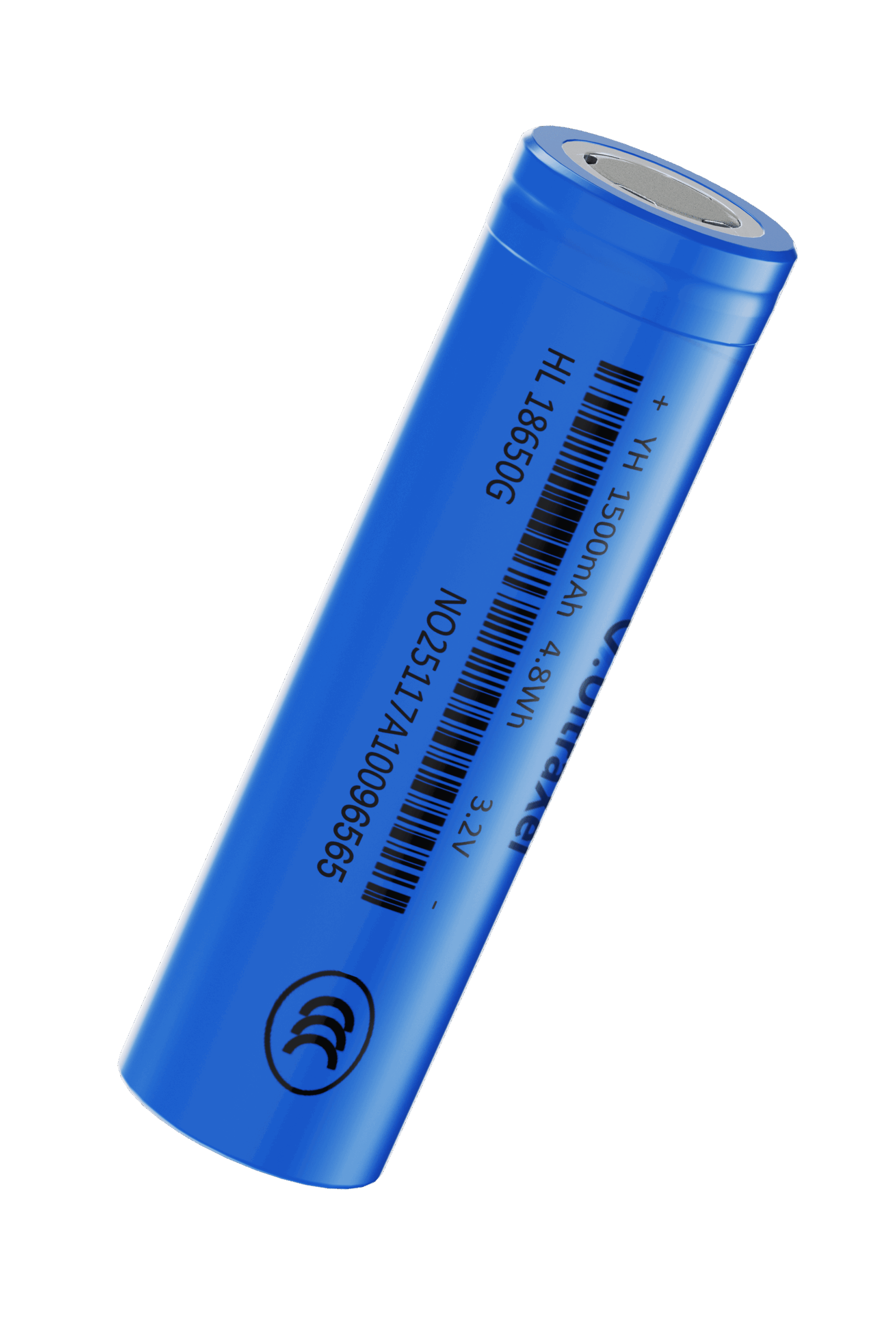
Discharge current and temperature ratings are subject to model-specific test conditions; charging temperature limits differ.
For applications requiring higher energy per cell, UltraXel’s 21700 battery options can also be evaluated based on capacity, discharge current, and temperature requirements.
Need help choosing between 18650 and 21700 batteries? Contact UltraXel and tell us your industrial application’s technical requirements. We will find the best wide-temp battery solution for you.
FAQ
Are 18650 and 21700 batteries interchangeable?
No. A 21700 battery is larger than an 18650 battery and cannot fit into a standard 18650 battery compartment. Even with an adapter, voltage, discharge current, and device compatibility must be verified.
Are 21700 batteries better than 18650?
Not necessarily. A 21700 battery generally offers higher capacity per cell, while an 18650 battery is smaller and may be better suited for compact devices. The better choice depends on power requirements, available space, and operating conditions.
Do 21700 batteries last longer than 18650 batteries?
A 21700 battery typically provides longer runtime per charge because of its higher capacity. However, actual runtime depends on discharge current, temperature, and device efficiency, while cycle life depends on cell chemistry and operating conditions.
Does a 21700 battery have a higher voltage than an 18650?
No. Most conventional lithium-ion 18650 and 21700 batteries have similar nominal voltages of 3.6V or 3.7V. The main differences are physical size and potential energy capacity, not nominal voltage.
Which battery is better for high-drain applications, 18650 or 21700?
Neither one is always better for high-drain applications. A high-discharge 18650 cell may deliver more current than a high-capacity 21700 cell, so engineers should compare continuous discharge ratings, internal resistance, and voltage stability under load.