For many conventional lithium-ion cells, the typical charging temperature range is 0°C to 45°C (32°F to 113°F), while the discharge temperature range is approximately -20°C to 60°C (-4°F to 140°F).
Specialized lithium-ion batteries may support lower or higher temperatures depending on their chemistry, cell design, and manufacturer specifications.
Understanding the lithium ion battery operating temperature range is important for equipment exposed to freezing conditions, elevated temperatures, or substantial seasonal temperature changes.
This guide explains the operating temperature range of lithium-ion battery, how temperature affects its performance, and which battery solutions may be suitable for demanding industrial environments.
What Is the Ideal Temperature Range of a Lithium-Ion Battery?
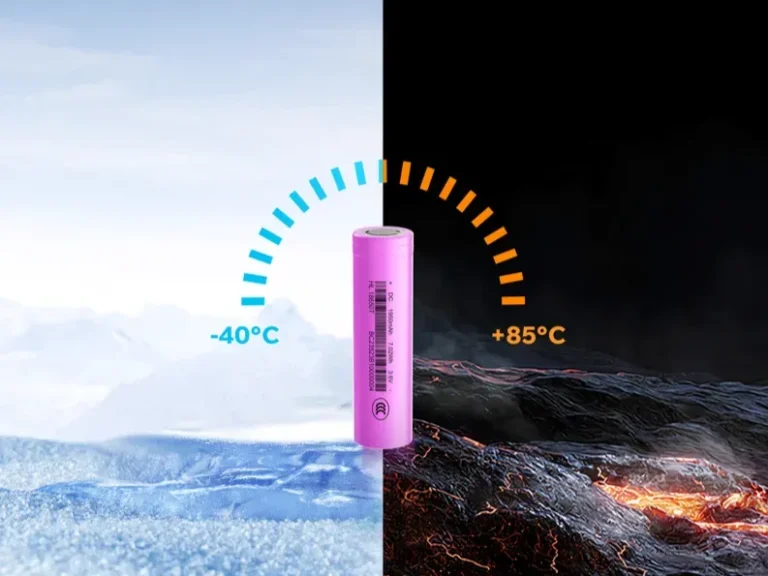
The lithium-ion battery operating temperature range defines the temperatures at which a battery can safely charge or discharge.
These limits vary by cell chemistry and design and do not necessarily represent the temperatures for optimal performance.
Typical Charging, Discharging, and Storage Temperature Ranges
| Operation | Typical Temperature Range | Key Considerations |
| Charging | 0°C to 45°C (32°F to 113°F) | Charging outside the specified range can increase degradation and safety risks. |
| Discharging | -20°C to 60°C (-4°F to 140°F) | Available capacity, voltage, and power capability vary with temperature. |
| Storage | Often around 15°C to 25°C (59°F to 77°F) for long-term storage | Cooler, dry, stable conditions and an appropriate state of charge generally support battery longevity. |
(Note: These are general reference values. Consult the cell manufacturer’s datasheet for rated charging, discharging, and storage limits.)
Charging typically has a narrower temperature range than discharging because the electrochemical processes involved in accepting lithium ions become more difficult at low temperatures.
At elevated temperatures, batteries may continue operating within their rated limits, but accelerated degradation can reduce their service life.
For demanding industrial applications, the operating temperature of the battery itself also matters. Ambient temperature and internal cell temperature are not always identical, particularly in enclosed equipment or systems with significant electrical loads.
Operating Temperature vs. Optimal Temperature
The operating temperature range defines the conditions under which a battery is permitted to function according to its specifications.
The optimal temperature range refers to conditions that provide a favorable balance of capacity, power capability, efficiency, and long-term durability.
For many conventional lithium-ion batteries, moderate temperatures around 20°C to 25°C (68°F to 77°F) provide a useful reference point for performance evaluation.
However, the optimal temperature can vary with battery chemistry, charging rate, discharge load, and intended service life.
For example, a battery rated for discharge at -20°C may still deliver considerably less usable capacity than it does at room temperature.
Similarly, a battery rated for operation at 60°C may experience faster aging when repeatedly exposed to elevated temperatures.
How Does Temperature Affect Lithium-Ion Battery Performance?
Temperature directly affects lithium-ion battery capacity, voltage, power output, and lifespan. Low temperatures increase internal resistance and reduce usable energy, while prolonged exposure to high temperatures accelerates battery aging.
Low-Temperature Effects on Capacity and Voltage
As temperature drops, lithium-ion movement slows and internal resistance increases, reducing the energy a battery can deliver under load.
Battery University provides the following approximate low-temperature capacity figures for an 18650 lithium-ion cell:
| Temperature | Approx. Available Capacity | Capacity Reduction vs. 25°C |
| 25°C (77°F) | 100% | Reference |
| 0°C (32°F) | 83% | 17% |
| -10°C (14°F) | 66% | 34% |
| -20°C (-4°F) | 53% | 47% |
Source: Battery University, BU-501a, Discharge Characteristics of Li-ion.
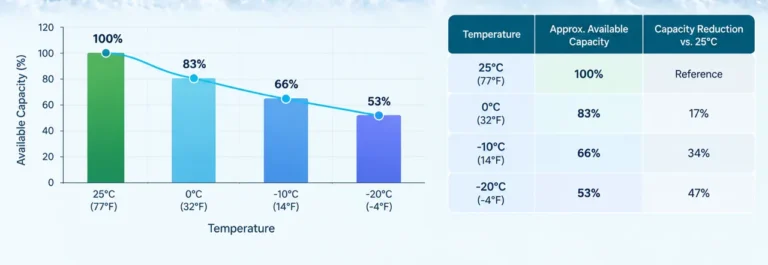
At -20°C, the referenced cell delivers approximately 53% of its room-temperature capacity under the reported test conditions. This means a device may have substantially less usable runtime even when the battery is fully charged.
Low temperatures also increase voltage sag during high-current discharge. For example, an outdoor IoT device may operate normally at low standby current but reach its cutoff voltage prematurely when its communication module draws a peak current.
For industrial applications, both capacity retention and discharge voltage under load should be evaluated at the lowest expected operating temperature.
High-Temperature Effects on Battery Life and Safety
High temperatures may temporarily reduce internal resistance, but prolonged heat exposure accelerates chemical degradation and permanent capacity loss.
Battery University provides estimated remaining capacity figures for cobalt-based lithium-ion batteries stored at different temperatures and states of charge:
| Temperature | Remaining Capacity at 40% SOC | Remaining Capacity at 100% SOC |
| 25°C (77°F) | 96% after 1 year | 80% after 1 year |
| 40°C (104°F) | 85% after 1 year | 65% after 1 year |
| 60°C (140°F) | 75% after 1 year | 60% after 3 months |
Source: Battery University, BU-808, How to Prolong Lithium-based Batteries.
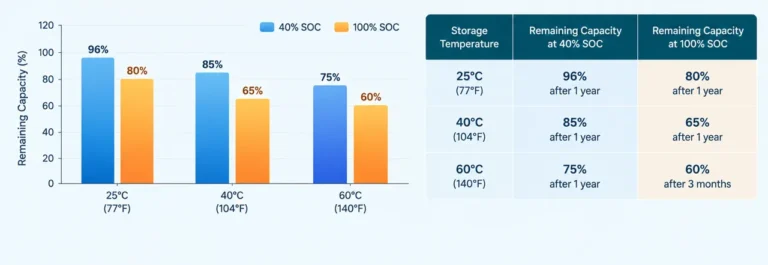
At 40°C and 100% state of charge, the estimated remaining capacity after one year is only 65%, compared with 80% at 25°C. This illustrates how elevated temperature and high state of charge can accelerate calendar aging.
Sustained heat exposure can also cause:
- Higher internal resistance over time: Electrolyte decomposition and electrode-interface degradation reduce long-term performance.
- Shorter service life: Elevated temperatures accelerate aging, particularly during repeated cycling or prolonged storage.
- Increased safety risk: Excessive temperatures, especially when combined with electrical abuse or internal defects, can increase the risk of thermal runaway.
For example, an outdoor monitoring device installed in a sealed enclosure may experience cell temperatures above the surrounding air temperature because of direct sunlight and internal heat.
Therefore, industrial battery systems should be evaluated using the actual cell temperature, not ambient temperature alone.
Charging vs. Discharging: Why Are their Temperature Limits Different?
Lithium-ion batteries generally have a narrower charging temperature range than discharging range. For many conventional cells, charging is typically limited to 0°C–45°C (32°F–113°F), while discharging may be permitted from -20°C to 60°C (-4°F to 140°F).
These differences arise because charging and discharging involve different electrochemical conditions and temperature-related risks.
Low-Temperature Charging and Discharging
Below 0°C, slower lithium-ion transport and charge-transfer reactions make it difficult for lithium ions to enter the graphite anode during charging. Instead, metallic lithium may deposit on the anode surface, a process known as lithium plating.
Lithium plating can cause permanent capacity loss, accelerated degradation, and increased safety risks. The likelihood depends on temperature, charging current, state of charge, and cell design.
During discharge, lithium ions move away from the graphite anode, so the same lithium-plating mechanism is not normally the limiting factor. This is why many conventional cells can discharge at -20°C but cannot be charged at that temperature.
Specialized low-temperature cells may support sub-zero charging under manufacturer-specified conditions.
High-Temperature Charging and Discharging
At elevated temperatures, charging can accelerate unwanted chemical reactions, including electrolyte decomposition and degradation of electrode interfaces. These effects become more significant at high states of charge and can reduce battery lifespan and increase safety risks.
For this reason, many conventional lithium-ion cells limit charging to approximately 45°C, even when discharging is permitted up to 60°C.
Discharging at higher temperatures may be allowed because it does not involve the same charging-related conditions. However, heat generated during discharge can further raise the internal cell temperature, potentially exceeding its rated limits.
Therefore, a higher maximum discharge temperature does not mean the battery can operate continuously at full power or charge safely at that temperature.
Do Different Lithium-Ion Batteries Have Different Temperature Ranges?
Yes. Lithium-ion batteries do not all share the same operating temperature limits.
Temperature performance varies with cell chemistry, electrolyte composition, electrode materials, internal construction, and application-specific design.
Temperature Differences Across Lithium-Ion Chemistries
Different lithium-ion chemistries can exhibit different temperature-related characteristics.
Common examples include lithium iron phosphate (LFP), lithium nickel manganese cobalt oxide (NMC), and lithium cobalt oxide (LCO).
| Battery Chemistry | General Characteristics | Temperature-Related Considerations |
| LFP | Strong thermal stability and long cycle-life potential | Low-temperature charging and power limitations still require attention |
| NMC | High energy density and versatile performance | Temperature affects aging, safety margins, and available power |
| LCO | High energy density, commonly used in compact electronics | Requires appropriate thermal and charging control |
Standard vs. Wide-Temperature Lithium-Ion Cells
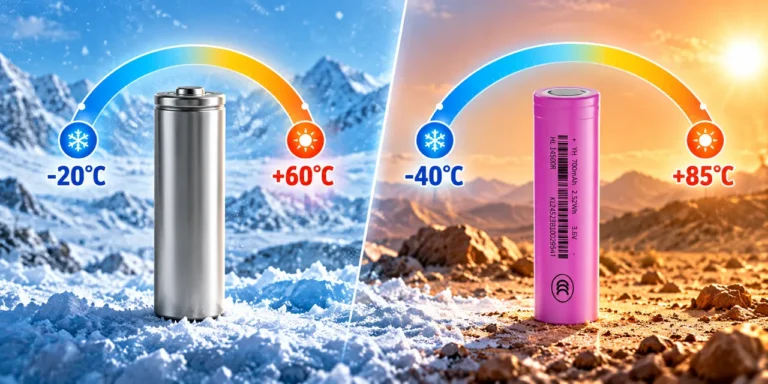
| Feature | Standard Lithium-Ion Cells | UltraXel Wide-Temperature Cells |
| Primary design objective | General-purpose energy storage | Reliable operation in extreme-temperature industrial environments |
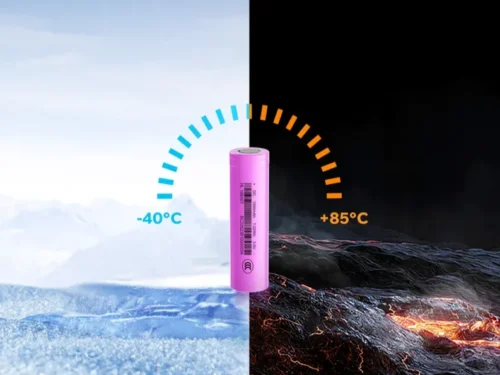
| Discharge Temperature Range | -20°C to +60°C | -40°C to +85°C |
| Typical applications | Consumer electronics and general devices | Automotive electronics, outdoor IoT, industrial monitoring, and security systems |
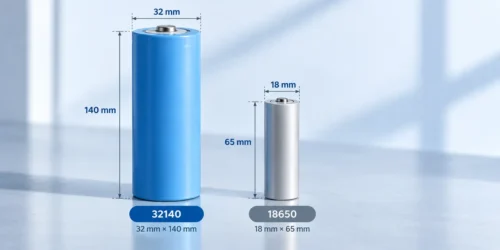
| Engineering considerations | Standard operating requirements | Wide-temperature 14500, 18650, 21700, 32140, and custom battery packs |
Conventional lithium-ion cells are generally designed to balance energy density, cost, cycle life, and performance under common operating conditions.
Specialized wide-temperature lithium-ion cells maintain acceptable operation over more demanding temperature ranges.
UltraXel Lithium-Ion Battery Solutions for Wide-Temperature Applications
UltraXel provides wide-temperature lithium-ion battery solutions for industrial equipment. (Read more about our wide temperature lithium battery guide.)
Low-Temperature Lithium-Ion Batteries for Cold Environments

For outdoor sensors, remote monitoring systems, and industrial equipment operating in freezing conditions, UltraXel offers the HL18650V Cold Weather 18650 Battery, for applications requiring reliable power in low-temperature environments.
| Feature | UltraXel HL18650V |
| Battery Type | Low-temperature 18650 lithium-ion cell |
| Key Benefits | Cold-weather discharge capability and improved power reliability |
| Typical Applications | Outdoor sensors, remote monitoring, cold-chain equipment, and industrial IoT |
High-Temperature Lithium-Ion Batteries for Hot Environments

For outdoor monitoring systems, solar-powered equipment, and industrial devices in high temperatures, UltraXel offers the HL18650T High Temperature Lithium Battery.
| Feature | UltraXel HL18650T |
| Battery Type | High-temperature 18650 lithium-ion cell |
| Key Benefits | High-temperature discharge capability and reliable power delivery in hot environments |
| Typical Applications | Outdoor industrial monitoring, solar-powered communication equipment, and industrial control systems |
Wide-Temperature Lithium-Ion Batteries for Industrial Equipment
For industrial equipment exposed to extreme cold and heat, UltraXel offers wide-temperature 18650 batteries designed for different power requirements.
| Application Requirement | Recommended UltraXel Battery | Key Specifications & Benefits | Typical Applications |
| High Discharge | HL18650F | 30A continuous discharge, 3000mAh capacity, -40°C to +85°C operation | Industrial power tools, robotics, outdoor surveillance |
| Long Cycle Life | HL18650G | 1500+ cycles, LiFePO4 chemistry, -40°C to +85°C operation | Remote monitoring, industrial IoT, solar-powered equipment |
| High Capacity | HL18650Y | 3200mAh capacity, approximately 70% capacity retention at -40°C, -40°C to +85°C operation | GPS tracking, outdoor data loggers, portable industrial devices |
For customized wide-temperature battery packs, UltraXel can support cell selection, voltage and capacity configuration, and PCM/BMS integration based on specific application requirements.
Need a Battery Solution for Extreme Temperatures?
FAQ
What is the ideal operating temperature for a lithium-ion battery?
For many conventional lithium-ion batteries, moderate temperatures around 20°C to 25°C (68°F to 77°F) provide favorable conditions for performance and longevity.
Can a lithium-ion battery operate below 0°C?
Yes. Many lithium-ion batteries can discharge below 0°C, with some conventional cells rated for discharge down to approximately -20°C.
Can lithium-ion batteries be charged below freezing?
Most conventional lithium-ion cells restrict charging below 0°C because low-temperature charging can cause lithium plating and permanent degradation. Some specialized low-temperature cells support sub-zero charging under specified conditions. Follow the manufacturer’s approved temperature and charging-current limits.
Can lithium-ion batteries work at -40°C?
Some specially engineered low-temperature lithium-ion cells can discharge at -40°C (-40°F), but this capability is not typical of standard cells. Their usable capacity and power output may be significantly reduced, and charging at that temperature is a separate requirement.
What temperature is safe for storing lithium-ion batteries?
For long-term storage, a cool, dry, stable environment around 15°C to 25°C (59°F to 77°F) is often recommended, together with an appropriate partial state of charge. Avoid prolonged exposure to excessive heat and follow the manufacturer’s storage temperature and maintenance instructions.