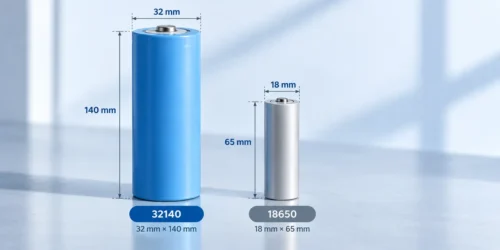
When comparing a 32140 vs 18650 battery, the most noticeable difference is their physical size. A 32140 cell is larger and generally offers more energy per cell, while an 18650 battery is smaller and provides greater flexibility for compact devices and battery pack designs.
Size is only part of the comparison. Battery chemistry, nominal voltage, discharge current, cycle life, operating temperature, and system requirements all influence which battery is better for an application.
For example, a 32140 LiFePO4 battery is suitable for high-capacity industrial power systems, while a specialized 18650 battery is better for compact equipment operating in extreme environments.
This guide compares the key differences between 32140 and 18650 batteries, explains their pros and cons, and helps engineers and OEM buyers select suitable cells for their applications.
32140 vs 18650 Battery: Quick Comparison
The following table summarizes the main differences between the two cylindrical battery formats.
| Feature | 32140 Battery | 18650 Battery |
| Nominal Dimensions | 32 mm diameter × 140 mm length | 18 mm diameter × 65 mm length |
| Common Chemistry | Primarily LiFePO4; other chemistries may be available | NMC, NCA, LiFePO4 |
| Typical Weight | Approx. 275–320g (LFP) | Approx. 39–50g |
| Nominal Voltage | 3.2V (LFP); typically 3.6–3.7V for certain NMC variants | 3.2V (LFP); 3.6–3.7V (NMC/NCA) |
| Typical Capacity | 12.5–17.5Ah (LFP) | 1.5–3.5Ah |
| Nominal Energy | Approx. 40–56Wh (LFP) | Approx. 4.8–12.6Wh |
| Cycle Life (to 80% Capacity) | Often 2,000–3,500+ cycles (LFP) | Approx. 300–1,000+ (NMC/NCA); 1,000–3,500+ (LFP) |
| Pack Design | Fewer cells may be needed for a given energy requirement | Flexible arrangement in compact or irregular spaces |
| Typical Applications | Industrial energy storage, solar lighting, larger power systems | Portable equipment, monitoring devices, automotive electronics |
| Main Advantage | High energy capacity per cell | Compact size and broad model selection |
Note:Values are illustrative ranges based on selected commercially available cells, not universal specifications.
What Is a 32140 Battery?

A 32140 battery is a cylindrical rechargeable cell with a nominal diameter of approximately 32 mm and a length of 140 mm.
Its larger internal volume allows manufacturers to accommodate more active material, potentially providing higher capacity and energy per cell.
Many commercially available 32140 batteries use lithium iron phosphate (LiFePO4 or LFP) chemistry. Other chemistries, including sodium-ion, LTO, and NMC, may also be used.
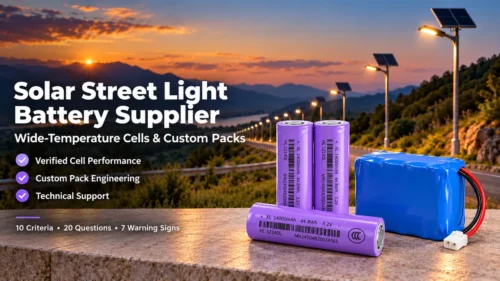
Its relatively high capacity makes it a potential option for solar-powered equipment, industrial monitoring systems, and larger rechargeable battery packs.
Pros and Cons of 32140 Batteries
| Pros | Cons |
| Higher capacity and energy per cell | Larger dimensions |
| Fewer cells and interconnections for a given battery pack energy requirement | Greater individual cell weight |
| Suitable for applications where larger cylindrical cells can be accommodated | Reduced flexibility in equipment with limited installation space |
What Is an 18650 Battery?
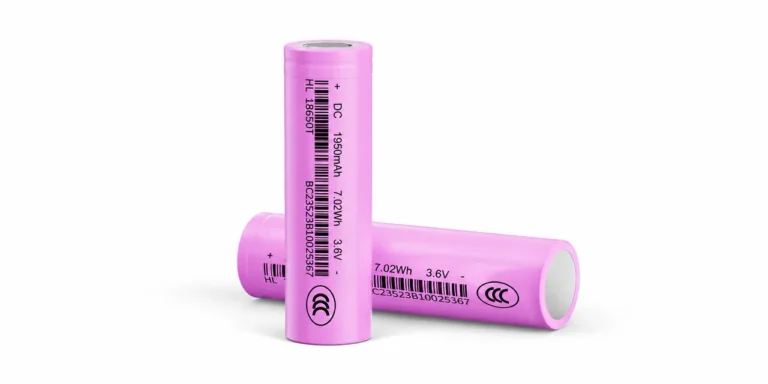
An 18650 battery is a cylindrical rechargeable lithium-ion cell measuring approximately 18 mm in diameter and 65 mm in length.
It is one of the most widely used cylindrical lithium-ion battery formats, appearing in portable electronics, industrial equipment, battery packs, monitoring systems, and backup power applications.
Unlike a battery designation that specifies chemistry, the term 18650 only identifies the cell’s physical format.
18650 batteries are available in several chemistries, including NMC/NCM, NCA, and LiFePO4. Their capacity, voltage, power capability, and cycle life vary accordingly.
This variety makes the 18650 format particularly useful when engineers need to balance size, energy requirements, environmental conditions, and battery pack configuration.
Pros and Cons of 18650 Batteries
| Pros | Cons |
| Compact and lightweight | Lower energy per cell when compared with 32140 |
| Flexible pack configurations | More cells for high-capacity systems |
| Wide chemistry and specialized model selection | Model-dependent performance |
5 Key Differences Between 32140 and 18650 Batteries
Although both batteries share a cylindrical design, their differences become more significant when evaluated at the cell and battery pack levels.
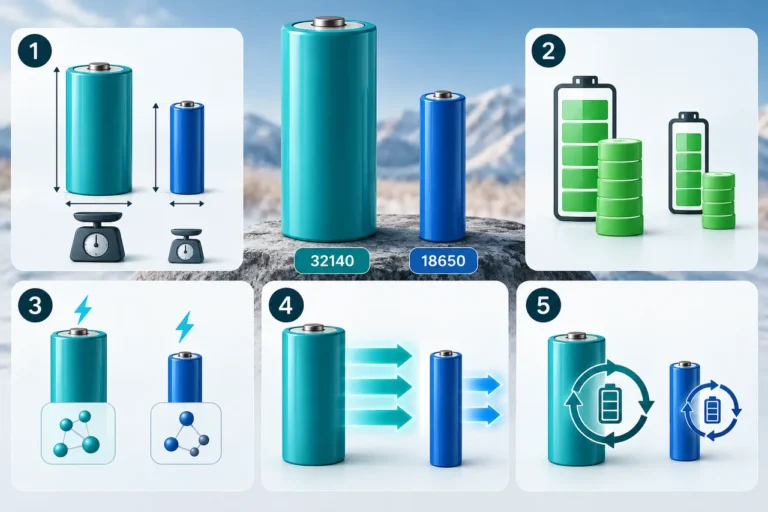
1. Size and Weight
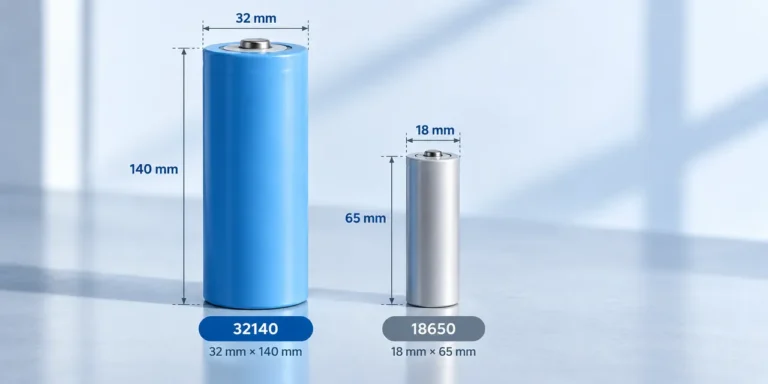
A 32140 cell has a nominal diameter of 32 mm and length of 140 mm, compared with 18 mm and 65 mm for an 18650 cell.
A 32140 cell occupies approximately 6.8 times the external geometric volume of an 18650 cell, based on their nominal dimensions. Its larger size generally allows for greater energy storage per cell but also increases individual cell weight.
For high-capacity battery packs, 32140 cells may reduce the number of cells and interconnections required. In contrast, the smaller 18650 format offers greater flexibility for compact devices and irregularly shaped battery compartments.
Choose 32140 when high energy per cell is important and sufficient installation space is available. Consider 18650 when compact dimensions, flexible packaging, or distributed cell arrangements are priorities.
2. Capacity and Energy Output
Because 32140 batteries are physically larger, they generally offer higher capacity per cell than 18650 batteries.
Comparing batteries with different nominal voltages requires converting capacity into watt-hours (Wh).
Take three UltraXel battery models for example:
| Battery Model | Chemistry | Nominal Voltage | Capacity | Nominal Energy |
| HL32140L | LiFePO4 | 3.2V | 15,000mAh | 48Wh |
| HL18650G | LiFePO4 | 3.2V | 1,600mAh | 5.12Wh |
| HL18650Y | NCM | 3.6V | 3,200mAh | 11.52Wh |
Based on these nominal specifications, one HL32140L stores approximately 9.4 times the energy of an HL18650G and 4.2 times that of an HL18650Y. (These are not necessarily energy density or actual runtime under load.)
A larger cell may store more energy overall while having lower energy per kilogram or per liter than a smaller cell using a different chemistry.
Actual usable energy also depends on discharge current, temperature, cutoff voltage, and cell aging.
3. Voltage and Battery Chemistry
32140 batteries commonly use LiFePO4 chemistry, but other chemistries, such as sodium-ion, LTO, and NMC, may also be available.
Similarly, 18650 batteries can use LiFePO4, NMC, NCA, and other compatible lithium-ion chemistries.
LiFePO4 cells typically operate at 3.2V, offering good thermal stability and long cycle life, while NMC/NCA cells typically operate at 3.6–3.7V and generally provide higher energy density.
Different chemistries require different charging and protection settings. 32140 and 18650 cells should not be considered directly interchangeable without verifying electrical compatibility.
4. Discharge Current and Power Capability
Discharge capability determines how much current a battery can safely deliver, particularly for industrial equipment with high startup or peak power demands.
Two key specifications are continuous discharge current (sustained output) and peak discharge current (short-duration output). Power capability is also expressed as C-rate. For example, at 1C, a 15Ah cell delivers 15A, while a 3Ah cell delivers 3A.
Although 32140 cells generally have higher capacity, a larger cell does not necessarily offer a higher C-rate or better power performance.
5. Cycle Life and Long-Term Reliability
A 32140 battery does not necessarily last longer than an 18650 battery.
For example, UltraXel’s HL32140L (LiFePO4) is rated for 2,000+ cycles, while the HL18650G (LiFePO4) offers about 1,500+ cycle life in a smaller format. These ratings depend on specific test conditions and should not be treated as universal values for either battery size.
Beyond chemistry, depth of discharge, charging rates, and operating temperature also affect battery longevity. Temperature is particularly important for batteries used in outdoor and industrial environments.
How Do 32140 and 18650 Batteries Perform in Extreme Temperatures?
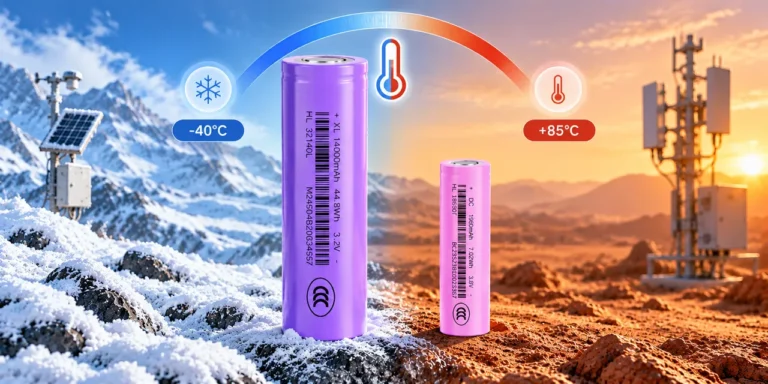
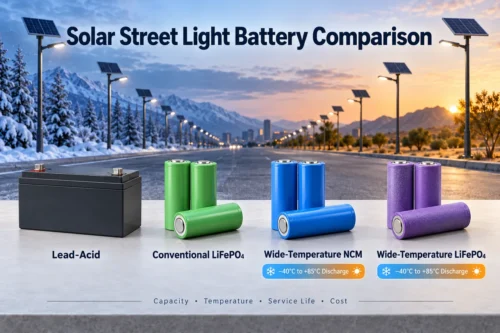
Standard 32140 and 18650 batteries are not superior in extreme temperatures. Actual performance depends on cell chemistry, internal design, and temperature ratings, rather than size alone.
For industrial applications, specialized cells in both formats can support operation beyond the limits of conventional lithium-ion batteries.
| Temperature Factor | 32140 Battery | 18650 Battery |
| Low-Temperature Discharge | Wide-temperature LFP models, such as UltraXel HL32140L, support discharge down to −40°C. | Specialized low-temperature models, such as HL18650V, are ideal for sub-zero operation. |
| Low-Temperature Charging | HL32140L specifies charging down to −20°C under defined conditions. | Conventional cells often restrict charging below 0°C. |
| High-Temperature Discharge | HL32140L supports discharge up to +80°C. | UltraXel high temperature batteries support discharge up to +85°C. |
| High-Temperature Reliability | LFP chemistry offers favorable thermal stability, but long-term performance needs spcialized batteries. | Specialized models such as HL18650T target high-temperature standby applications. |
32140 vs 18650: Which Is Better for Your Application?
The following table provides general selection guidance for common industrial applications.
| Application | Recommended Format | Main Consideration |
|---|---|---|
|
Solar Street Lighting

|
32140 | Higher energy per cell and cycle-life requirements |
|
Outdoor Monitoring Stations

|
32140 or 18650 | Runtime, environmental temperature, and installation space |
|
GPS Tracking Devices
|
18650 | Compact size and energy requirements |
|
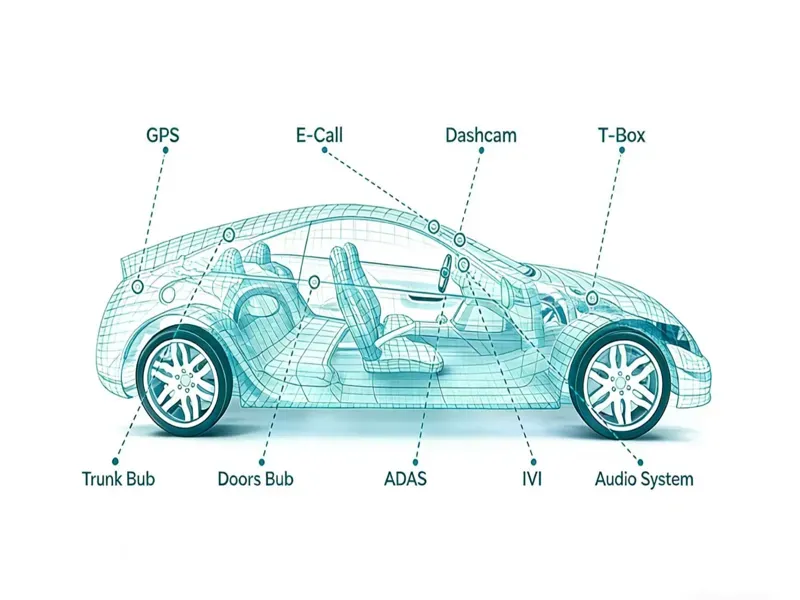
Automotive Electronics
|
Specialized 18650 | Temperature resistance and standby reliability |
|
AGV and AMR Equipment

|
Application-specific battery pack | Power demand, total energy, weight, and packaging |
|
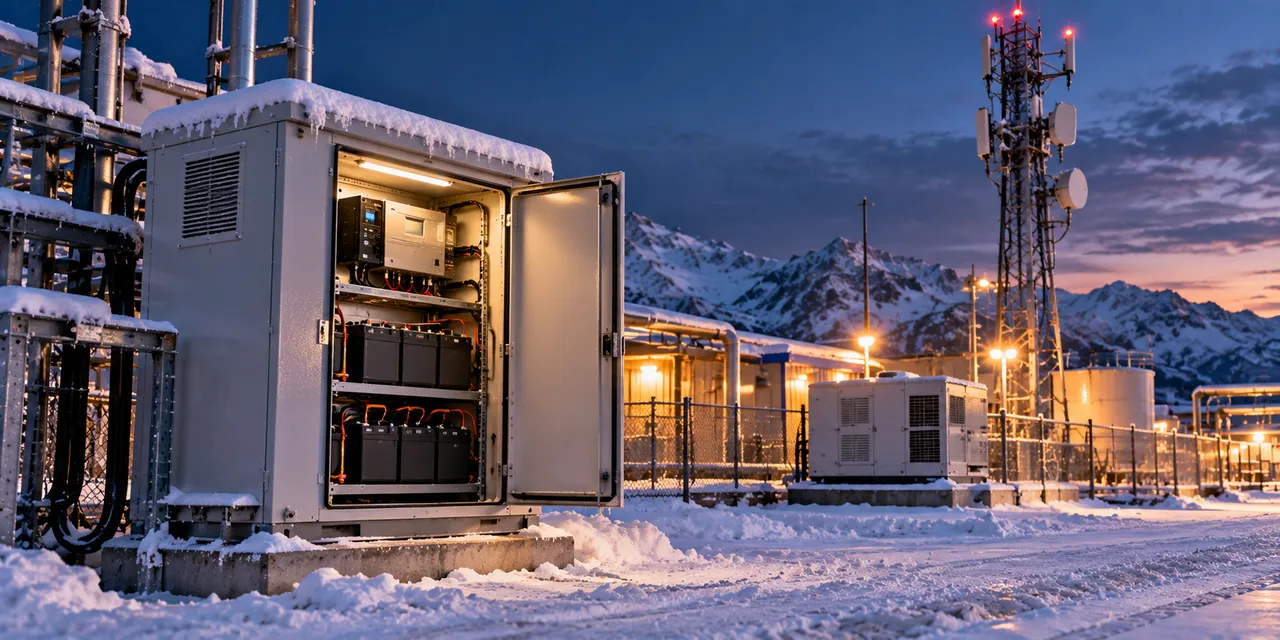
Industrial Backup Power
|
32140 or 18650 | Standby life, temperature, and system voltage |
|
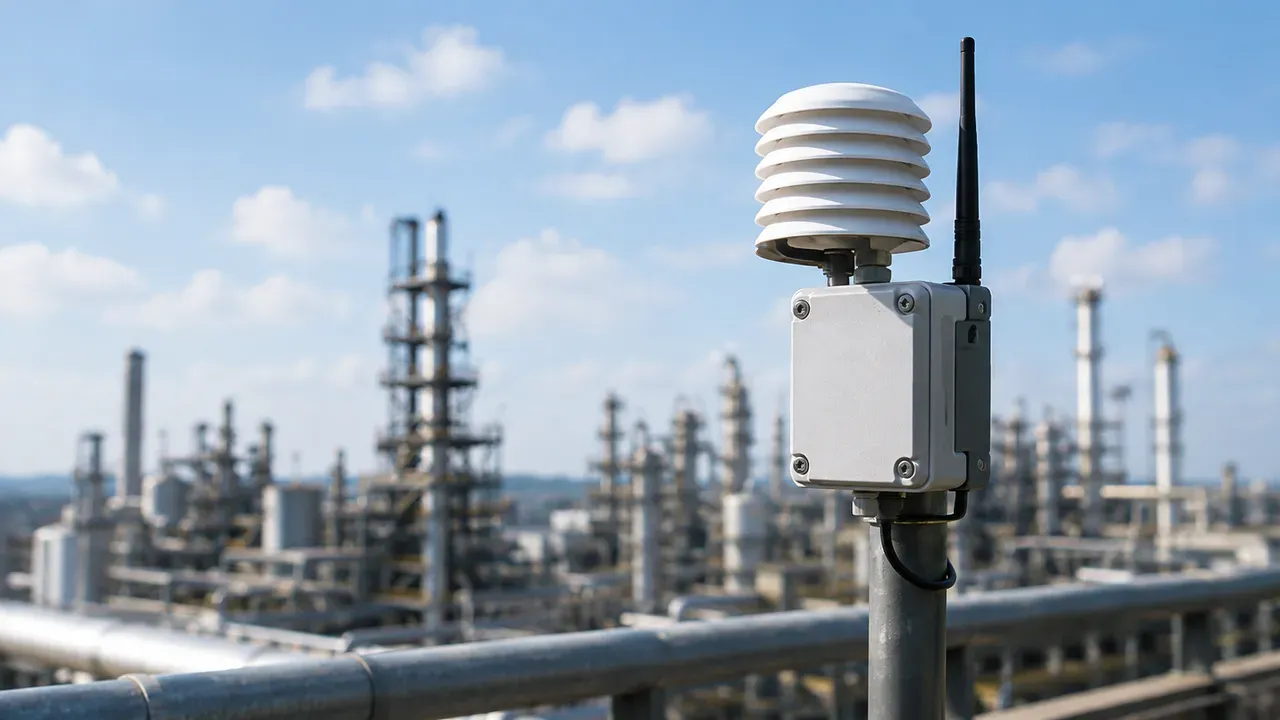
Remote Industrial Sensors
|
Specialized 18650 | Compact size, environmental conditions, and load profile |
UltraXel 32140 and 18650 Wide Temperature Battery Solutions
Different industrial applications require different combinations of capacity, voltage, temperature performance, and physical dimensions.
UltraXel provides both 32140 and 18650 cylindrical wide temperature lithium battery options for these requirements.
The following models illustrate how different UltraXel’s cells can address different application priorities.
| UltraXel Model | Chemistry | Key Advantage | Potential Applications |
| HL32140L | LiFePO4 | 15Ah capacity, wide-temperature operation, long cycle life | Solar lighting, industrial energy systems |
| HL18650G | LiFePO4 | Long cycle life in a compact cylindrical format | Industrial IoT, remote monitoring |
| HL18650Y | NCM | 3,200mAh capacity in an 18650 format | Portable industrial equipment |
| HL18650V | NCM | Low-temperature-focused design | Outdoor sensors, cold-weather monitoring |
| HL18650T | NCM | High-temperature standby performance | Automotive electronics, industrial monitoring, backup systems |
Need Help Choosing Between 32140 and 18650 Batteries?
FAQ
Is a 32140 battery better than an 18650 battery?
Not necessarily. A 32140 battery generally provides higher capacity and energy per cell, while an 18650 offers a more compact size and greater packaging flexibility.
How much capacity does a 32140 battery have?
Capacity varies by chemistry and manufacturer. For example, UltraXel’s HL32140L LiFePO4 battery has a nominal capacity of 15,000mAh at 3.2V, equivalent to 48Wh of nominal energy. Other 32140 models may have different capacities and voltages.
Can I replace an 18650 battery with a 32140 battery?
A 32140 battery is not a direct physical replacement for an 18650 because of its significantly larger dimensions. Electrical compatibility must also be checked, including nominal voltage, charging limits, battery chemistry, discharge requirements, and protection circuitry.
Which lasts longer, 32140 or 18650?
A higher-energy 32140 cell may provide longer runtime under comparable conditions. For longer cycle life, it depends mainly on battery chemistry, cell design, and operating conditions.
Is a 32140 battery always LiFePO4?
No. Although LiFePO4 is commonly used in 32140 batteries, the 32140 designation refers to physical dimensions rather than chemistry. Other lithium-ion chemistries may also be used.