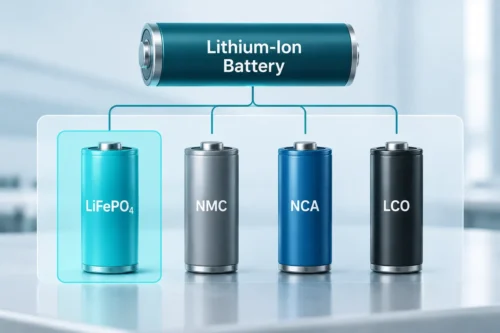
LiFePO4 (LFP) is a type of lithium-ion battery, but it differs from other lithium-ion chemistries in several ways. Compared with common nickel-based lithium-ion batteries, such as NMC and NCA, LiFePO4 generally offers longer cycle life, higher thermal stability, and lower cathode material costs.
This guide compares LiFePO4 vs lithium-ion batteries across the most important performance factors, explains their advantages and limitations, and provides practical guidance for selecting batteries for industrial and wide-temperature applications.
Is LiFePO4 a Type of Lithium-Ion Battery?
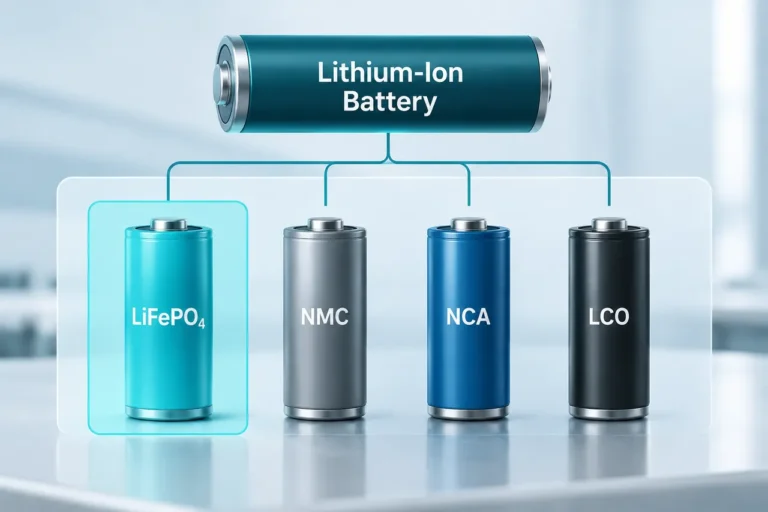
Yes. Lithium iron phosphate (LiFePO4 or LFP) is one of several lithium-ion battery chemistries. It is not a separate category of rechargeable battery.
Common lithium-ion cathode chemistries include:
| Battery chemistry | Cathode material | Typical characteristics |
| LFP (LiFePO4) | Lithium iron phosphate | Long cycle life, high thermal stability, lower energy density |
| NMC | Lithium nickel manganese cobalt oxide | Balanced energy density, power capability, and lifespan |
| NCA | Lithium nickel cobalt aluminum oxide | High energy density, commonly used in energy-intensive applications |
| LCO | Lithium cobalt oxide | High energy density, historically common in portable electronics |
| LMO | Lithium manganese oxide | Good power capability, sometimes used in blended cathode systems |
In everyday usage, lithium-ion batteries often mean conventional cobalt- or nickel-based lithium-ion cells, while LiFePO4 battery refers specifically to lithium iron phosphate cells.
Therefore, when comparing LFP batteries vs lithium-ion batteries, we primarily compares LFP with common NMC and NCA chemistries. LCO and other chemistries are discussed where relevant.
LiFePO4 vs Lithium-Ion: Quick Comparison
The following table summarizes typical differences between LiFePO4 and common lithium-ion chemistries (NMC and NCA).
| Feature | LiFePO4 (LFP) | Conventional Li-ion (NMC/NCA) |
| Cathode material | Lithium iron phosphate | Lithium nickel manganese cobalt oxide (NMC) / lithium nickel cobalt aluminum oxide (NCA) |
| Nominal cell voltage | 3.2V | 3.6–3.7V |
| Maximum charge voltage | 3.65 V/cell | 4.20 V/cell |
| Cell-level gravimetric energy density | 120–200 Wh/kg | 180–300 Wh/kg |
| Cycle life (to 80% capacity retention) | Often 2,000–5,000+ cycles | Often 500–2,000+ cycles |
| Cell mass for 100 Wh nominal energy | 0.50–0.83 kg | 0.33–0.56 kg |
| Low-temperature performance | Capacity and charging capability decrease in cold conditions | Also temperature-sensitive |
| Cathode material cost | Lower | Higher due to nickel and cobalt content |
| Main advantages | Long cycle life, nickel- and cobalt-free cathode | Higher energy density, lower mass and volume for equivalent stored energy |
| Common applications | Energy storage, backup power, industrial battery systems | Electric vehicles, portable electronics, compact industrial equipment |
Note: Values represent reference characteristics of commercial LFP and NMC/NCA cells, not universal specifications.
Key Differences Between LFP and Other Lithium-Ion Chemistries
Although LFP, NMC, and NCA batteries operate through similar lithium-ion transport principles, their electrode materials produce important differences in electrical, thermal, and aging behavior.
Energy Density and Battery Size
NMC/NCA batteries offer higher energy density than LiFePO4 batteries, allowing more energy to be stored in a smaller or lighter cell.
For example, UltraXel’s wide-temperature 18650 batteries illustrate this difference:
| Specification | LFP: HL18650G | NCM: HL18650Y |
| Nominal voltage | 3.2 V | 3.6 V |
| Capacity | 1600 mAh | 3200 mAh |
| Nominal energy | 5.12 Wh | 11.52 Wh |
| Cell weight | ≈39 g | ≈47 g |
| Gravimetric energy density | ≈131 Wh/kg | ≈245 Wh/kg |
| Cell format | 18650 | 18650 |
With a similar physical size, the NCM HL18650Y stores 2.25 times the nominal energy of the LFP HL18650G, while weighing approximately 21% more.
Cycle Life and Battery Lifespan
LiFePO4 batteries offer longer cycle life than many high-energy NMC/NCA batteries, making them suitable for applications requiring frequent charging and long-term operation.
UltraXel’s wide-temperature 18650 cells provide a practical example:
| Specification | LFP: HL18650G | NCM: HL18650Y |
| Battery chemistry | LiFePO4 | NCM |
| Rated capacity | 1600 mAh | 3200 mAh |
| Cycle life | 1,500+ cycles | 500+ cycles |
| Charging/discharging test rate | 1C / 1C (catalog value) | 0.5C / 1C (catalog value) |
Safety and Thermal Stability
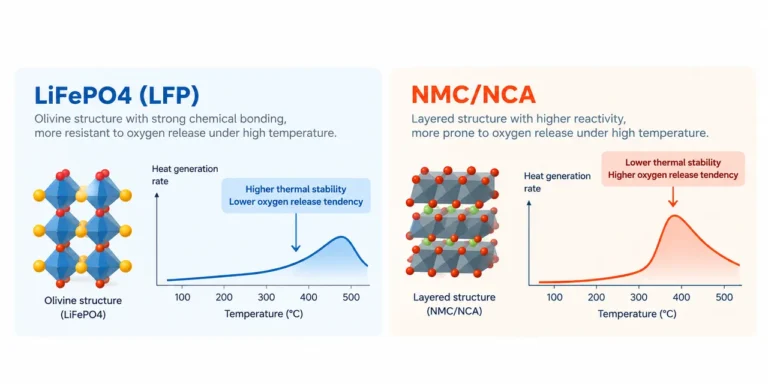
LiFePO4 batteries have higher cathode thermal stability than nickel-rich NMC/NCA batteries. Their phosphate-based structure is more resistant to oxygen release during thermal abuse, reducing certain thermal runaway risks.
Actual thermal runaway behavior depends on SOC, cell construction, electrolyte, and test conditions.
Neither chemistry is fireproof. Both require appropriate protection against overcharging, short circuits, overheating, and mechanical damage.
Cell Voltage and Discharge Characteristics
LiFePO4 cells operate at a lower nominal voltage and have a flatter discharge curve than conventional NMC/NCA lithium-ion cells. These differences affect battery-pack voltage, charging requirements, and state-of-charge (SOC) estimation.
Using UltraXel’s HL18650G (LFP) and HL18650Y (NCM) as examples:
| Voltage Parameter | LFP: HL18650G | NCM: HL18650Y |
| Nominal cell voltage | 3.2 V | 3.6 V |
| Maximum charging voltage | 3.65 V | 4.20 V |
| Nominal voltage of a 4S pack | 12.8 V | 14.4 V |
| Maximum charging voltage of a 4S pack | 14.6 V | 16.8 V |
| Discharge voltage profile | Relatively flat plateau | More gradually declining |
| Voltage-based SOC estimation | More challenging across the plateau | More voltage variation across SOC |
For the same 4S configuration, the LFP pack has a nominal voltage of 12.8 V, compared with 14.4 V for the NCM pack. Their charging voltage limits also differ, so the two chemistries are not automatically interchangeable.
LFP’s flat discharge plateau provides relatively stable voltage during operation but makes voltage-only SOC estimation more difficult.
Charging Speed and Discharge Rate
Both LFP and NMC batteries can support high-current applications.
Charging and discharge rates are expressed as C-rate, where 1C corresponds to the battery’s rated capacity in amperes.
UltraXel’s wide-temperature 18650 cells provide a practical comparison:
| Specification | LFP: HL18650G | NCM: HL18650Y |
| Rated capacity | 1600 mAh | 3200 mAh |
| Maximum charge current | 1.6 A | 3.2 A |
| Maximum discharge current | 7.75 A | 10 A |
| Maximum discharge rate | ≈4.84C | ≈3.13C |
The NCM HL18650Y supports a higher absolute discharge current (10 A), while the LFP HL18650G provides a higher discharge rate relative to its capacity (4.84C vs 3.13C).
Temperature Performance: Standard LiFePO4 vs Lithium-Ion
As we mentioned before, LFP offers higher cathode thermal stability. But, it does not mean it performs better at extreme operating temperatures.
Both LFP and NMC/NCA batteries experience capacity loss, power limitations, and faster aging outside their optimal temperature ranges.
Low-Temperature Discharging
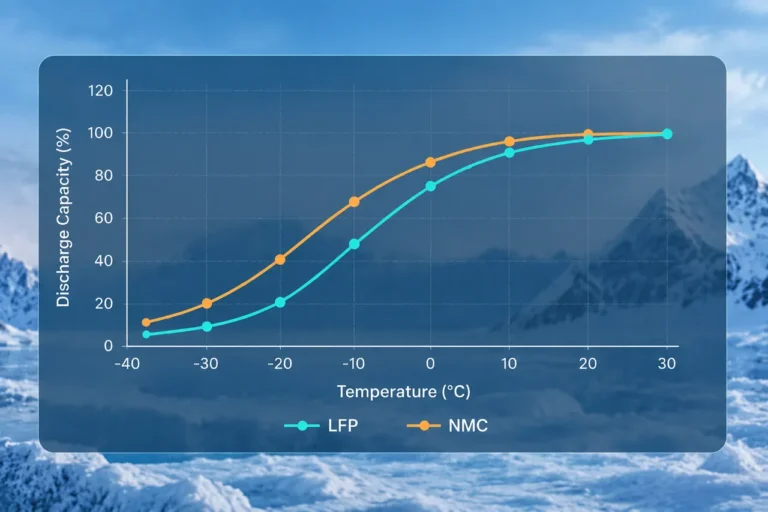
At low temperatures, internal resistance increases, reducing usable capacity and discharge power.
| Performance Factor | LFP | NMC/NCA |
| Discharge capacity below 0°C | Decreases | Decreases |
| Voltage under load | Greater voltage sag possible | Voltage sag also increases |
| High-current discharge | Can be significantly limited | Also limited by cell design |
| Cold-weather suitability | Requires low-temperature performance validation | Requires low-temperature performance validation |
For equipment operating at −20°C or below, compare usable capacity, discharge voltage, and current capability at the actual operating temperature.
Specialized low-temperature cells may outperform standard cells regardless of chemistry.
Low-Temperature Charging
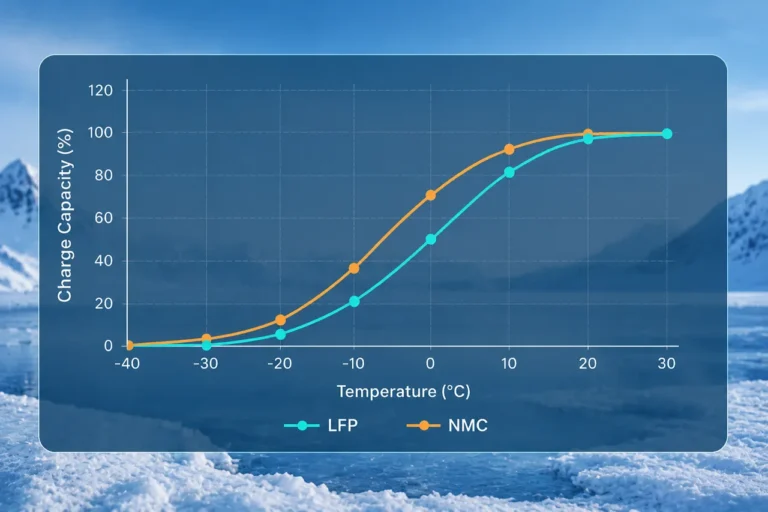
Most standard LFP and NMC/NCA batteries restrict charging below 0°C because lithium plating can damage the anode and increase safety risks.
Cold-weather charging may require temperature-controlled charging, reduced current, cell preheating, or specially designed low-temperature cells.
A battery rated for discharge at −40°C is not necessarily approved for charging at −40°C.
High-Temperature Operation
LFP generally has better cathode thermal stability, but both LFP and NMC/NCA batteries experience accelerated aging at elevated temperatures.
High temperatures can increase electrolyte degradation, internal resistance, and capacity loss.
For industrial applications, verify the manufacturer’s maximum operating temperature and cycle-life performance at the expected temperature.
LiFePO4 Batteries: Pros and Cons
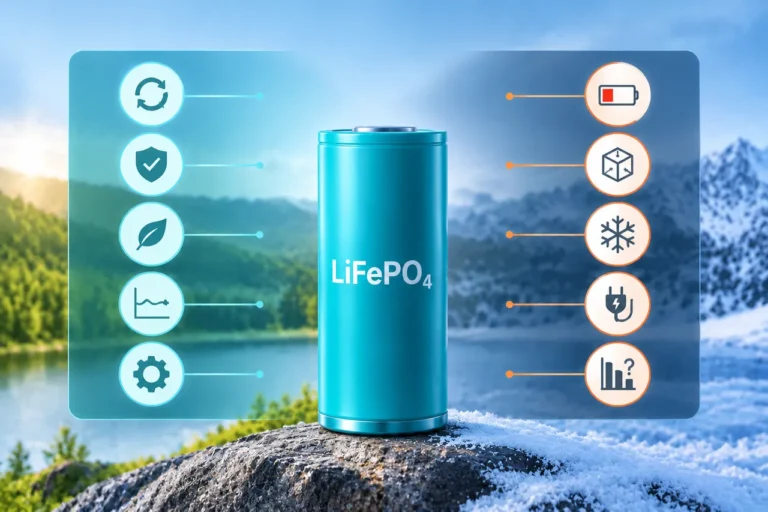
LiFePO4 batteries are best suited for applications prioritizing long cycle life, thermal stability, and lower maintenance costs over compact size and maximum energy density.
| Pros | Cons |
| Long cycle life and fewer replacements | Lower energy density than high-energy NMC/NCA |
| Higher cathode thermal stability | Larger or heavier packs for equivalent energy |
| Nickel- and cobalt-free cathode | Reduced capacity and power in cold conditions |
| Relatively stable discharge voltage | Different charging voltage requirements |
| Well-suited for frequent cycling | More challenging voltage-based SOC estimation |
Bottom line: Choose LFP for long-life, frequently cycled equipment. Consider high-energy NMC/NCA for compact, weight-sensitive devices. For extreme-temperature applications, compare actual cell specifications rather than chemistry alone.
Which Battery Chemistry Is Better for Your Application?
Choose LFP for long cycle life and thermal stability, or NMC/NCA for higher energy density and compact designs. However, demanding industrial applications require more than a chemistry-based comparison.
For common applications, LFP is widely used in solar energy storage and backup power, while high-energy lithium-ion batteries are often preferred for portable electronics and weight-sensitive devices.
How about Industrial Applications in Extreme Temperature?
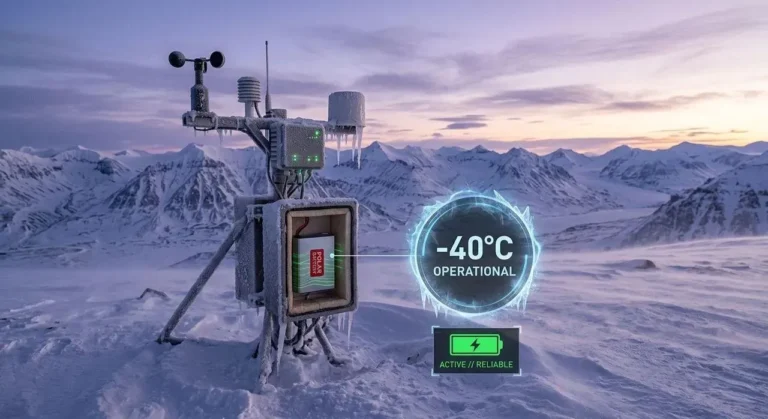
Outdoor IoT Sensors and Data Loggers
Key Battery Requirements: Low-temperature capacity, long standby life, and reliable startup.
Selection Priority: Cold-weather discharge performance.
Remote Communication Equipment
Key Battery Requirements: Peak discharge current, voltage stability, and low-temperature charging capability.
Selection Priority: Reliable power under fluctuating loads.
High-Temperature Industrial Monitoring
Key Battery Requirements: Heat resistance, capacity retention, and long-term reliability.
Selection Priority: Validated high-temperature operation.


Cold-Chain Tracking and Monitoring
Key Battery Requirements: Sub-zero operation, compact size, and long runtime.
Selection Priority: Usable energy at low temperatures.
Industrial Equipment in Extreme Climates
Key Battery Requirements: Wide operating temperature range, cycling durability, and safety.
Selection Priority: Qualified wide-temperature cells and protection systems.

For extreme-temperature applications, cell-level performance matters more than chemistry labels alone. A standard LFP battery may not meet cold-weather requirements, while a specially designed NMC cell may offer better performance under the same conditions.
This is where application-specific wide-temperature lithium battery solutions become essential.
UltraXel Wide-Temperature Lithium Battery Solutions for Industrial Equipment
UltraXel offers specialized LFP and NMC lithium batteries for industrial applications requiring reliable performance in extreme temperatures.
All cells support discharge from −40°C to +85°C, with options for long cycle life, high capacity, high discharge current, and customized battery packs.
Recommended UltraXel Wide-Temperature Batteries
| Battery Model | Key Specifications | Recommended Applications | Why Choose It |
| HL18650G (LFP) | 1600mAh, 3.2V | Industrial backup power, solar lighting | Long cycle life and lower replacement frequency |
| HL14500S (LFP) | 500mAh, 3.2V | Outdoor sensors, smart locks | Compact size and long cycle life |
| HL14500R (NMC) | 750mAh, 3.6V | GPS trackers, automotive electronics, outdoor IoT | Compact size, wide-temperature performance and higher capacity |
| HL18650V (NMC) | 2900mAh, 3.6V | Outdoor IoT, GPS trackers | Low-temperature discharge performance |
| HL18650Y (NMC) | 3200mAh, 3.6V | Remote monitoring, outdoor electronics | Higher capacity and longer runtime |
| HL18650T (NMC) | 2000mAh, 3.6V | Automotive electronics, backup systems | High-temperature standby reliability |
| HL18650F (NMC) | 3000mAh, 3.6V, 30A discharge | High-power industrial equipment | High-temperature standby reliability |
The listed models are rated for discharge from −40°C to +85°C.
For OEM equipment, UltraXel also provides custom lithium battery packs with tailored voltage, capacity, cell configuration, PCM/BMS protection, temperature monitoring, connectors, and enclosure design.
Need a Battery Solution for Extreme Temperatures?
FAQ
Is LiFePO4 the Same as Lithium-Ion?
LiFePO4 is a type of lithium-ion battery. The difference is that LFP uses lithium iron phosphate as its cathode material, while other lithium-ion batteries may use NMC, NCA, LCO, or other cathode chemistries.
Is LiFePO4 Better Than Lithium-Ion?
LiFePO4 is generally better suited to applications prioritizing long cycle life and thermal stability. NMC and NCA batteries often provide higher energy density, making them more suitable for compact or lightweight equipment.
The better choice depends on the application’s electrical, mechanical, temperature, safety, and lifetime requirements.
Are LiFePO4 Batteries Safer Than Other Lithium-Ion Batteries?
LFP generally offers higher cathode thermal stability than many nickel-rich lithium-ion chemistries. However, LFP batteries can still experience dangerous failures under abuse or improper operating conditions.
Safe operation requires appropriate cell selection, electrical protection, thermal design, and system validation.
Do LiFePO4 Batteries Last Longer Than Lithium-Ion Batteries?
LFP batteries typically offer longer cycle life than many high-energy NMC and NCA batteries under comparable test conditions.
However, actual lifespan depends on temperature, charging rate, depth of discharge, storage conditions, and cell quality. Cycle-life claims should always be evaluated against their test conditions.
Which Is Better in Cold Weather: LiFePO4 or Lithium-Ion?
Neither chemistry is universally better in cold weather.
Standard LFP and conventional lithium-ion batteries both experience reduced discharge performance at low temperatures. Some specially designed lithium-ion cells may outperform standard LFP cells in extreme cold.
For equipment operating below freezing, compare actual cell discharge data at the required temperature and load.
Can LiFePO4 Batteries Be Charged Below 0°C?
Many standard LFP batteries do not permit charging below 0°C because low-temperature charging can cause lithium plating and battery degradation.
Some specialized cells support controlled low-temperature charging under specified conditions. Other systems use temperature monitoring and preheating before charging.
Always follow the cell manufacturer’s approved charging temperature and current limits.
Can You Replace Lithium-Ion with LiFePO4?
Yes, but LiFePO4 is generally not a direct drop-in replacement for NMC/NCA lithium-ion batteries. LFP cells have a lower nominal voltage (3.2V vs. 3.6–3.7V) and different charging limits (typically 3.65V vs. 4.2V per cell).
Before switching, verify voltage compatibility, charger and BMS settings, physical dimensions, discharge current, and operating temperature limits.
For OEM applications, replacing one chemistry with another may require battery-pack redesign rather than a simple cell swap.
Is LiFePO4 Suitable for Industrial Equipment?
Yes. LFP can be suitable for industrial equipment that benefits from long cycle life, thermal stability, and frequent cycling.
However, equipment with strict size limitations, unusual voltage requirements, high peak loads, or extreme-temperature exposure may require another lithium-ion chemistry or a specialized battery design.