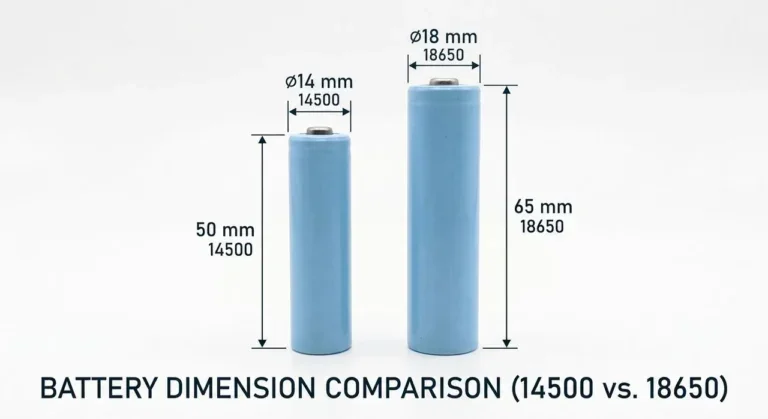
When comparing cylindrical lithium-ion batteries, 14500 and 18650 are two common cell formats. The main difference is size: a typical 14500 cell measures about 14 × 50 mm, while an 18650 one is about 18 × 65 mm.
The larger 18650 generally provides higher capacity and energy per cell, while the more compact 14500 can be useful when space and weight are limited.
This comparison guide explains the key differences between 14500 and 18650 batteries and provides a practical framework for selecting the appropriate cell.
What Is the Difference between 14500 and 18650 Battery?
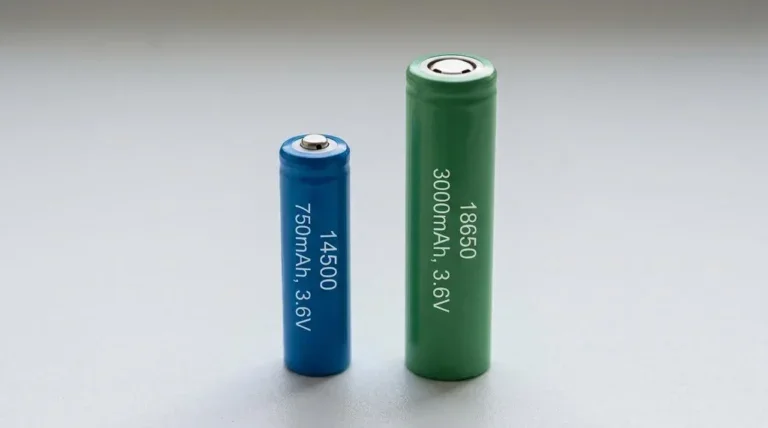
Have a quick look at the key differences. Actual capacity, discharge capability, temperature performance, and cycle life vary between individual cell models.
| Specification | 14500 Battery | 18650 Battery |
| Cell format | Cylindrical | Cylindrical |
| Typical dimensions | 14 × 50 mm | 18 × 65 mm |
| Typical nominal voltage | 3.6–3.7 V | 3.6–3.7 V |
| Capacity | Generally lower | Generally higher |
| Energy per cell | Generally lower | Generally higher |
| Space requirement | More compact | Larger |
| Pack design | May require more cells for higher energy | Require fewer cells for the same energy |
| Typical advantage | Compact size and lower weight | Higher energy per cell |
| Common applications | Compact LED flashlights Mini electronic gadgets Laser pointers Wireless keyboards and mice Industrial IoT sensors Portable instruments | Laptops Power banks E-bikes and e-scooters Industrial flashlights Automotive electronics Backup power systems |
| Industrial considerations | Size, weight, temperature, current | Energy, current, temperature, pack efficiency |
14500 vs 18650 Size and Dimensions
The numbers in the names describe the approximate dimensions of cylindrical cells.
“14500” refers to a cell approximately 14 mm in diameter × 50 mm in length, while “18650” refers to a cell approximately 18 mm in diameter × 65 mm in length.
14500 vs 18650 Capacity and Discharge Performance
Capacity and discharge capability are two important factors when selecting a cell.
For a practical comparison, we use the specifications of the actual UltraXel cell models.
| Parameter | UltraXel 14500 Cells | UltraXel 18650 Cells |
| Nominal Voltage | 3.2V/3.6V | 3.2V/3.6V |
| Capacity | 500mAh/750mAh | 1600mAh/2000mAh/2900mAh/3000mAh/3200mAh |
| Max. Discharge | 2.4A/3.5A | 10A/15A/30A |
| Operating Temperature | −40°C to +85°C | −40°C to +85°C |
| Cell Size | 14 × 50 mm | 18 × 65 mm |
Capacity and Energy
18650 generally provides higher capacity per cell than a 14500 because of its larger physical volume.
Battery capacity is normally expressed in mAh or Ah, while energy can be estimated using:
Energy (Wh) = Voltage (V) × Capacity (Ah)
For example, a 3.7 V cell with a 2.5 Ah capacity has approximately 9.25 Wh of nominal energy.
Actual usable energy depends on discharge conditions, temperature, cutoff voltage, and cell design.
Continuous and Peak Discharge
A larger cell does not automatically mean higher discharge capability.
Continuous and peak discharge performance depends on factors such as:
- Cell chemistry
- Electrode design
- Internal resistance
- Thermal characteristics
- Cell construction
This means a high-current 14500 can be more suitable for a specific application than an 18650 with lower current capability.
14500 and 18650 for Consumer Electronics
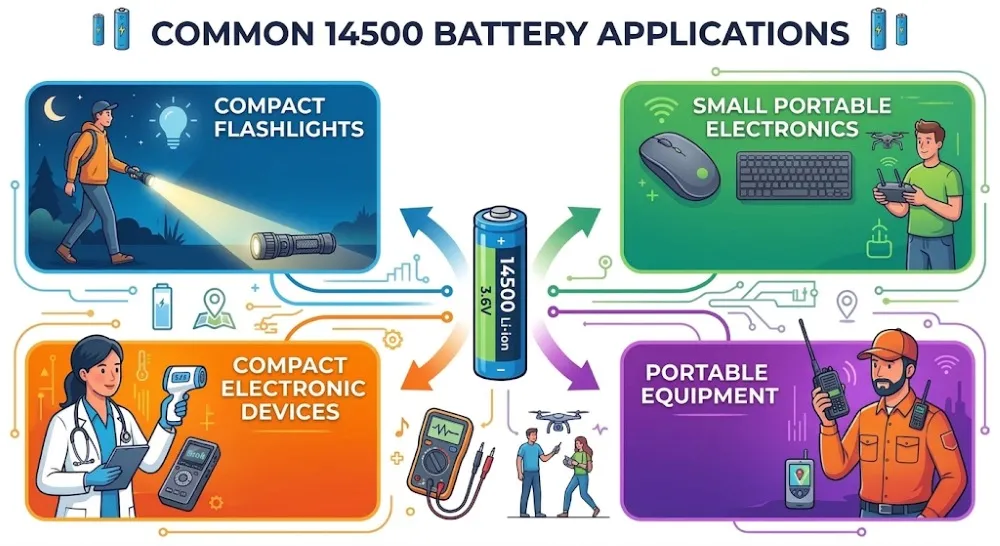
Common 14500 Applications
14500 cells can be found in compact products such as:
- Flashlights
- Small portable electronics
- Compact electronic devices
- Portable equipment
Their smaller form factor is useful when internal battery space is limited.
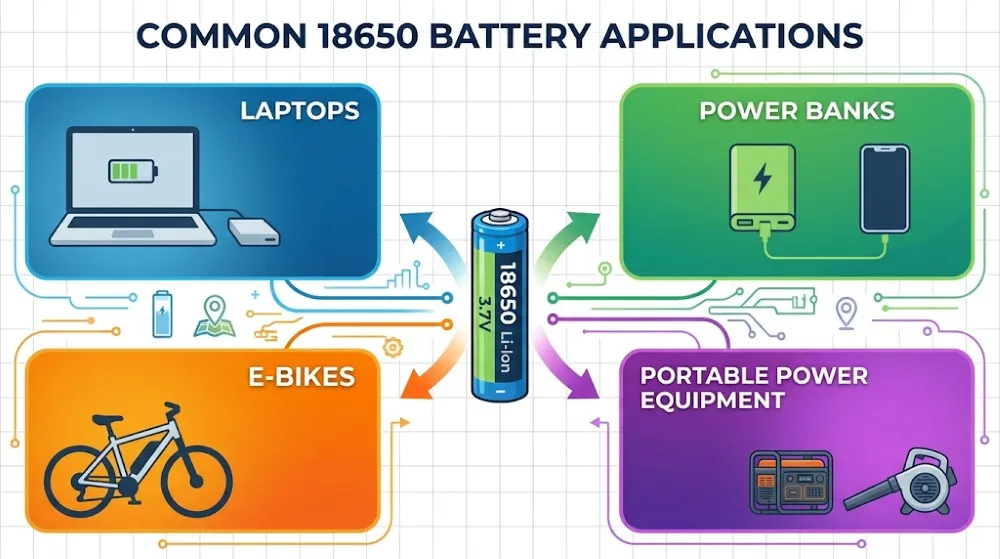
Common 18650 Applications
18650 cells are widely associated with products such as:
- Laptops
- Power banks
- E-bikes
- Portable power equipment
Their larger size allows many 18650 models to provide higher capacity and energy per cell.
14500 vs 18650 for Industrial Applications
For industrial equipment, choosing between 14500 and 18650 is not simply a question of which cell is larger. Engineers need to consider the complete operating environment and battery system requirements.
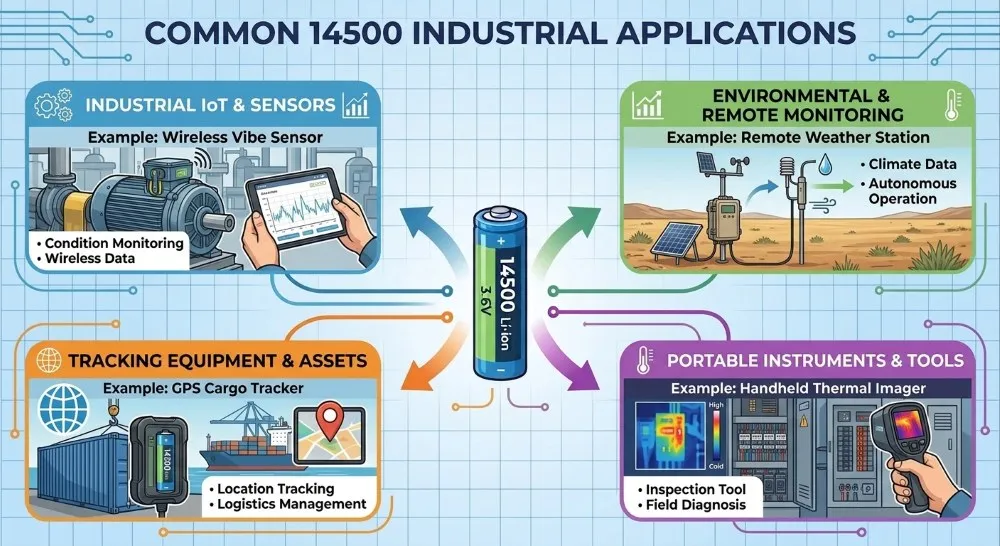
14500 Industrial Applications
Typical applications include:
- Industrial IoT sensors
- Environmental monitoring devices
- Agricultural sensors
- Tracking equipment
- Portable instruments
- Remote monitoring systems
- Compact industrial electronics
For these applications, a 14500 can combine a small footprint with the performance required by the equipment.
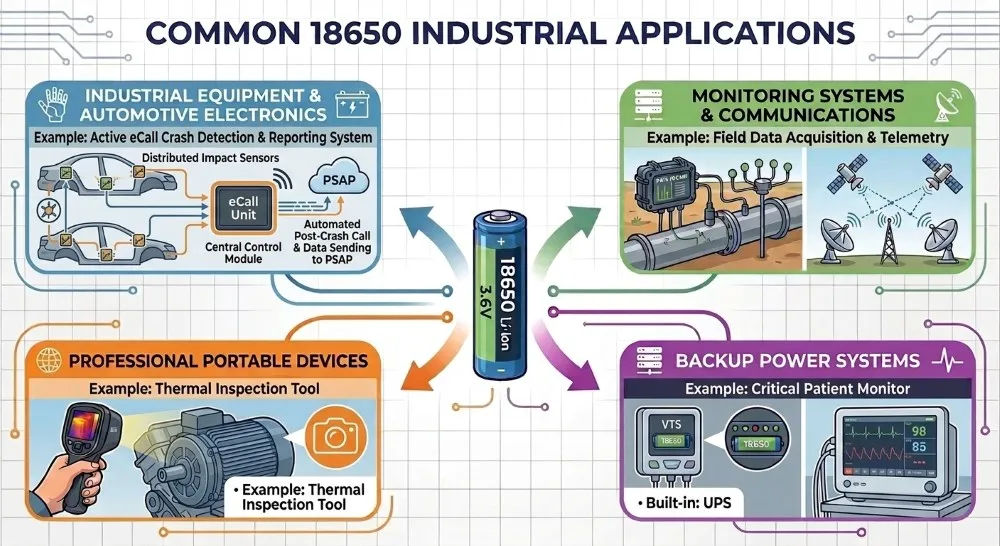
18650 Industrial Applications
Potential industrial applications include:
- Industrial equipment
- Professional portable devices
- Automotive electronics
- Monitoring systems
- Backup power systems
- Industrial communication equipment
An 18650 can also simplify some pack designs by providing more energy per cell.
How to Choose Between 14500 and 18650 Batteries
The choice between a 14500 and 18650 should start with the equipment requirements rather than the cell format.
| Application Requirement | Cell to Consider |
| Limited installation space | 14500 |
| Lower battery weight | 14500 |
| Higher energy per cell | 18650 |
| More available battery space | 18650 |
| Compact industrial electronics | 14500 |
| Higher overall pack energy | 18650 |
| High continuous or peak current | Evaluate actual cell specifications |
| Wide-temperature operation | Select a cell rated for the required temperature range |
| OEM battery pack | Evaluate the complete battery system |
Why Wide-Temperature Performance Matters for Industrial Batteries
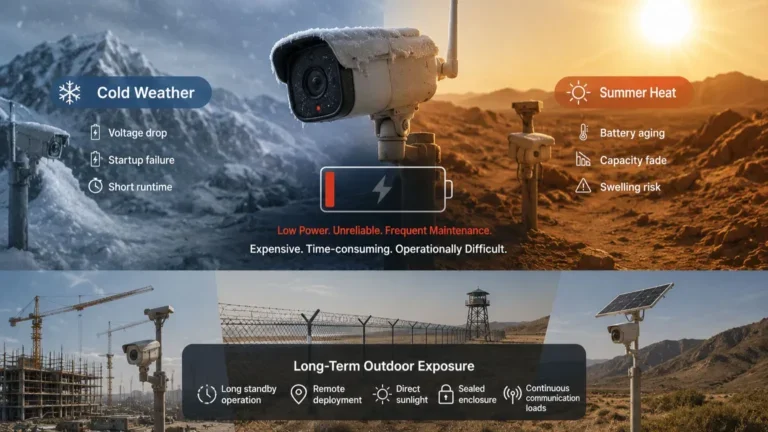
Many industrial battery applications operate outside controlled indoor environments.
Outdoor IoT equipment, agricultural systems, automotive electronics, and industrial monitoring devices may experience significant temperature changes during operation.
Temperature can affect:
- Available capacity
- Internal resistance
- Discharge performance
- Charging performance
- Battery service life
For this reason, engineers should evaluate battery performance across the actual operating temperature range rather than relying only on capacity measured under standard room-temperature conditions.
A wide-temperature cell can provide a more suitable battery platform for equipment that must operate reliably in challenging environmental conditions.
This is particularly important when a battery is installed in equipment that is difficult to access or service after deployment.
UltraXel Wide-Temperature 14500 and 18650 Battery Solutions
UltraXel offers a range of wide-temperature 14500 and 18650 lithium battery cells designed for different industrial power requirements. Instead of using a single cell for every application, engineers can select from different cell chemistries and performance profiles based on capacity, discharge current, operating temperature, safety, and cycle life.
Wide-Temperature 14500 Battery
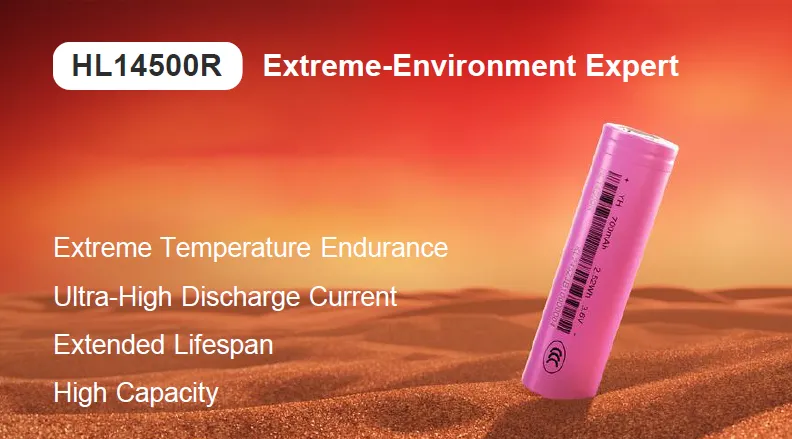
HL14500R — Automotive-Grade, High-Capacity 14500
- 750mAh typical capacity
- 3.6V nominal voltage
- -40°C to +85°C discharge temperature
- Up to 3.5A continuous discharge
- Automotive-grade design
- High-temperature aging and low-temperature performance
Typical applications
- T-Box and eCall systems
- GPS tracking devices
- Outdoor IoT equipment
- Security and monitoring devices
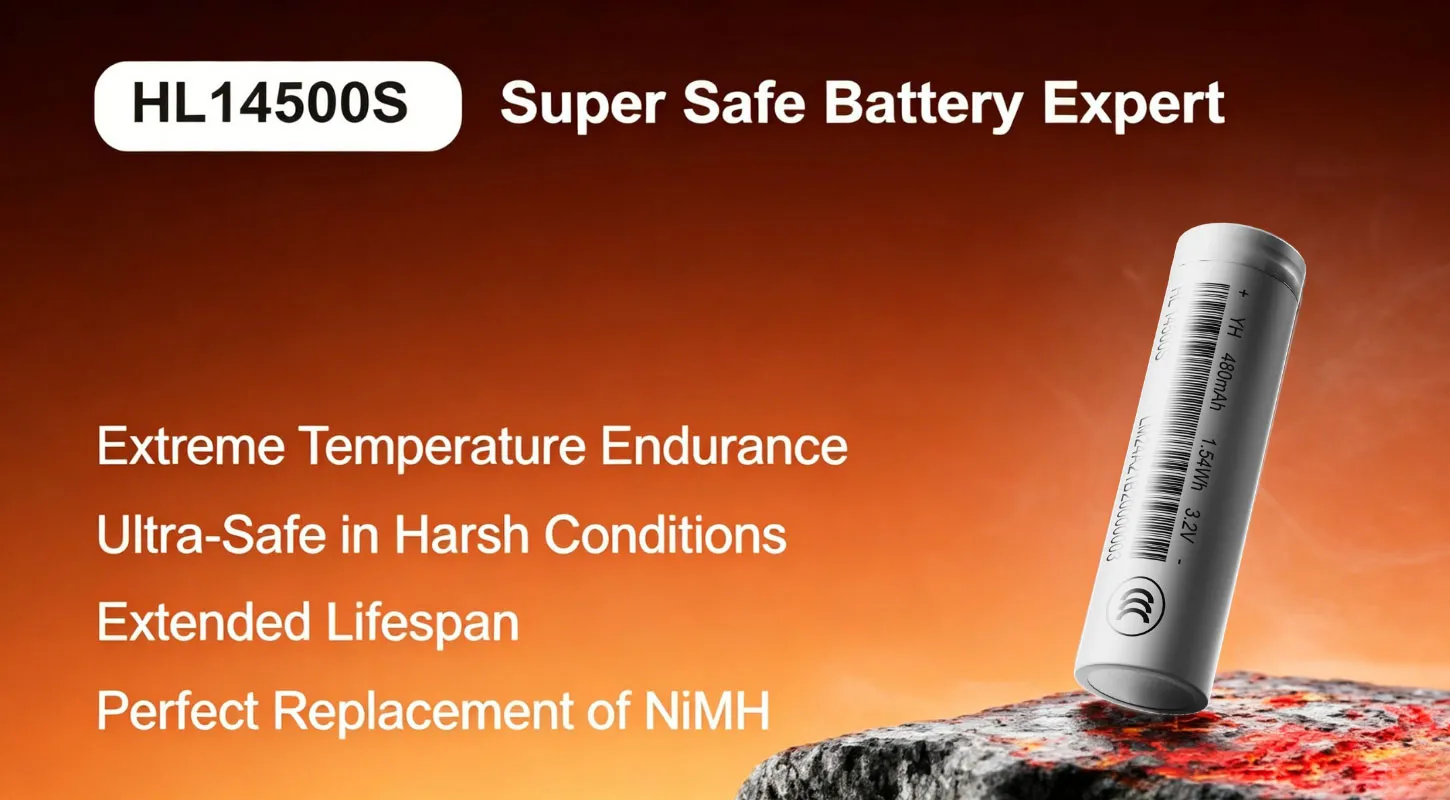
HL14500S — Long-Life LiFePO4 14500
- 500mAh typical capacity
- -40°C to +85°C operating temperature
- 1000+ charge/discharge cycles
- Supports 8C continuous discharge
- High-safety LiFePO₄ chemistry
Typical applications
- Remote monitoring systems
- Wireless sensors
- GPS and asset tracking
- Outdoor alarm systems
- Smart logistics equipment
Wide-Temperature 18650 Battery

HL18650F — High-Discharge 18650
Key Features
- 3000mAh typical capacity
- Up to 30A continuous discharge
- -40°C to +85°C discharge temperature
- Approximately 70% capacity retention at -40°C
- High-discharge performance for demanding loads
Typical Applications
- Industrial power tools
- Outdoor security cameras
- Industrial field equipment
- Robotics
- Rugged portable equipment
- High-power electronic systems

HL18650T — High-Temperature 18650
Key Features
- 2000mAh typical capacity
- Up to 10A continuous discharge
- -40°C to +85°C discharge temperature
- Stable long-term standby performance
- Designed for high-temperature aging and float-charge applications
Typical Applications
- Automotive electronics
- T-Box backup systems
- GPS trackers
- Security equipment
- Industrial backup systems
- Long-term standby applications

HL18650V — Cold-Weather 18650
Key Features
- 2900mAh typical capacity
- Up to 10A continuous discharge
- -40°C to +85°C discharge temperature
- Approximately 70% capacity retention at -40°C
- Designed for reliable low-temperature operation
Typical Applications
- Outdoor monitoring systems
- Remote IoT gateways
- Logistics tracking
- Solar monitoring equipment
- Field instruments
- Cold-weather electronic equipment

HL18650Y — High-Capacity 18650
Key Features
- 3200mAh typical capacity
- 3.6V nominal voltage
- -40°C to +85°C discharge temperature
- Approximately 70% capacity at -40°C
- High-capacity NCM cell design
Typical Applications
- Industrial monitoring equipment
- Remote IoT systems
- Outdoor electronic equipment
- Portable professional devices
- Energy-intensive industrial applications
HL18650G — Long-Life LiFePO4 18650
Key Features
- 1600mAh typical capacity
- LiFePO4 chemistry
- -40°C to +85°C discharge temperature
- 1500+ cycle life
- Up to 7.75A continuous discharge
- Designed for long-term, low-maintenance operation
Typical Applications
- Industrial IoT
- Remote monitoring systems
- Industrial sensors
- Automotive T-Box backup
- Outdoor signage
- Field instruments and detectors
FAQ
Are 14500 and 18650 batteries the same size?
No. A typical 14500 cell is approximately 14 mm in diameter and 50 mm long, while a typical 18650 cell is approximately 18 mm in diameter and 65 mm long. They should not be assumed to fit into the same battery holder or enclosure.
What is the difference between 14500 and 18650 battery capacity?
18650 cells generally have higher capacity than 14500 cells because their larger physical volume.
However, capacity varies between individual cell models. For an industrial application, the required energy and runtime should be calculated based on the actual cell specification.
Can a 14500 be used instead of an 18650?
Not necessarily. A 14500 is smaller and has a lower capacity per cell. If the original design requires the energy or current capability of an 18650, replacing it with a single 14500 may not meet the application’s requirements.
Can 14500 and 18650 cells be used in the same battery pack?
They should not be mixed simply because they are both cylindrical lithium-ion cells.
Different cell formats can have different capacities, internal resistance, current capabilities, and physical dimensions. Battery packs should be designed using compatible cells with appropriate electrical characteristics and protection systems.
Are All 14500 Batteries the Same?
No. “14500” identifies a cylindrical battery form factor. It does not mean every 14500 battery has identical electrical characteristics.
Different 14500 cells can vary in: chemistry, nominal voltage, capacity, continuous discharge current, internal resistance, terminal configuration, cycle life, or other factors.
Which battery is better for an industrial application?
The choice depends on the application. A 14500 can be considered when compact size and lower weight are priorities, while an 18650 can be considered when higher energy per cell is required.
Industrial applications should also be evaluated for current demand, operating temperature, cycle life, and battery pack requirements.