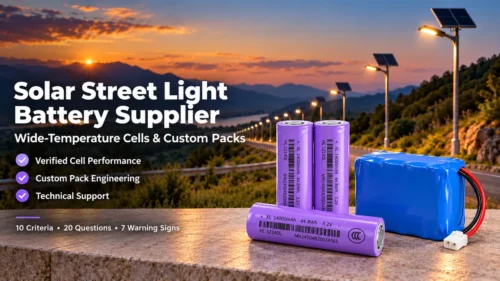
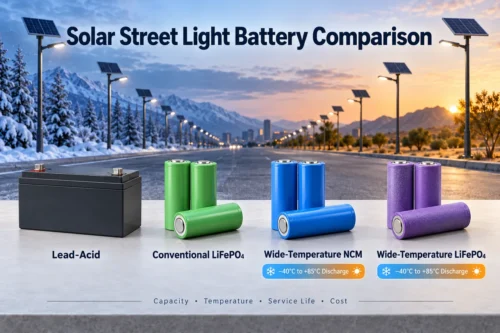
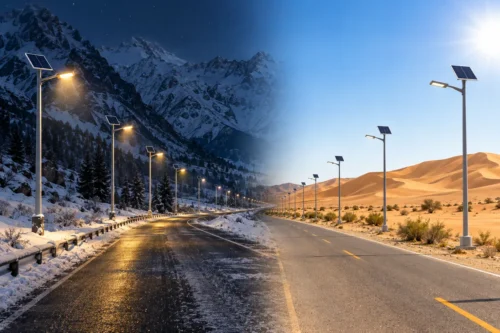
Choosing a battery for solar street light requires balancing capacity, temperature performance, service life and cost.
Lead-acid, LiFePO4 and NCM offer different advantages. However, conventional LiFePO4 and wide-temperature LiFePO4 should be evaluated separately.
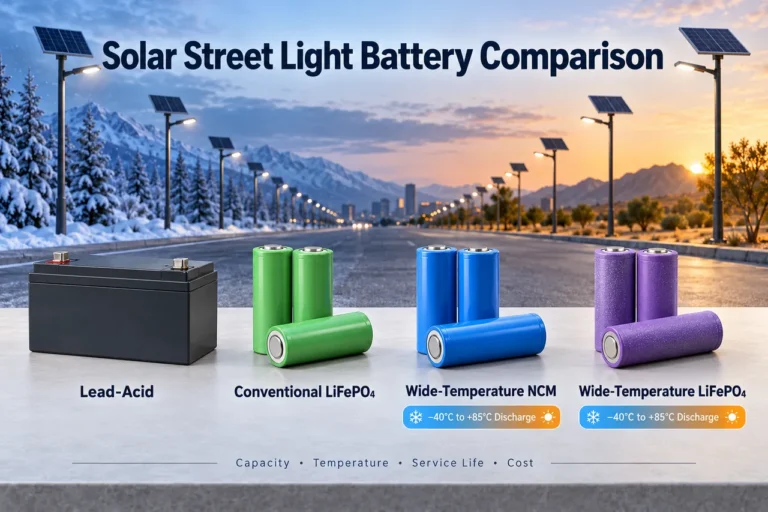
This guide compares four options: lead-acid, conventional LiFePO4, wide-temperature NCM(ultraxel.com/ncm-battery-cell/) and wide-temperature LiFePO4(ultraxel.com/lifepo4-cylindrical-cells/).
Three Battery Types at a Glance
These three chemistries provide four practical options when conventional and wide-temperature LiFePO4 are considered separately.
| Specification | Lead-Acid (VRLA/Gel) | Conventional LiFePO4 | NCM (Wide-Temperature) | LiFePO4 (Wide-Temperature) |
| Chemistry | Lead-acid | LiFePO₄ | Nickel cobalt manganese oxide | LiFePO₄ |
| Nominal voltage | 2.0 V/cell | 3.2 V/cell | 3.6–3.7 V/cell | 3.2 V/cell |
| Cycle life | Sensitive to deep discharge | Long cycle-life potential | Model- and condition-dependent | Model-specific; HL18650G: 1,500+ cycles under specified conditions |
| Discharge temperature | Typically around −20°C to +50°C | Typically around −20°C to +60°C | Selected UltraXel models: −40°C to +85°C | Selected UltraXel models: −40°C to +85°C |
| Charging temperature | Manufacturer-specific | Commonly starts at 0°C | Selected UltraXel models: −20°C to +60°C | Selected UltraXel models: −20°C to +60°C |
| Energy density | Low | Moderate | Generally higher than LFP | Model-specific; compare actual pack size and weight |
| Self-discharge | Depends on temperature and condition | Model-specific | Model-specific | Model-specific |
| Safety profile | Lead content; venting and leakage risks | Good thermal stability; protection required | Protection and thermal control required | Good thermal stability; protection required |
| Relative cost | Usually lowest upfront | Often economical for routine cycling | Specialty-cell pricing | Typically higher than conventional LFP |
| 5-year TCO | Replacement costs can offset initial savings | Favorable within suitable conditions | Depends on space, climate and lifetime | Potential advantage where temperature capability reduces replacement needs |
| Main advantage | Low initial cost | Cycle life and value | Compact energy storage across a wide temperature range | LFP chemistry with an extended temperature range |
Temperature ranges are model-specific. Cycle life and self-discharge must be compared under equivalent test conditions. Five-year costs require a project-specific calculation.
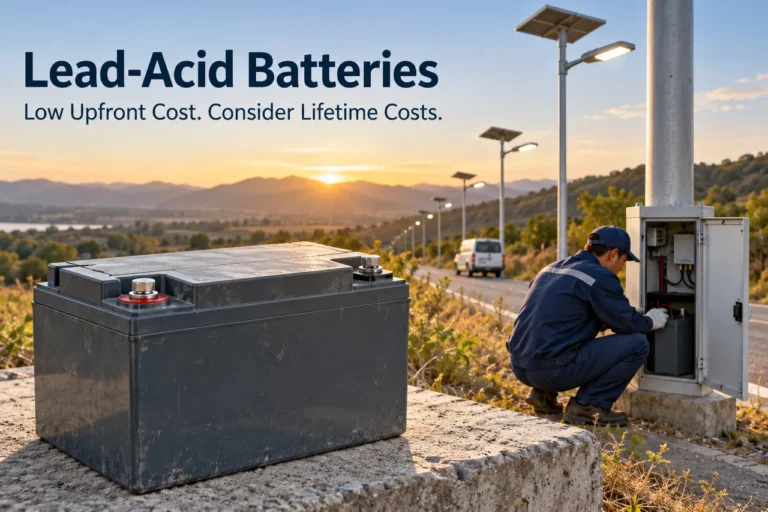
Lead-Acid: A Legacy Choice on Its Way Out
Lead-acid remains relevant for compatible replacement projects and installations prioritizing low initial cost.
Why Lead-Acid Was Used
- Low purchase cost
- Established supply and recycling channels
- Familiar charging technology
Why Lead-Acid Is Being Phased Out
Low energy density increases battery weight and installation space. Deep discharge, cold conditions and prolonged heat can also reduce usable capacity or service life.
VRLA and gel batteries normally do not require water topping-up, although the installation still needs inspection.
When Lead-Acid Still Makes Sense
Consider it for temporary lighting or budget-limited replacement projects where the existing system is designed for lead-acid.
Verdict: Compare replacement and service costs alongside the initial purchase price.
LiFePO4: The Current Market Mainstream
LiFePO4 is widely used in solar lighting for its thermal stability and cycle-life potential. The key distinction is whether the cell is a conventional or wide-temperature design.
Why LiFePO4 Became the Default
- Good thermal stability
- Long cycle-life potential
- Lower weight than lead-acid
- Suitable for daily charging and discharging
Where LiFePO4 Falls Short
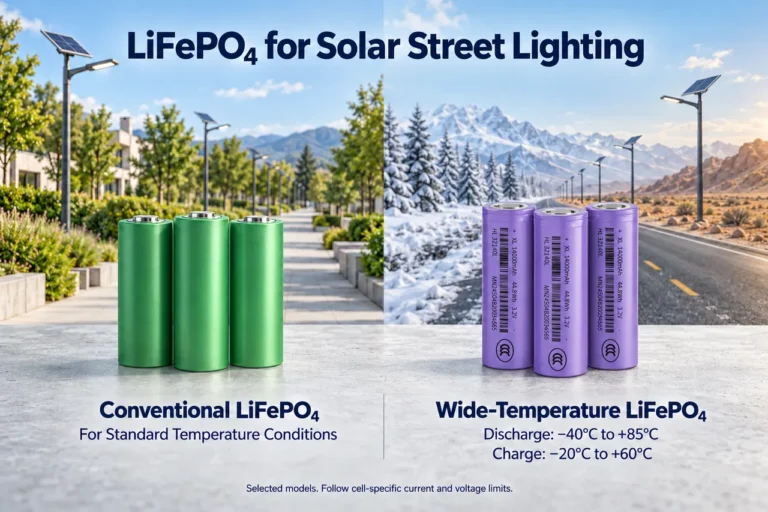
Conventional LiFePO4 cells commonly restrict charging below 0°C, while low temperatures reduce discharge capacity. Their energy density is also generally lower than NCM.
Wide-temperature LiFePO4 addresses the temperature limitation. Selected UltraXel models support −40°C to +85°C discharge and −20°C to +60°C charging, within specified current and voltage limits.
This makes LFP an option for harsh climates as well as moderate environments. However, wide-temperature capability does not automatically mean longer cycle life than conventional LFP; compare model-specific data.
Best-Fit Applications for LiFePO4
| LiFePO4 Type | Suitable Applications |
| Conventional LiFePO4 | Daily-cycling solar lighting where cell temperatures remain within standard limits |
| Wide-temperature LiFePO4 | Cold-region, heat-exposed and remote lighting projects prioritizing LFP thermal stability |
Both types require appropriate protection and charging control.
NCM (Wide-Temperature): Built for Extreme Environments
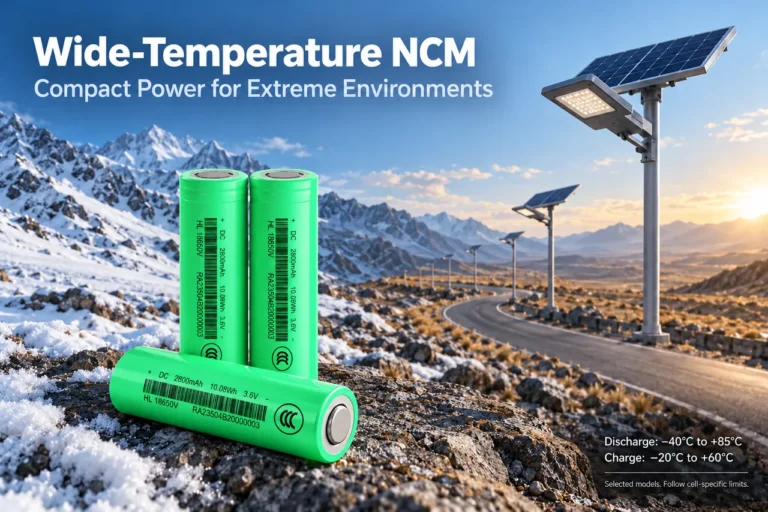
Wide-temperature NCM offers high energy density alongside an extended operating range.
Why NCM Wide-Temp Excels in Harsh Conditions
- Compact packs for restricted installation space
- Selected models support −40°C to +85°C discharge
- Model options emphasizing cold-weather capacity or high-temperature storage performance
Trade-offs to Be Aware Of
NCM requires suitable protection and thermal control. Its cycle life and aging characteristics depend on temperature, charging strategy and cell design.
Selected UltraXel models support −20°C to +60°C charging, subject to model-specific limits.
Best-Fit Applications for NCM Wide-Temperature
- Integrated solar street lights with limited battery space
- Weight-sensitive installations
- Cold-region lighting requiring verified low-temperature capacity
- Heat-exposed applications requiring validated high-temperature models
Wide-temperature NCM is not the only extreme-weather option. Compare it with wide-temperature LFP: NCM generally favors energy density, while LFP offers greater thermal stability. Actual temperature performance must be assessed by model.
Head-to-Head Comparison: Key Performance Metrics
Cycle Life
Conventional LFP can be a strong choice for routine cycling in moderate conditions. Wide-temperature LFP combines LFP chemistry with broader temperature capability, while wide-temperature NCM offers compact energy storage.
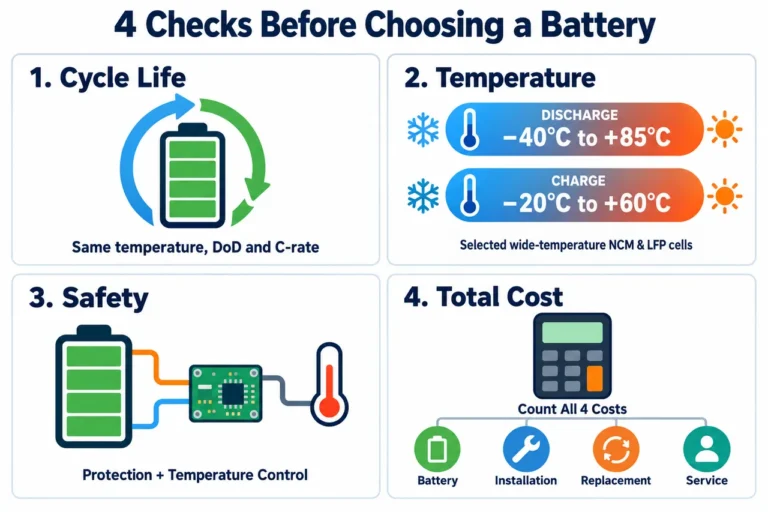
Compare cycling data at the same temperature, depth of discharge and charge/discharge rates. A wider operating range does not guarantee a higher cycle count.
Temperature Performance
| Battery Option | Main Temperature Consideration |
| Lead-acid | Reduced cold-weather capacity and heat-related aging |
| Conventional LiFePO4 | Subzero charging is commonly restricted |
| Wide-temperature NCM | Extended discharge and charging ranges, with model-specific current limits |
| Wide-temperature LiFePO4 | Extended discharge and charging ranges while retaining LFP chemistry |
For selected UltraXel wide-temperature NCM and LFP models:
- Discharge: −40°C to +85°C
- Charge: −20°C to +60°C
Use actual cell temperature to control charging. Discharge capability at −40°C does not permit charging at −40°C.
Safety
Both conventional and wide-temperature LFP generally offer good thermal stability. NCM offers higher energy density but requires careful protection and heat management.
All lithium packs need suitable charging control, electrical protection and enclosure design. No chemistry should be treated as fireproof.
Total Cost of Ownership (5-Year Horizon)
The most economical option depends on the installation:
- Lead-acid: Lower initial cost, with potentially higher replacement costs.
- Conventional LFP: Often economical when standard temperature limits are sufficient.
- Wide-temperature NCM : Useful when compact size and harsh-climate performance justify specialty-cell costs.
- Wide-temperature LFP: Worth evaluating when standard LFP temperature restrictions could increase system complexity or replacement needs.
Include the battery, controller compatibility, installation, replacements and site-service costs in the calculation.
How to Choose: A Decision Tree by Application
| Application | Battery Options to Evaluate | Main Reason |
| Urban or suburban lighting in moderate climates | Conventional LiFePO4 | Cycle-life potential and cost-effectiveness |
| Extreme cold regions | Wide-temperature NCM or wide-temperature LiFePO4 | Evaluate cold-weather capacity and permitted charging conditions |
| Desert or tropical installations | Validated wide-temperature LFP high-temperature NCM | Assess heat exposure, storage aging and enclosure temperature |
| High-power lighting with limited battery space | Wide-temperature NCM | Higher energy density supports compact packs |
| Remote installations prioritizing thermal stability | Wide-temperature LiFePO4 | Combines LFP chemistry with extended temperature capability |
| Existing lead-acid system upgrade | Conventional or wide-temperature LiFePO4 | Select by climate and verify charging-system compatibility |
| Temporary, budget-limited installation | Lead-acid | Low initial cost where weight and replacement frequency are acceptable |
UltraXel Battery Recommendations by Scenario
UltraXel offers both wide-temperature NCM and wide-temperature LFP cells. Select the model around usable capacity, installation space and expected aging conditions.
Application 1: Higher-Capacity Solar Street Lighting
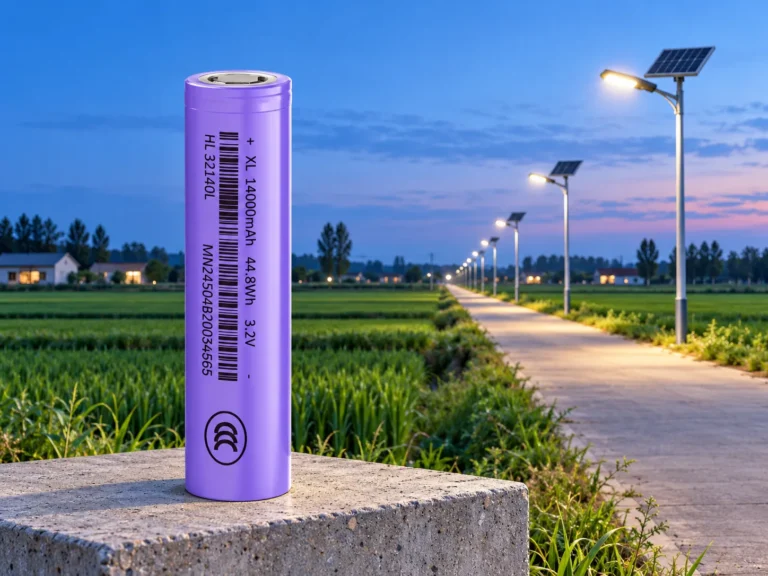
RECOMMENDED CELL: UltraXel HL32140L
| LFP (LiFePO₄) |
| 15 Ah |
| 2000 cycles (under specified test conditions) |
| Higher-capacity solar lighting, extended backup runtime |
Application 2: Cold Region Solar Street Lights
RECOMMENDED CELL: UltraXel HL18650V
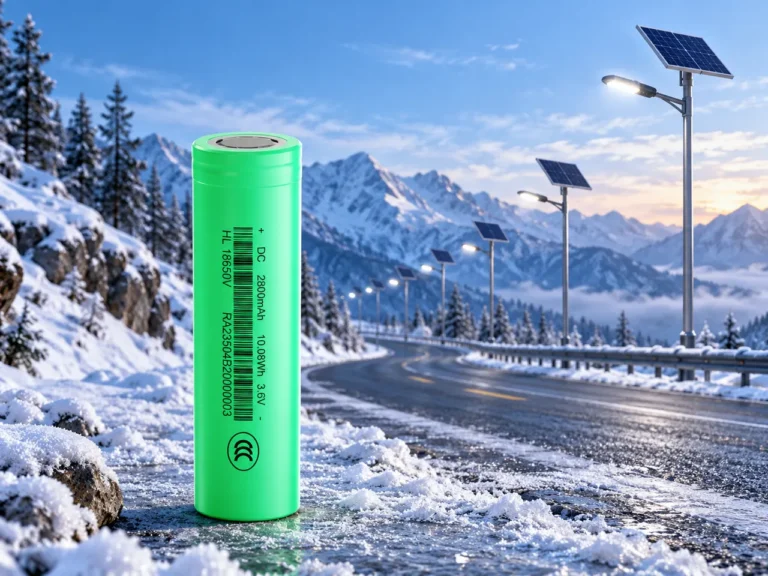
| NCM |
| 2900 mAh |
| −40°C to +85°C |
| Cold climates, mountain roads, Northern Europe, Canada |
Application 3: Desert Solar Street Lights
RECOMMENDED CELL: UltraXel HL18650T
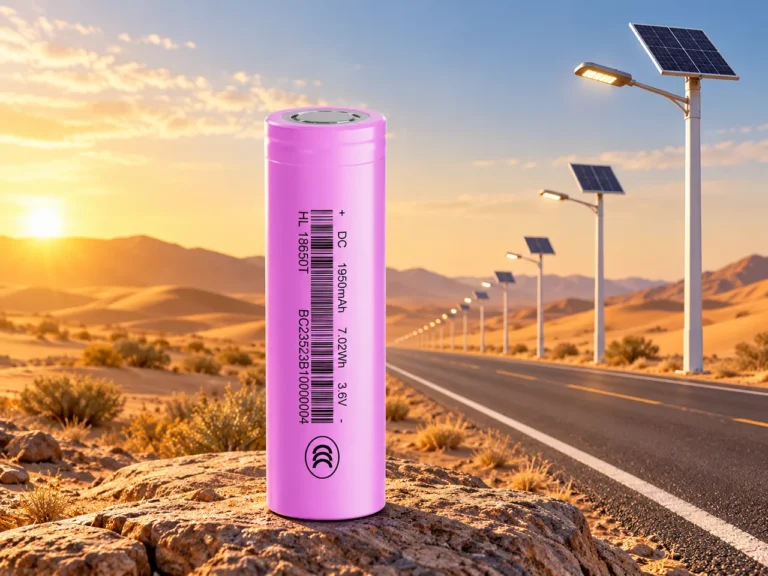
| NCM |
| 2000 mAh |
| −40°C to +85°C |
| Desert, Middle East, Africa, Australia, tropical regions |
Application 4: Long-Life Remote Solar Lighting
RECOMMENDED CELL: UltraXel HL18650G
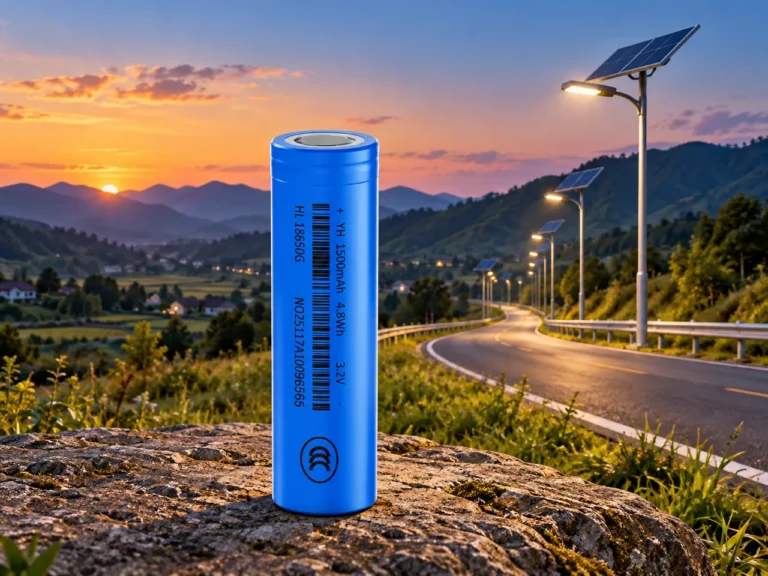
| LFP (LiFePO₄) |
| 1600 mAh |
| 1500+ cycles (under standard test conditions) |
| Long-life remote installations, safety-critical projects |
Battery Pack Design and BMS Considerations
A complete battery for solar street light must match the lighting load, charge controller and climate.
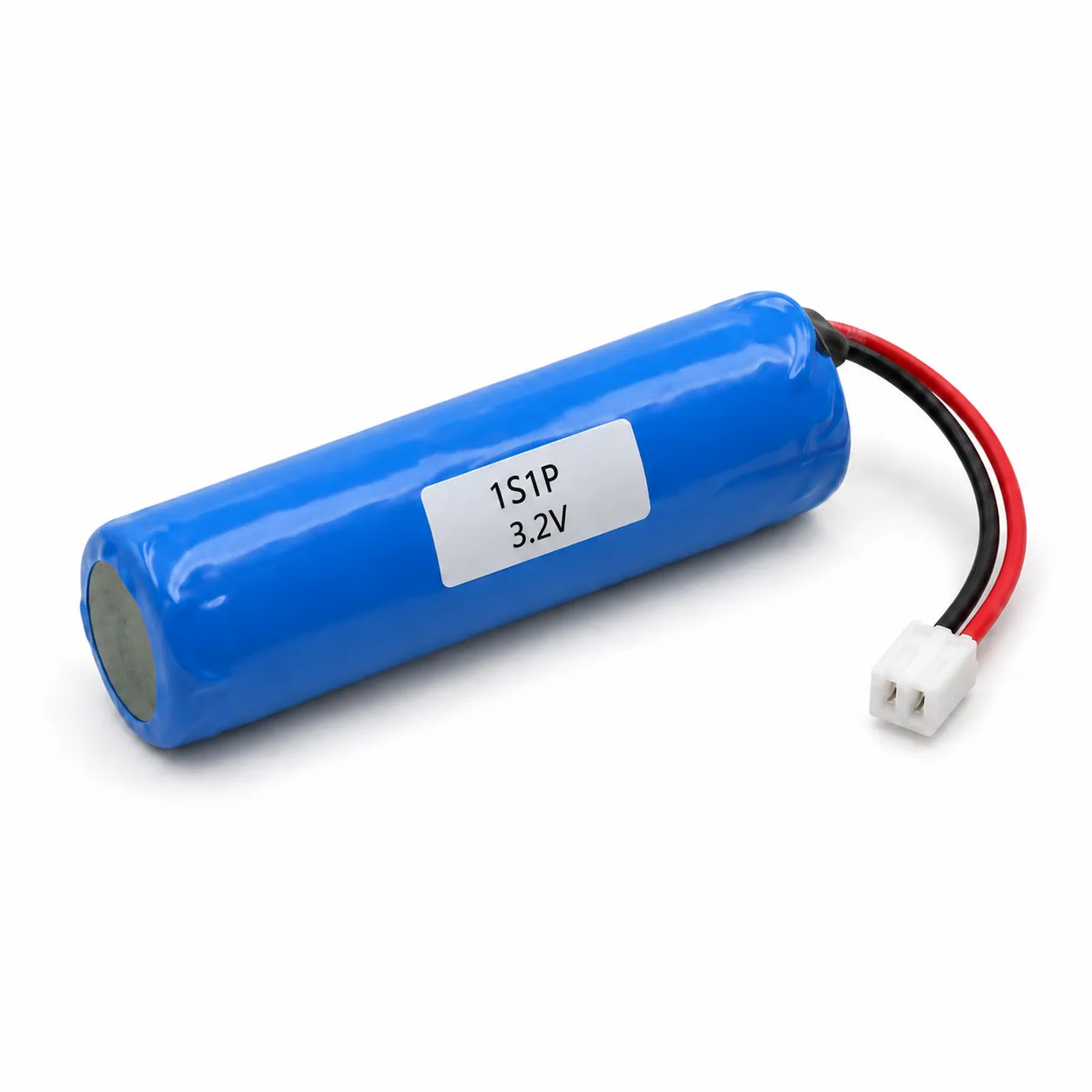
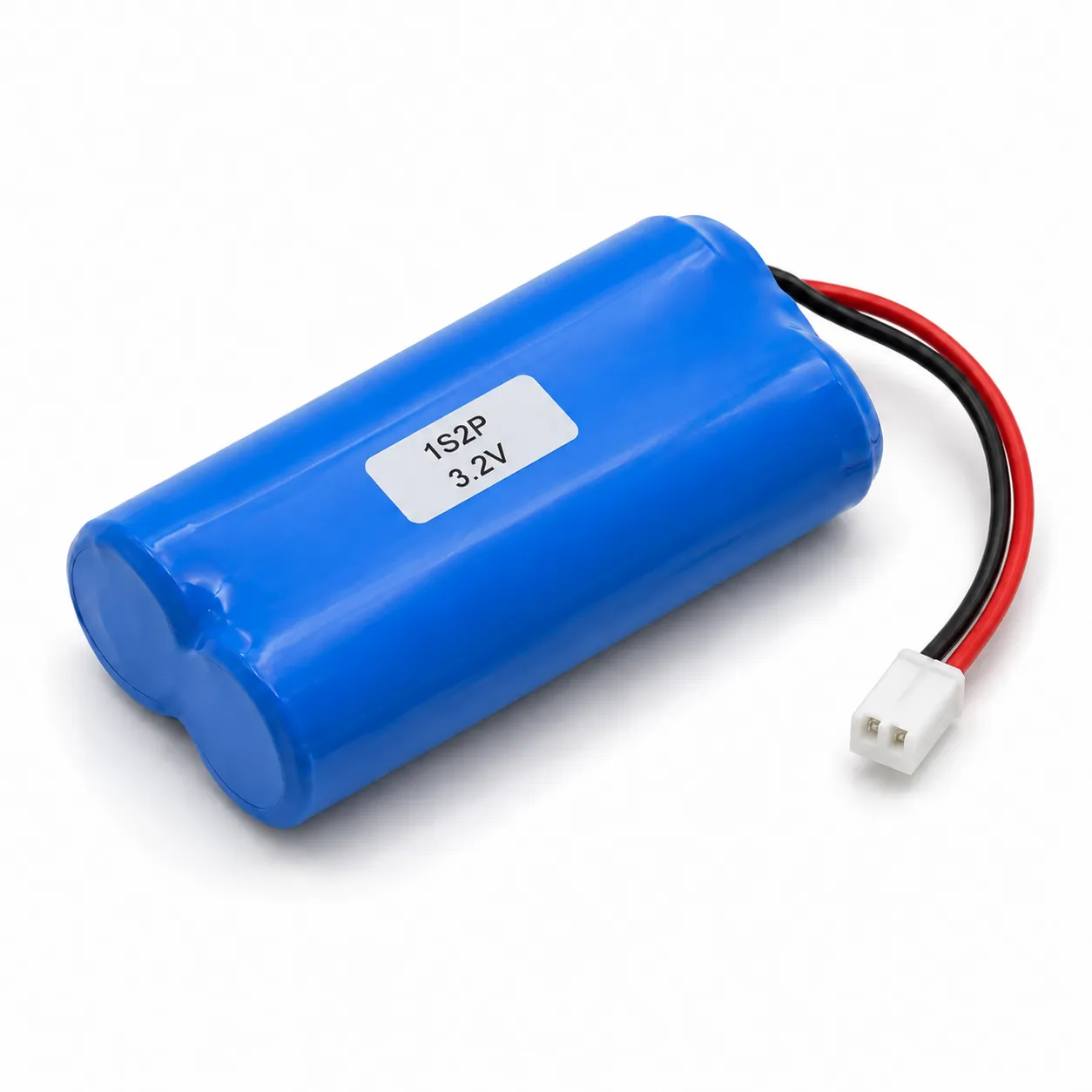
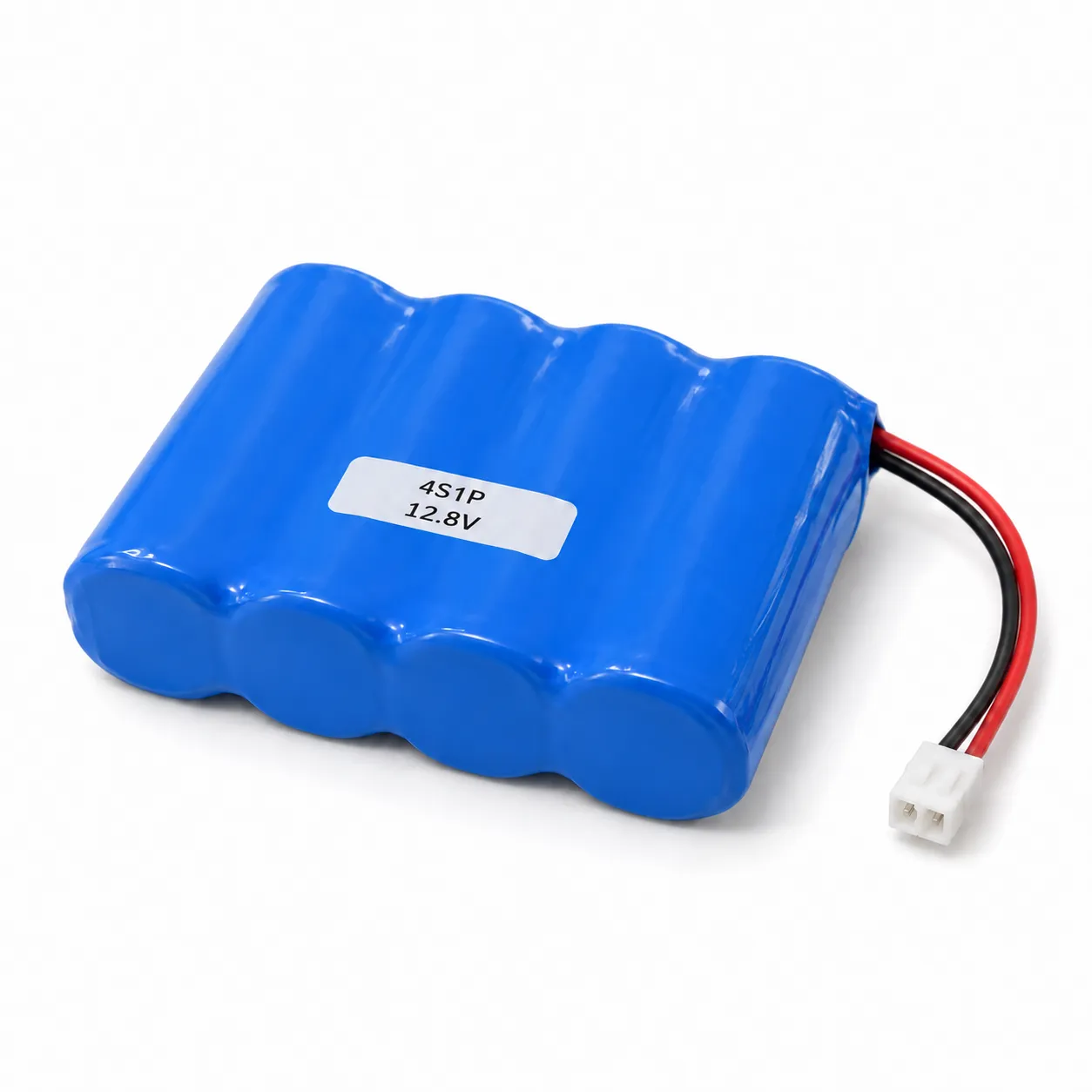
Common Pack Configurations
| Configuration | Nominal Voltage | Typical Use | Battery Pack |
|---|---|---|---|
| 1S1P | 3.2V | Compact solar lights and garden path lighting |
|
| 1S2P | 3.2V | Solar lighting requiring increased battery capacity |
|
| 4S1P | 12.8V | Solar street lights with compatible 12.8V controllers |
|
Conventional and wide-temperature LFP have the same nominal cell voltage, but their permitted charging conditions can differ.
Essential BMS Functions
- Overcharge and over-discharge protection
- Overcurrent and short-circuit protection
- Temperature monitoring and charging cutoffs
- Appropriate balancing for series-connected cells
Set temperature thresholds according to the cell model. A conventional LFP charging cutoff should not automatically be applied to a wide-temperature LFP design, or vice versa.
Frequently Asked Questions
Q1: What is the best battery for solar street light?
Conventional LiFePO4 is often suitable for moderate climates. For extreme temperatures, compare wide-temperature LiFePO4 and NCM. Choose based on usable capacity, installation space, charging conditions and lifetime data.
Q2: What is the difference between conventional and wide-temperature LiFePO4?
Both use LiFePO4 chemistry, but their temperature capabilities differ. Conventional LFP commonly restricts charging below 0°C. Selected UltraXel wide-temperature LFP cells support −40°C to +85°C discharge and −20°C to +60°C charging, within model-specific limits.
Q3: Should I choose wide-temperature LiFePO4 or wide-temperature NCM?
Wide-temperature LiFePO4 offers good thermal stability, while wide-temperature NCM generally provides higher energy density for compact packs. Compare model-specific cold-weather capacity, heat-aging data and cycle life before selecting.
Q4: Can wide-temperature LiFePO4 batteries charge below 0°C?
Selected models can. UltraXel wide-temperature LFP cells support charging down to −20°C, subject to specified current and voltage limits. The controller must monitor cell temperature and stop charging outside the permitted range.
Q5: Is wide-temperature LiFePO4 suitable for desert solar street lights?
It can be, provided the selected model meets the actual cell-temperature and aging requirements. Check high-temperature storage and cycling data, and manage enclosure heat buildup. A +85°C discharge rating does not permit charging at that temperature.
Q6: Does wide-temperature LiFePO4 last longer than conventional LiFePO4?
Not necessarily. Wide-temperature capability extends the operating range; it does not automatically increase cycle life. Compare both cycle life and calendar aging under the project’s expected conditions.
Q7: Can wide-temperature LiFePO4 replace lead-acid batteries?
Yes, with suitable system integration. Verify pack voltage, charging profile, controller settings, protection functions and dimensions. Similar nominal voltage alone does not guarantee a drop-in replacement.
Explore solar street light battery solutions(按钮)
Conclusion: Match the Chemistry to the Climate
Battery selection should distinguish between chemistry and temperature capability:
- Lead-acid: Low initial cost for suitable temporary or replacement projects.
- Conventional LiFePO4: Daily-cycling performance within standard temperature limits.
- Wide-temperature NCM: Compact energy storage for demanding climates.
- Wide-temperature LiFePO4: LFP thermal stability with extended charging and discharging ranges.
Not Sure Which Battery Is Right for Your Project?
Share your climate, lighting power, nightly operating hours, backup requirements and battery dimensions. UltraXel’s engineering team can help evaluate suitable cells and pack configurations.