In June, UltraXel organized a 2-day hands-on lithium battery product design training program at UltraXel lithium-ion battery factory. A total of 72 employees participated in the training, covering sales, marketing, operations, purchasing, project support, and other office functions.
As a lithium-ion battery manufacturer specializing in wide-temperature lithium-ion cells and custom lithium battery pack solutions, UltraXel continues to strengthen internal product training, factory-based learning, and cross-functional collaboration. The purpose of this training was to help office teams gain a deeper understanding of lithium-ion battery structure, cylindrical cell design, battery pack customization, manufacturing processes, and real application requirements.
Through on-site learning and practical demonstrations, UltraXel further improved the team’s ability to support customers with professional wide-temperature battery solutions and industrial lithium battery solutions.
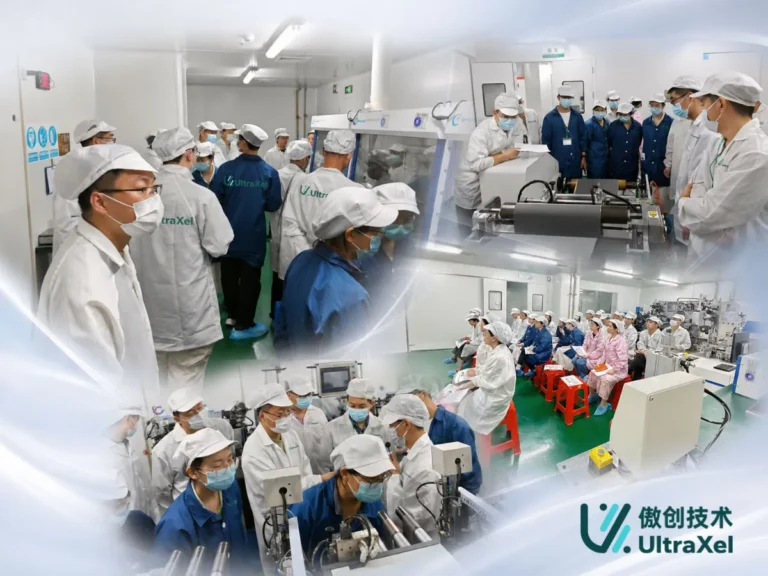
72 Employees Joined the On-Site Battery Factory Training
Unlike traditional classroom-style training, this program brought office employees directly into the production and technical environment. Guided by the engineering and production teams, participants observed key processes related to cylindrical lithium-ion cells, battery structure, material handling, production equipment, and quality control.
A total of 72 employees joined the 2-day session, reflecting UltraXel’s strong internal training system and commitment to building a more product-driven organization.
By learning directly from the lithium battery manufacturing process, employees were able to better understand how lithium battery products are designed, manufactured, tested, and applied in real-world devices.
From Lithium Battery Product Design to Practical Understanding
During the training, UltraXel provided systematic explanations and practical demonstrations covering lithium-ion battery fundamentals, product design, wide-temperature lithium-ion battery applications, and battery manufacturing processes.
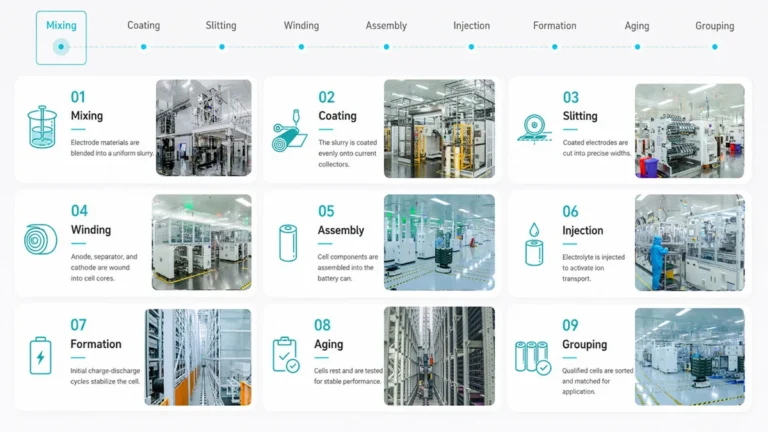
01 Mixing
Electrode materials are accurately mixed with solvents and additives to form a uniform slurry. A stable slurry consistency is essential for coating quality and battery performance.
02 Coating
The prepared slurry is evenly coated onto current collectors. This step determines the uniformity of the electrode layer and directly affects cell consistency.
03 Slitting
The coated electrode rolls are cut into precise widths according to cell design requirements. Accurate slitting helps ensure stable assembly and product consistency.
04 Winding
The anode, separator, and cathode are wound together into a cylindrical cell core. Proper winding control is important for internal structure stability.
05 Assembly
The cell core and key components are assembled into the battery can. This step forms the basic structure of the cylindrical lithium-ion cell.
06 Injection
Electrolytes are injected into the cell to enable ion transport between the electrodes. Controlled injection helps ensure stable electrochemical performance.
07 Formation
The cell goes through initial charge and discharge cycles to activate the battery system. Formation helps stabilize the cell and verify basic performance.
08 Aging
Cells are stored and tested under controlled conditions to evaluate stability, self-discharge, and consistency. This step helps identify qualified cells before final sorting.
09 Grouping
Qualified cells are sorted and matched based on performance parameters. Grouping ensures better consistency for battery pack assembly and final applications.
As a cylindrical lithium-ion cell manufacturer, UltraXel attaches great importance to helping every team understand product design from the source. Through this hands-on approach, office teams gained a clearer understanding of customer requirements in automotive electronics, industrial IoT, outdoor equipment, remote monitoring devices, GPS tracking systems, and industrial handheld devices.
Strengthening Cross-Functional Collaboration for Battery Solutions
UltraXel serves customers across multiple professional fields, including automotive electronics, industrial equipment, outdoor monitoring, remote IoT devices, geological exploration, smart sensors, and harsh-environment applications.
Different applications may have different requirements for operating temperature, capacity, discharge current, installation space, service life, certification, and battery pack design. This makes cross-functional collaboration essential for a lithium battery manufacturer that provides both cells and customized battery solutions.
By helping sales, marketing, project support, purchasing, and operations teams better understand lithium battery product design and application requirements, UltraXel can respond to customer needs more efficiently and communicate technical value more accurately.
Building a More Professional Lithium Battery Team System
UltraXel has always placed strong emphasis on internal training and knowledge development. This 72-person hands-on training program is part of the company’s continuous effort to build a more professional, systematic, and application-oriented team.
The program allowed office employees to walk into the battery factory, observe real production processes, interact with technical staff, and understand how lithium-ion cells and custom battery packs move from design to application.
This reflects UltraXel’s long-term investment not only in product technology, but also in organizational capability, team development, manufacturing understanding, and customer service quality.

Supporting Wide-Temperature Lithium-Ion Battery and Custom Pack Solutions
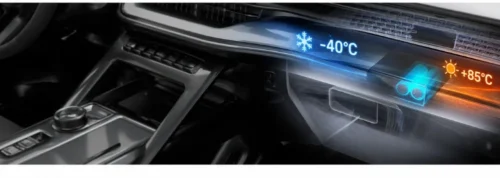
UltraXel specializes in wide-temperature lithium-ion batteries for -40°C to +85°C applications. Its product portfolio covers multiple cylindrical cell formats, including 14500, 18650, 21700, 32140, and 4695, with chemistry systems including LiFePO4, NCM, and NCA.
As a lithium-ion cell manufacturer, UltraXel provides wide-temperature cylindrical cells for automotive electronics, industrial IoT, outdoor monitoring, GPS tracking, remote telemetry, and harsh-environment devices. In addition to lithium-ion cells, UltraXel also supports custom lithium battery pack solutions based on customer requirements.
Battery pack customization can be developed around voltage, capacity, series-parallel configuration, protection design, BMS, NTC, connector, structure, operating temperature, and certification needs.
Moving forward, UltraXel will continue to strengthen its internal training system and encourage more employees to understand product design, lithium battery manufacturing processes, and customer application scenarios. With a larger, better-trained, and more collaborative team, UltraXel aims to provide reliable wide-temperature lithium-ion batteries, custom battery pack solutions, and industrial lithium battery solutions for global customers.