
The main types of 18650 batteries include LCO, NMC/NCA and LFP by cathode chemistry, protected and unprotected by safety design, and high-drain and low-drain by discharge rating — each built for distinct use cases from consumer electronics to industrial monitoring systems.
Despite sharing the same 18mm × 65mm form factor, these 18650 cell types differ widely in performance, lifespan, safety and applicable scenarios. Choosing the wrong type can cause premature degradation, unexpected device downtime and even safety risks. This guide breaks down every major category, explains their tradeoffs and ideal applications, and introduces industrial-grade wide-temperature 18650 variants for extreme operating environments.


18650 Battery Types
By Cathode Chemistry
Lithium Cobalt Oxide (LCO / ICR18650)
- Key characteristics: Classic commercial lithium-ion chemistry with a 3.7V nominal voltage and high volumetric energy density.
- Advantages: Mature and standardized production; flat discharge voltage platform; outstanding capacity for compact form factors.
- Disadvantages: Poor thermal stability under abuse; limited high-rate discharge capability; high cobalt content drives up cost and safety risks.
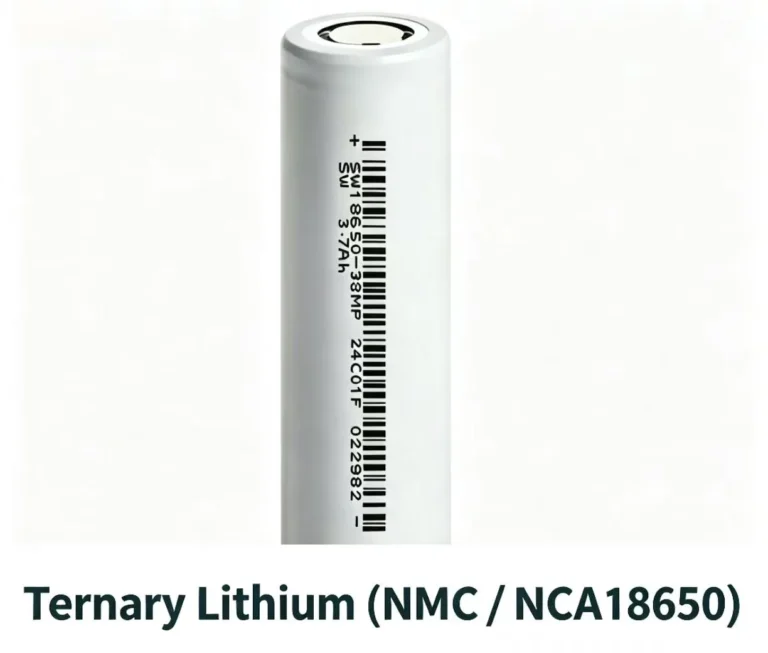
Ternary Lithium (NMC/ NCA18650)
Key characteristics: The dominant mainstream 18650 chemistry, 3.7V nominal voltage, delivering a well-rounded performance profile.
- Advantages: Excellent balance of high energy density and strong power capability; reliable low-temperature discharge performance; long service life.
- Disadvantages: Higher material cost than LFP and LMO; thermal stability lags behind LFP; requires robust BMS management for large battery packs.

Lithium Iron Phosphate (LFP / IFR18650)
- Key characteristics: 3.2V nominal voltage; industry-leading chemical stability and cycle durability.
- Advantages: Exceptional safety with minimal thermal runaway risk; ultra-long cycle life (thousands of charge-discharge cycles); strong high-temperature tolerance; lower total cost of ownership.
- Disadvantages: Significantly lower energy density than ternary cells; lower nominal voltage requires more cells in series; poor discharge performance in cold environments.
Note: 18650-sized NiMH cells run at 1.2V nominal. They are low-cost and safe, but suffer from very low energy density and high self-discharge, and are rarely used in modern high-performance applications.

Protected 18650 Batteries
- Key characteristics: Integrated protection circuit board (PCB) built into the cell casing.
- Advantages: Automatic protection against overcharge, over-discharge, over-current and short circuit; safe for direct end-user operation; no additional protection circuitry required.
- Disadvantages: Slightly increased overall length and unit cost; the PCB limits maximum discharge current; not ideal for custom high-power pack assembly.

Unprotected 18650 Batteries
- Key characteristics: Standard bare cells with no built-in electronic protection.
- Advantages: Lower per-unit cost; standard dimensions for flexible pack design; supports higher peak discharge current.
- Disadvantages: No built-in safety mechanisms; requires external BMS or protection circuits; carries higher safety risk if used or assembled improperly.

High Drain 18650 Batteries
- Key characteristics: Low internal resistance design, rated for continuous high-current discharge.
- Advantages: Stable output under heavy load; minimal voltage sag; supports strong instantaneous burst power.
- Disadvantages: Generally lower capacity than capacity-focused models; higher heat generation under sustained load; higher cost per amp-hour.

Low Drain (Capacity-Type) 18650 Batteries
Key characteristics: Electrode design optimized for maximum capacity, rated for low-current continuous discharge; this is the most common high capacity battery configuration for long-runtime devices.
- Advantages: Higher capacity for extended runtime; higher energy efficiency at low currents; lower cost per unit capacity.
- Disadvantages: Cannot sustain high-current discharge; risk of overheating and permanent damage under heavy load; unsuitable for power-driven devices.
18650 Battery Types Quick Comparison Table
For at-a-glance reference, the table below summarizes core specifications, features and typical use cases for each type, with no redundant pros and cons.
| Battery Type | Nominal Voltage | Core Key Features | Typical Applications |
| LCO (ICR18650) | 3.7V | High energy density, mature manufacturing technology | Older laptops, compact consumer electronics, small digital devices |
| LMO (IMR18650) | 3.7V | Good thermal safety, cost-effective, decent rate performance | Entry-level power tools, low-cost battery packs, blended chemistry assemblies |
| NMC / NCA | 3.7V | Balanced energy density and power, reliable low-temperature performance | E-bikes, electric vehicles, power banks, high-performance electronics, general-purpose use |
| LFP (IFR18650) | 3.2V | Ultra-high safety, extremely long cycle life, high temperature tolerance | Solar energy storage, backup power systems, industrial equipment, stationary energy storage |
| Protected 18650 | 3.7V (common) | Built-in PCB protection, plug-and-play, end-user friendly | Flashlights, standalone device replacement, consumer retail products |
| Unprotected 18650 | 3.7V / 3.2V | Standard size, low cost, flexible for custom assembly | Custom battery pack manufacturing, industrial PACK production, BMS-integrated systems |
| High Drain 18650 | 3.7V (common) | Low internal resistance, high continuous current rating | Power tools, drones, car jump starters, electric vehicles, high-power devices |
| Low Drain 18650 | 3.7V / 3.2V | High capacity, optimized for steady low-current output | Laptop battery packs, energy storage systems, IoT sensors, backup power supplies |
UltraXel Wide-Temperature 18650 Product Lineup
As a professional manufacturer supporting wholesale 18650 battery orders, UltraXel wide-temperature 18650 cells are engineered for reliable operation from -40°C to +85°C, delivering stable performance in both freezing cold and extreme heat. Each model is tuned for a specific industrial use case:

HL18650V – Cold-Weather 18650 Battery Cell
- Operating Temp.: -40℃~+85℃
- Key Feature: Low-temperature performance
- Typical Capacity(0.2C): 2900mAh
- Max charge/discharge: 1.4A / 10A

HL18650G – Wide Temperature Long-Life
- Operating Temp.: -40℃~+85℃
- Key Feature: 1500+ cycle life / safer LFP chemistry
- Typical Capacity(0.2C): 1600mAh
- Max charge/discharge: 1.6A / 7.5A

HL18650T – High-Temperature 18650 Battery
- Operating Temp.: -40℃~+85℃
- Key Feature: High-temperature standby reliability
- Typical Capacity(0.2C): 2000mAh
- Max charge/discharge: 1.95A / 10A

HL18650F -High Discharge
- Operating Temp.: -40℃~+85℃
- Key Feature: High discharge capability
- Typical Capacity (0.2C): 3000mAh
- Max charge/discharge:3A / 30A

HL18650Y High-Capacity NCM
Operating Temp.: -40℃~+85℃
Key Feature: High-capacity NCM chemistry
Typical Capacity (0.2C): 3200mAh
Max charge/discharge: 3.2A / 10A
For at-a-glance reference, the table below summarizes core specifications, features and typical use cases for each type, with no redundant pros and cons. We support custom sample testing and wholesale 18650 battery bulk orders for all industrial-grade models.
How to Choose the Right Type of 18650 Battery
- By cathode chemistry
- Pick LCO (ICR18650) for compact low-drain consumer devices that prioritize maximum energy density in a small form factor
- Pick NMC/NCA for a balanced mix of capacity, discharge capability and low-temperature performance, suitable for most mainstream electronics and power tools
- Pick LFP (IFR18650) for scenarios where long cycle life, inherent thermal safety and high-temperature tolerance are top priorities
- By protection design
- Pick protected 18650 batteries for standalone end-user devices, with built-in protection for ready-to-use safety and no extra circuitry needed
- Pick unprotected 18650 batteries for custom battery pack builds, paired with an external BMS to support higher peak current and flexible configuration
- By discharge rate
- Pick high-drain 18650 batteries for power tools, motor-driven equipment and high-pulse applications that need stable high-current output
- Pick low-drain (capacity-type) 18650 batteries for low-power, long-standby devices to maximize runtime and energy efficiency
- For extreme industrial & outdoor environments
- Standard consumer-grade 18650 types cannot deliver reliable performance and sufficient service life in harsh temperature conditions
- UltraXel wide-temperature 18650 lineup includes dedicated cold-weather, high-temperature standby, high-capacity, high-discharge and long-cycle models, all operating stably from -40°C to +85°C for mission-critical industrial systems
Standard consumer-grade 18650 types cannot deliver reliable performance and sufficient service life in harsh temperature conditions. For bulk project requirements, we offer wholesale 18650 battery solutions with full certification support; UltraXel wide-temperature 18650 lineup includes dedicated cold-weather,high-temperature standby, high-capacity, high-discharge and long-cycle models, all operating stably from -40°C to +85°C for mission-critical industrial systems
Frequently Asked Questions About types of 18650 Batteries
What is the difference between INR and IMR 18650 batteries?
INR 18650 batteries use a nickel-manganese-cobalt cathode for balanced energy density and discharge performance, while IMR 18650 batteries feature a lithium manganese oxide cathode that prioritizes high-current output and thermal stability, each designed for different power demand scenarios.
Which is the best 18650 battery?
There is no universal “best” 18650 battery for all applications. The optimal choice depends on your specific needs: high-capacity models suit long-runtime devices, high-drain variants work for power-intensive equipment, and industrial wide-temperature cells are the most reliable option for extreme operating environments.
Are there different sizes of 18650 batteries?
18650 batteries follow a universal industry standard of 18mm in diameter and 65mm in length, so core dimensions are consistent. Protected models may be slightly longer due to built-in safety circuitry, and there are flat-top and button-top terminal differences, but there are no official alternate size classes for the 18650 form factor.